Who Was Yahweh to the Ancient World?
The rules of the house
To understand Yahweh, you first have to understand the world he rose in — a world where the kingship of the gods was real politics, seats changed occupants, and everybody knew the rules of a succession because they watched human kings live by them.
The ancient world knew two ways for a god to take the top seat, and they did not work the same way.
The first was violence. In the Hurrian cycle copied at Hattusa, Alalu reigns nine years and is deposed by Anu; Anu reigns nine years and is deposed by Kumarbi, who bites off his genitals and is impregnated with the storm god who will take the kingship in turn. Greece tells the same shape: Kronos castrates Ouranos and takes the kingship, and Zeus throws Kronos down and apportions the honours. But notice what violence never moves. No wife passes from loser to winner anywhere in those stories. Kronos marries his sister Rhea; Zeus marries his sister Hera; the deposed god's household simply ends with him. Conquest takes a throne. It does not transfer a house.
The second way was identification — two gods declared, by equation, to be one. That way, everything moves. Aššur, the city god of Assyria, began with no family of record: no consort, no sons, no mythology of his own. From about 1300 BC the Assyrians identified him with Enlil, head of the older pantheon, and the household re-registered under the new name as a package — Enlil's sons entered as Aššur's sons, and Enlil's wife Ninlil became Aššur's wife, worshipped in Assyria under her Assyrian name-form, Mullissu. The identification itself was gradual, and never total in every period and text: what the record traces, from about 1300 BC onward, is attempts to identify the two, deepening over centuries, while other Assyrian texts keep Aššur standing in his own right. Nobody fought anybody. The names were equated, and the family came with the equation.
The human sphere ran on the same logic, and the Hebrew Bible states it as law of the office: a predecessor's household, women included, was part of the regalia. Nathan tells David, in Yahweh's name: "I gave you your master's house, and your master's wives into your bosom" (2 Samuel 12:8). Absalom's public taking of David's concubines on the palace roof is staged as a claim to the throne. Adonijah's mere request for Abishag, David's attendant, is read by Solomon as a bid for the kingdom and answered with execution. To receive the former king's women was to hold the office. To reach for them was to claim it. These episodes are an illustration, not evidence: they show the logic of office as the culture that produced the Yahweh texts itself reasoned about it. Court stories about kings prove nothing by themselves about what passed between gods, and nothing below rests on them.
Hold those rules in mind — violence moves nothing but a throne; identification moves the whole house; an office carries its household with it — and then look at what the record shows for Yahweh.
The first exhibit
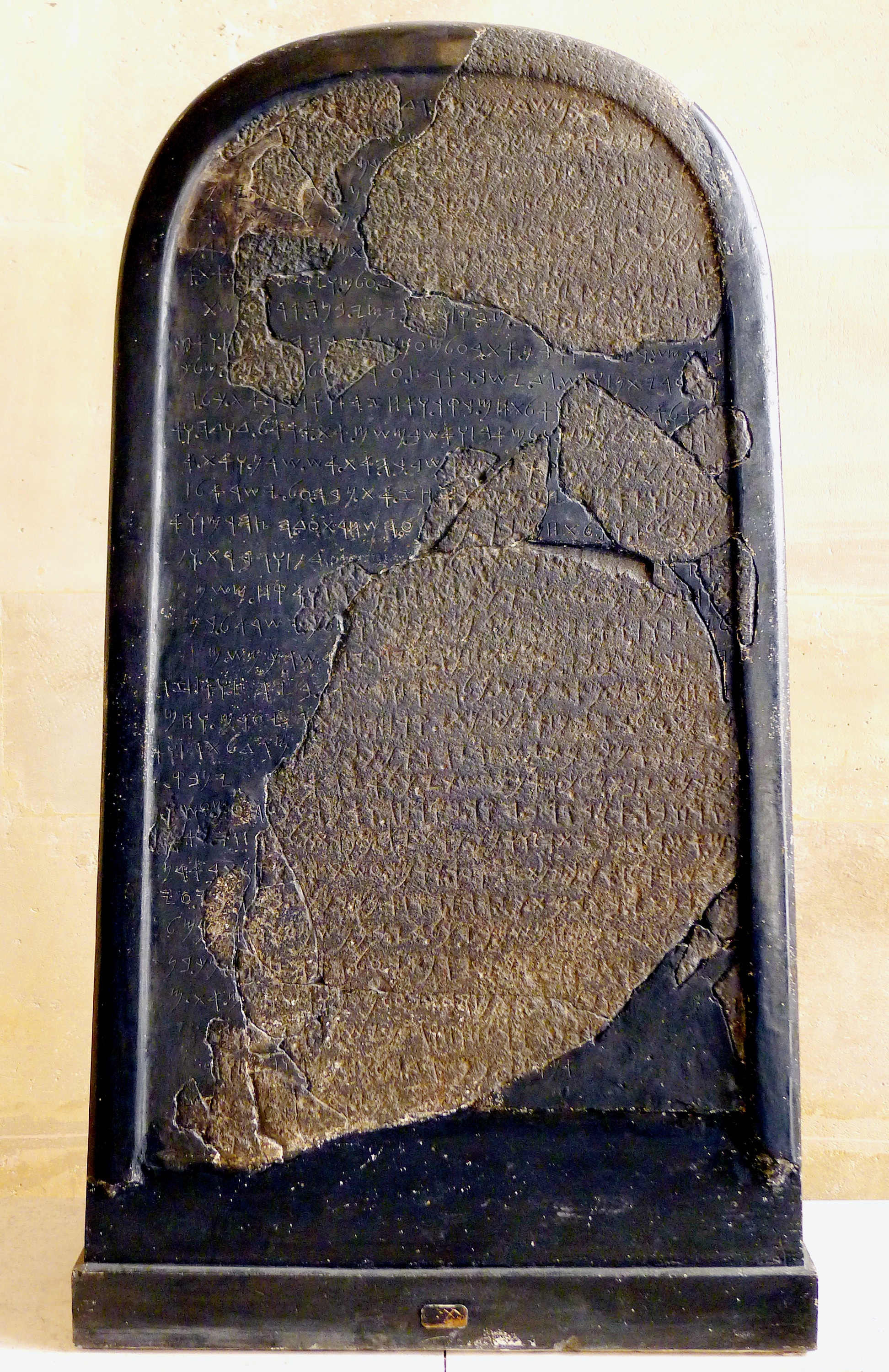
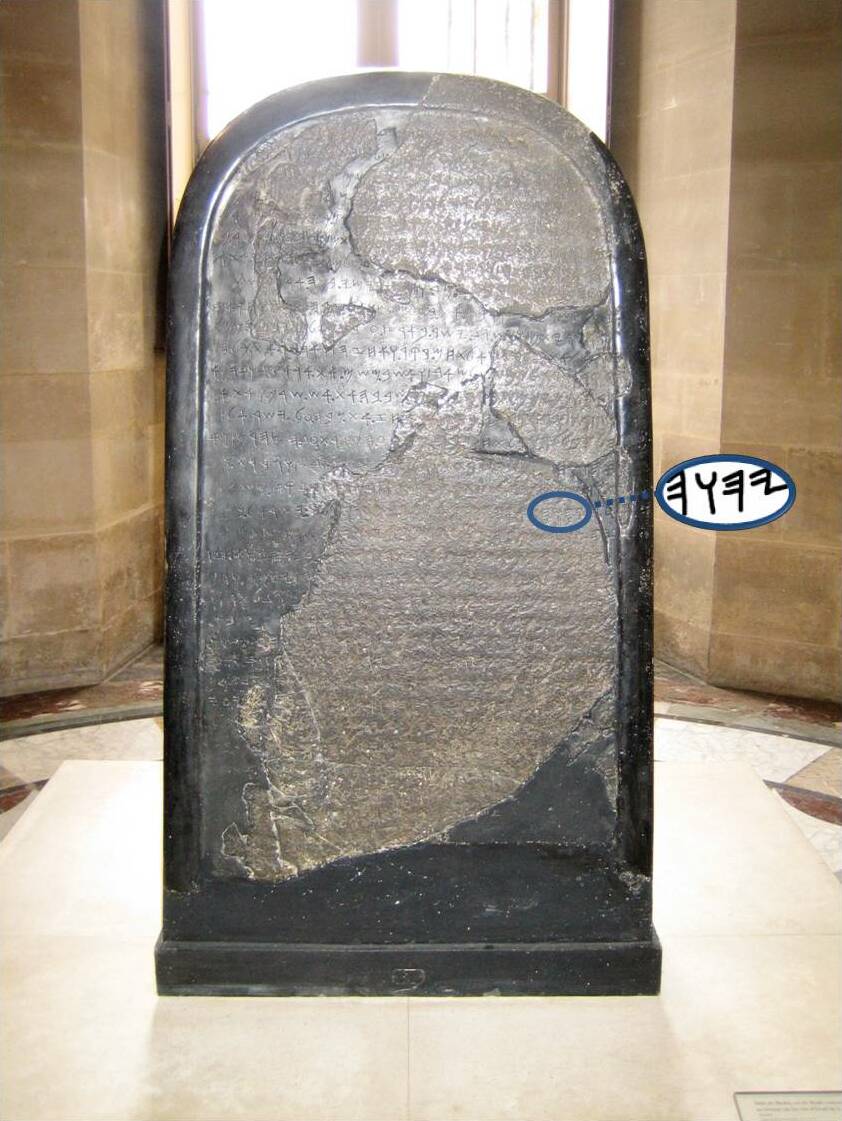
The oldest certain mention of Yahweh outside the Bible was carved by an enemy. Around 840 BC, Mesha, king of Moab, set up a basalt stone recording that he dragged the vessels of YHWH from Nebo before Chemosh, his god. The stone sits in the Louvre: Yahweh, national god of Israel, beaten by the national god of Moab.
Around 800 BC, travellers at a Sinai way-station were blessed in two regional forms — "by Yahweh of Samaria" and "by Yahweh of Teman." Around 600 BC, two tiny rolled silver scrolls carrying a blessing in Yahweh's name were found in a Jerusalem burial cave, the oldest surviving biblical text by four centuries. In the fifth century BC, a temple of Yahweh stood on an island in the Nile, and its priests wrote to Bagoas, the Persian governor of Judah, asking leave to rebuild it.
The record does not show one God, alone from the start. It shows a god who enters writing in the southern desert, becomes one nation's god among nations with gods of their own, is identified with an older god named El and takes over his household, and only in exile, around 540 BC, is stated to be the only god there is.
The name in the southern desert
The earliest plausible occurrence of the name is not in Israel. In the temple of Amenhotep III at Soleb, in Nubia, a column carved between about 1390 and 1352 BC lists subject peoples. One entry reads, in Egyptian, "the land of the Shasu of Yhw." The Shasu were semi-nomadic herders east of Egypt. Copied again at Amarah West under Ramesses II, its neighbouring names — Seir among them — put that group in the southern desert country, not the Israelite highlands.
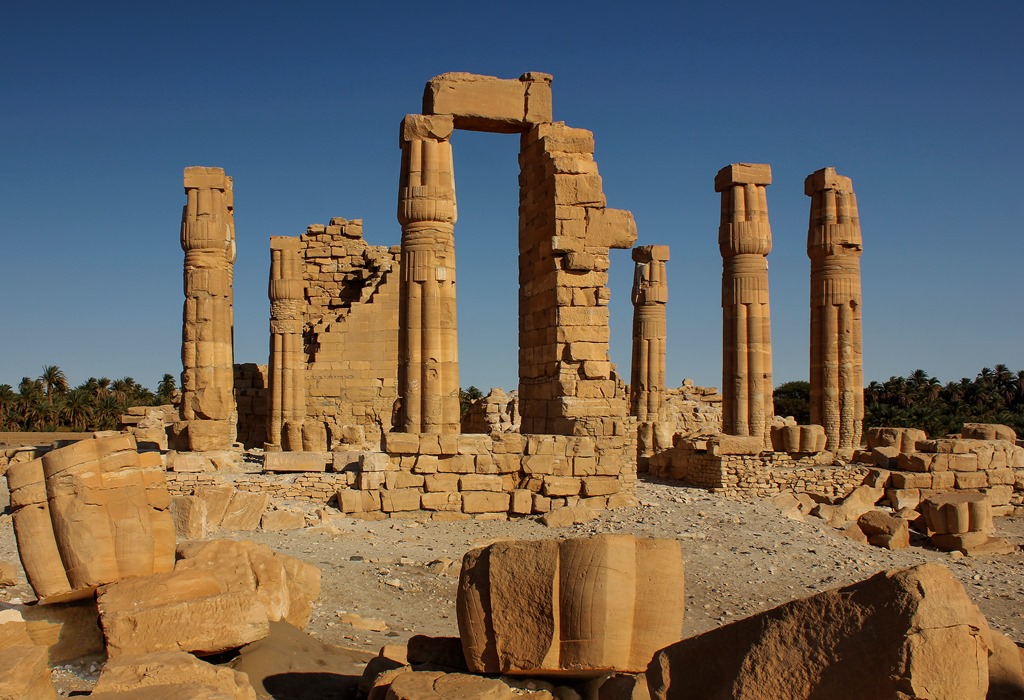
What Yhw means there is disputed: the list is a list of lands and peoples, and the word carries no divine marker. Some scholars read a place or a people. Others read a god behind the name — a land called after the god its people worshipped. Neither reading attests that Amenhotep knew a god named Yahweh, and nothing at Soleb identifies those Shasu as Israelites.
A written attestation is a floor, not a beginning. The name reaches us in somebody else's list. A god worshipped by desert nomads could have been worshipped for generations before any literate state wrote his name down. Those generations cannot be recovered. But no earlier writing is evidence about writing — not evidence that there was no worship before the writing starts.
Some of Israel's oldest poems point at the same country: "YHWH came from Sinai, dawned from Seir, shone forth from Mount Paran" (Deuteronomy 33:2). Scholars have long connected this with the Midianites and Kenites, and that route has been called the best explanation currently available. It has not been proven; no Midianite inscription naming Yahweh has ever been found. Southern origin, probably; a specific carrier people, plausibly, not certainly. Between Soleb and Mesha there is a gap of five hundred years with no certain attestation at all.
A world of national gods
Chemosh was angry with Moab, so Israel oppressed it; then Chemosh relented, and Mesha took Yahweh's vessels. It is the same logic the books of Kings use for Yahweh: a god bound to a people, angry, abandoning, restoring. Moab had Chemosh, Ammon Milcom, Edom Qos, Israel Yahweh.
The house of El
You will see it stated flatly, in videos and posts and more than a few books, that El is Yahweh — one god, two names, nothing more to explain. The evidence does not show that. It shows two gods with separate origins, later identified with each other inside Israel.
El is old, and he is not a title invented for Yahweh. In the clay tablets from Ugarit — texts copied between about 1350 and 1185 BC — El heads a full pantheon: Bull El, Father of Years, Creator of creatures, presiding over the assembly of his children. His consort is Athirat, the Asherah of the Hebrew Bible, and one tablet calls the gods "the seventy sons of Athirat."
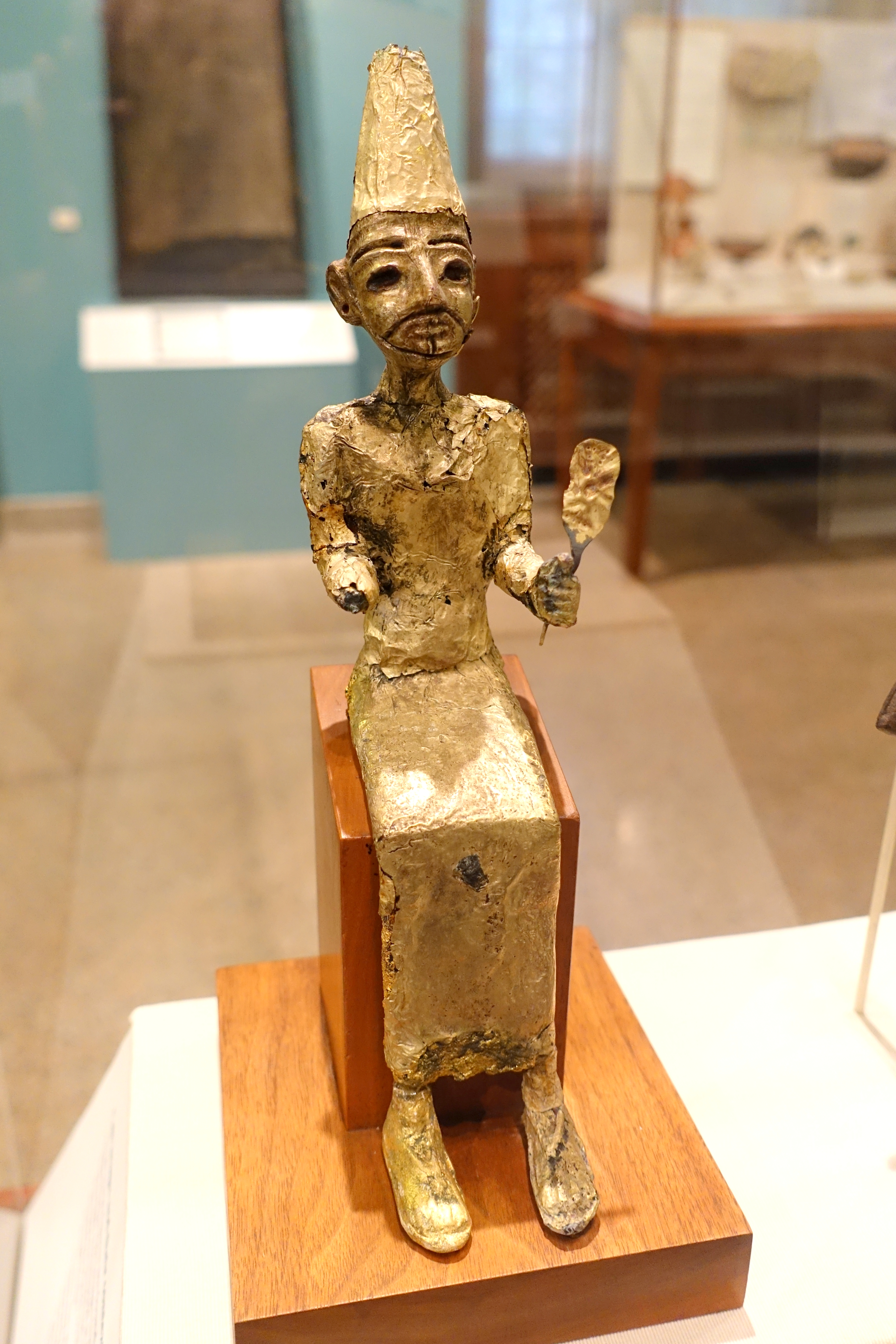
Yahweh is not in those tablets — no Ugaritic god list, myth, or epic names him, as a son of El or at all. An absence in a northern archive does not prove a god did not exist in the south. It proves Yahweh was no member of the Canaanite pantheon as Ugarit knew it. The Deir Alla inscription tells the same negative story from the other side: Balaam's text names El and the Shaddayin, and never Yahweh.
The Bible keeps the seam where the two were joined. Exodus 6:3 states it in so many words: "I appeared to Abraham, to Isaac and to Jacob as El Shaddai, but by my name YHWH I did not make myself known to them." The patriarchal stories run on El's names: El Elyon, God Most High, served by Melchizedek, priest-king of Salem (Genesis 14), where Abraham swears by "YHWH, El Elyon" — the identification made inside the text itself. El Shaddai in Genesis 17, El Olam at Beersheba, and more.
The mainstream account, worked out most fully by Mark S. Smith, runs in two movements. First, convergence: in early Israel the incoming southern warrior god was coalesced with the old high god of a Canaanite religious world. El was not fought — there is no biblical war against El, as there is against Baal. El was identified as Yahweh, who took his titles, his council, and his creator-and-father profile. Then, from the ninth century through the exile, differentiation: native practices — Baal worship, asherah poles, sun and moon cults — were reclassified as foreign and driven out. Francesca Stavrakopoulou calls the end state a radical pantheon reduction.
One dissent belongs on the record: Frank Moore Cross proposed in 1973 that the name Yahweh began as an epithet of El, "El who creates the hosts," making Yahweh a form of El from the start. It fits the smooth identification well, the southern evidence poorly, and it has not carried the field. The majority position is distinct origin, then merger — held for or against no faith.
The allotment and the sentencing
Deuteronomy 32:8–9, in the Song of Moses, shows the older arrangement still standing inside the Bible. The Hebrew text most Bibles were translated from reads that Elyon, the Most High, fixed the boundaries of the peoples "according to the number of the sons of Israel." But a Qumran scroll, 4QDeutj, reads "according to the number of the sons of God," and the Greek Septuagint reads "angels of God," pointing back to the same Hebrew phrase. Two older, independent witnesses agree against the later text, and a copyist had motive to change "sons of God" into "sons of Israel" and none to change it back. The strong majority of text critics judge "sons of God" original — one Qumran fragment plus the Greek tradition, against the Masoretic and Samaritan texts. On the original reading: "When Elyon gave the nations their inheritance, when he separated humankind, he fixed the boundaries of the peoples according to the number of the sons of God. For YHWH's portion is his people, Jacob his allotted heritage."
Elyon allots. Yahweh receives. In the poem's logic Yahweh stands among the divine sons handed a nation each, and Israel is his share. Scholars read this as Yahweh standing as a subordinate member of El's family at the layer where the poem was composed. The verse does not call him El's son in so many words, and neither will this article: sonship is an inference from the allotment, not a statement in the text. The same poem also says, near its end, that there is no god beside Yahweh — a later, monotheising layer over the older material.
Psalm 82 takes the next step, in court. "Elohim stands in the council of El; among the elohim he gives judgment." The gods are charged with ruling their nations unjustly: "You are gods, all of you sons of Elyon. Nevertheless, you shall die like men." It ends with the judge inheriting all the nations. The patron gods are sentenced to mortality — the takeover of the council, in one poem.
The council did not vanish; it was re-graded. The Greek translators already render the sons of God as angels, and in Daniel, in final form around 165 BC, the allotment has become a war among named angels — the prince of Persia, Michael as Israel's prince, the prince of Greece.
His asherah
Two inscriptions put a second name beside Yahweh's in blessing. At Kuntillet Ajrud, a Sinai way-station, around 800 BC, two jars carry blessings: "by YHWH of Samaria and by his asherah," and "by YHWH of Teman and by his asherah." A generation or two later, a tomb inscription at Khirbet el-Qom, west of Hebron, reads: "Blessed be Uriyahu by YHWH, and by his asherah."
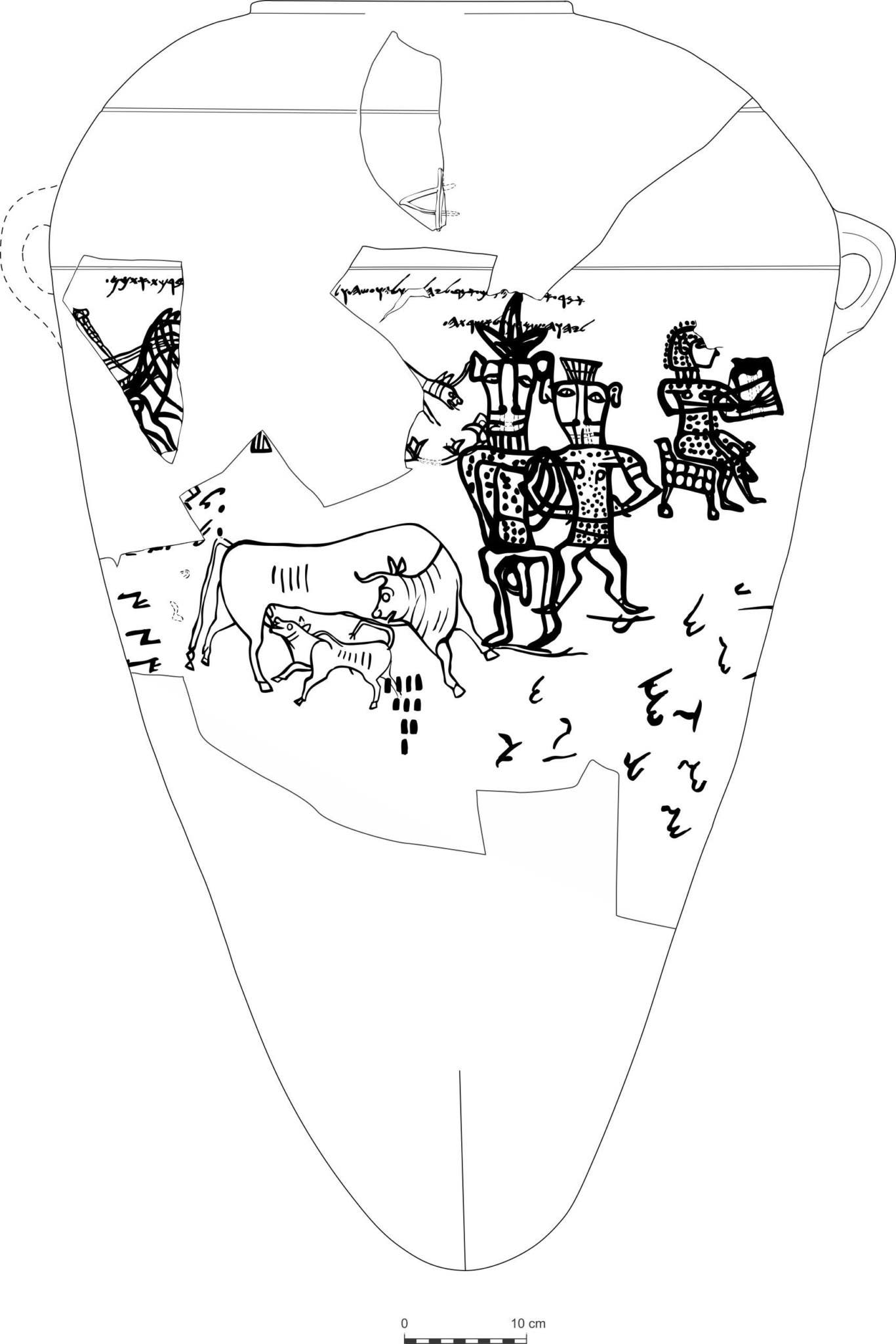
The wording has to be carried here, because both stronger versions outrun the grammar: blessed by Yahweh and his asherah — whether that means the goddess Asherah, Yahweh's consort, or her sacred pole or tree symbol, scholars still dispute; that Yahweh was publicly blessed alongside a feminine divine symbol or power is not disputed. The argument turns on one letter: a proper name does not normally take the suffix "his," which points to a pole. A 2025 reassessment argues the ending may be an archaic form of the goddess's name, not a suffix at all.
The storm god's clothes
El gave Yahweh a household. Baal gave him weather. In Psalm 29 the voice of Yahweh sounds seven times: over the waters, breaking Lebanon's cedars, enthroned over the flood. That is Baal's signature profile at Ugarit, where Baal is Rider of the Clouds and king by victory over the Sea. Psalm 29 is best described as written in Baal's storm idiom, plausibly adapting a Canaanite hymn type. No Baal original survives, and a shared idiom could produce the parallels without copying — so "a Baal hymn with the name swapped," stated as fact, goes further than the evidence.
One parallel is exact. In the Baal Cycle (KTU 1.5), Lotan was smitten, described as "the fleeing serpent, the twisting serpent, the tyrant with seven heads." Isaiah 27:1 takes the formula over in cognate words: "On that day YHWH will punish Leviathan the fleeing serpent, Leviathan the twisting serpent, and slay the dragon in the Sea." Lotan and Leviathan are the same name in two languages.
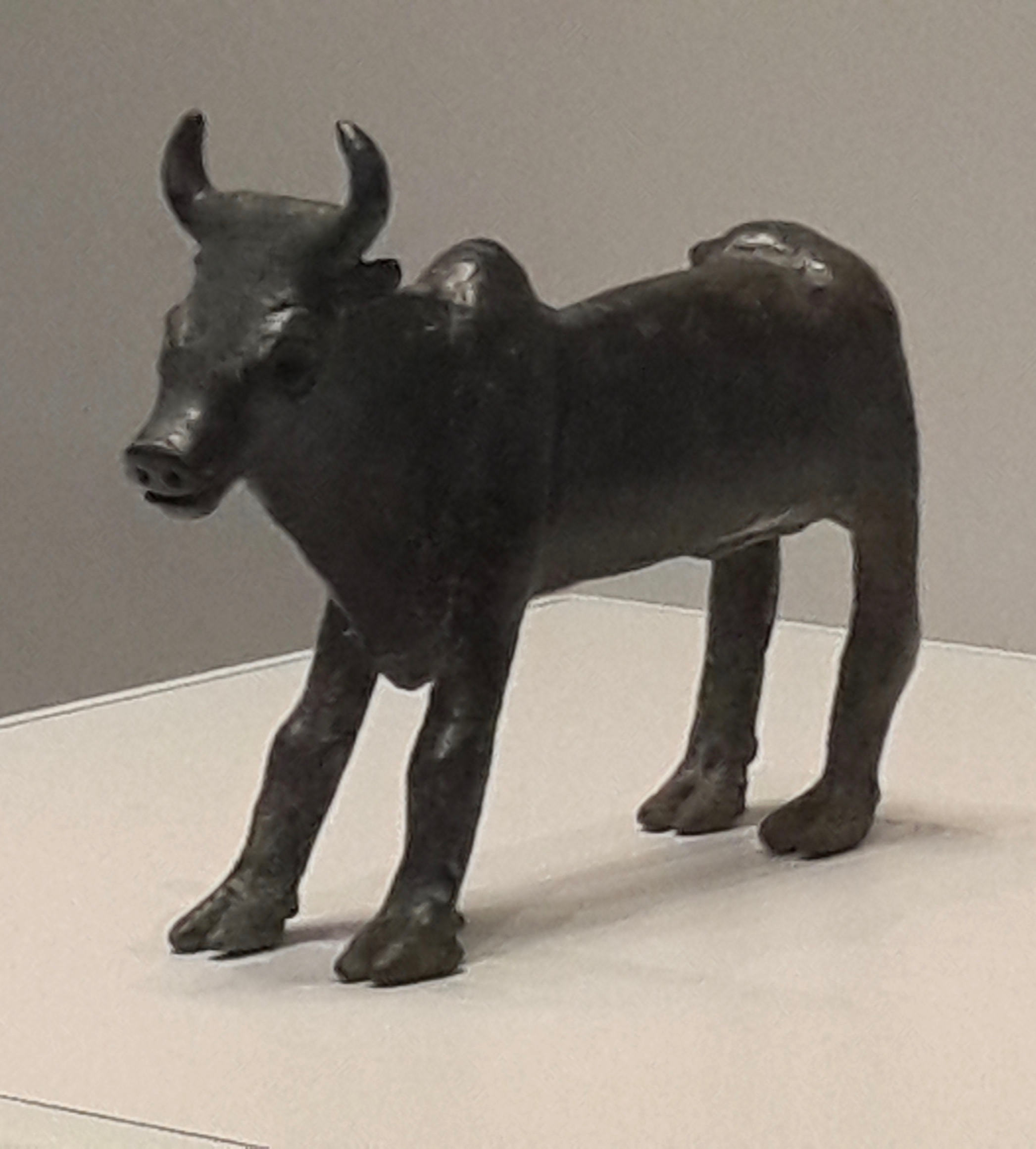
Bulls belong to the same transfer, from El's side — El is Bull El at Ugarit. At an open-air shrine in the Samarian hills, dated between about 1200 and 1000 BC, excavators found a bronze bull near early Israelite villages; which god it stood for — El, Baal, or Yahweh — is inference, for the object carries no inscription. The golden calves of Bethel and Dan exist only as text (1 Kings 12), read by the mainstream as Yahweh's cult condemned by later editors.
What can be proven
Strip the theory away and the following stands on the objects and the texts alone:
- Around 840 BC, a Moabite king's inscription names YHWH as Israel's god — the first certain attestation of Yahweh as a national god, in an enemy's hand.
- Around 1400 BC, an Egyptian list names "the land of the Shasu of Yhw" in the southern desert country. The name is early and southern; whether a god stands behind it is disputed.
- At Ugarit, in texts copied between about 1350 and 1185 BC, El heads the pantheon with Athirat as his consort and mother of the gods. Yahweh appears nowhere in those tablets.
- The Bible itself preserves the join: Exodus 6:3 says the patriarchs knew God as El Shaddai and did not know the name Yahweh.
- Deuteronomy 32, in its older reading preserved at Qumran and in the Greek translation, has Elyon allotting the nations to the sons of God, with Yahweh receiving Israel as his portion.
- Around 800 and again around 750 BC, inscriptions bless people by Yahweh "and by his asherah" — a feminine divine name or symbol standing grammatically attached to Yahweh, a century and more before any reform.
- Assyrian texts and god lists show Aššur identified with Enlil from about 1300 BC, with Enlil's wife Ninlil held to be Aššur's wife under the name Mullissu.
- The Ugaritic tablets show Baal winning kingship and a palace while Athirat remains El's consort and acts as Baal's intercessor with her husband.
- The Hebrew Bible's succession texts — 2 Samuel 12:8, the Absalom episode, the Adonijah episode — treat a predecessor's women as part of a king's regalia. They are cited as an illustration of that culture's logic of office — not as direct evidence for divine succession.
- No text of any kind shows Yahweh fighting, defeating, or condemning El.
- 2 Kings 23 describes a reform hauling Asherah's vessels and image out of Yahweh's own Temple and burning them — the reform party's own account, with the inscriptions standing as independent proof that the pairing it attacked was real and old.
The parallels
Those are the facts at home. The ancient world's attested practice, set beside them, runs like this.
Aššur: the whole house moves. A god with no family of record is identified with the old head, and acquires the old head's wife, sons, rank, and titles by equation. This is the only fully documented consort transfer in the record, and it happened under identification, not conquest — an identification that was itself gradual and never total: attempts at it are traceable from about 1300 BC, deepening over centuries, and Assyrian tradition kept Aššur distinct in other texts throughout.
Marduk: the office moves, the consort does not. Babylon's god took Enlil's rank-number fifty, his title, his kingship of the gods, and the Tablet of Destinies — and kept his own wife, Ṣarpanītum, who rose with him as queen of the gods. Marduk supplanted Enlil while remaining a separate god, son of Ea, with a house of his own already standing. The package split, and it split exactly at the consort.
Amun-Ra: the merger that kept both names. Thebes' Amun, identified with Heliopolis' Ra, produced a composite god who carries both names hyphenated to this day in the textbooks — Amun's household heading the new order, Ra's solar kingship supplying the job description. Two great cults bargained as near-equals, and neither name was swallowed. In Israel the same kind of identification ran one way only: Yahweh's name survived as the name, and El's survived demoted — as the ordinary word for "god," as fossil titles in Genesis, and inside personal names like Isra-el and Micha-el.
Baal: kingship without identification, and no transfer. At Ugarit the younger storm god got the executive work of kingship — the battles, the palace — while the old head kept the house, the council, and the wife. Rise alone does not move a household. Baal was never identified with El, and nothing of El's was ever re-registered to him.
Kumarbi and the Greek succession: violence without transfer. Generational overthrow, in the Hurrian cycle and in Hesiod, moves a throne and nothing else. No household, no consort, no council passes to the winner in any version.
The north, at its exact weight. Týr's name descends from the old Indo-European sky-father word — the same root as Zeus and Jupiter — yet in the Norse myths that survive, it is Odin who holds the chief seat, and Týr ends as a god of law and war with one great deed to his name, the hand he left in the wolf's mouth as the gods' pledge. No Norse story tells of any handover. The northern case shows that chiefs fade and seats change occupants, and that the change can leave no story behind. It does not carry the consort point, and nothing in this article rests on it.
Richard Vigslist's theory
What follows is a theory — Richard Vigslist's, argued here from the evidence and the parallels above, and labelled as a theory because that is what it is. It does not add facts. It proposes the order in which the facts make sense — one coherent organization of the evidence, not the only one the evidence will bear. The live alternatives stay on the table: Frank Moore Cross held that Yahweh began as an epithet of El, "El who creates hosts," a form of El from the start, with no separate southern god arriving to merge; and some specialists run the convergence without any distinct southern carrier for the Yahweh cult at all, letting the identification happen inside Canaanite religion itself. Specialists still hold both positions. The reasons for preferring the reconstruction that follows are the ones already argued in the sections above; the alternatives are named here so the reader knows they exist and were weighed.
Vigslist's theory: Yahweh did not take El's household by storm, because gods do not merge in the abstract — peoples merge, and their gods are brought together when they are. Israel was, in its own earliest layers, a Canaanite people carrying a southern god up into El's country. On this reconstruction, it may have gone down like this.
First, the peoples come together. The southern god's worshippers settle among El's people, intermarry with them, bury their dead in the same hills. There is no border at which one religion stops and the other starts, because there is no border in the population.
Second, the cults share ground. The same shrines serve both names — Bethel, whose name means "house of El," becomes in the tradition Yahweh's own sanctuary, and the patriarchs' stories, which ran on El's titles, are told of the God the tellers now also call Yahweh. Shared priests and shared storytellers do what no decree could do: they make the two names answer to the same altar.
Third, the gods are named as one. This is the step the Bible itself records, in Exodus 6:3, and performs, in Genesis 14, where Abraham swears by "YHWH, El Elyon" in a single breath. Identification is not a metaphor laid over the process; on this theory it is the process — the moment the equation is spoken in liturgy, the transfer has legally, so to speak, already happened.
Fourth, the household re-registers under the surviving name. This is the Aššur pattern running in Israel. The titles move: Elyon, Shaddai, Olam are now Yahweh's. The council moves: Yahweh presides where El presided. The creator-and-father profile moves. And the consort moves — not because anyone chose her for Yahweh, but because she was the consort of the god Yahweh now was. The blessings at Kuntillet Ajrud and Khirbet el-Qom, on this reading, are the paperwork of that re-registration, still being written out in ordinary people's hands around 800 BC. One label is carried in plain sight at exactly this step, because the step turns on it: that the "his asherah" of those blessings names the goddess Asherah herself, as Yahweh's consort, is one side of an open scholarly dispute. The pairing — a feminine divine name or symbol standing beside Yahweh's in blessing — is inscriptional fact. Whether the words mean the goddess or her sacred pole is contested, and the theory adopts the goddess reading as a reading, labelled as such, not as settled fact. The theory states its own condition plainly: the consort transfers where the rising god has no consort of his own on record. Aššur had none, and acquired a household entire. Marduk had Ṣarpanītum, and acquired none of Enlil's. Yahweh, in the surviving record, had none — and Asherah, on the goddess reading this theory adopts, is what the vacancy was filled with.
Fifth, the generations pass, and the mixture is strained. Mark Smith's two phases describe the machinery: convergence, then differentiation. What had been identified with Yahweh could no longer be separated from him — El's titles, council, and creator-profile are simply Yahweh by then, and no reformer could cut them out without cutting out his own God. What had only been attached could be detached: the consort, who was never equated with Yahweh, only positioned beside him, and whose standing had always been relational — she was in Israel the wife of a god who no longer existed as a separate person, in a national story that gave her no scene, no feast, no temple, no children. What had never been merged at all, the live rival, was fought — while his best lines were kept and re-issued under Yahweh's name. On this theory the three fates are one logic: what was identical stayed, what was attached was cut, what was rival was fought and stripped. El disappears by being swallowed; Asherah disappears by being left behind.
Sixth, the end state. Read as structure rather than as a dated sequence — the texts cannot be dated finely enough for a chronicle, and Psalm 82 cannot be dated within centuries — the estate arc runs: council inherited, in Deuteronomy 32's older reading, where Yahweh receives his nation inside the allotment; council dissolved, in Psalm 82, where the presiding god sentences the sons of Elyon to die like men; staff reclassified, as the Greek translators turn the sons of God into angels and Daniel's princes of Persia and Greece fight under one supreme God with Michael holding Israel's seat; consort disposed of as inventory, in 2 Kings 23, vessels and image hauled out of the Temple and burned, by a reform party whose own history this is — with the desert inscriptions standing behind it as proof she had genuinely been in the house. A regional god of the southern desert, worshipped in local forms — Yahweh of Samaria, Yahweh of Teman — comes out the other side of that process as the God in whose name the exile would say: there is no other.
Scorecard
The theory was tested against the comparative record before it was written into this article. The honest state of it:
Survives intact. The identification mechanism: in every documented case where a household — consort included — moved from an old head to a rising god, the two gods had been identified, and in no case of conquest or mere succession did a consort move. The three-fates reading fits the record without forcing a single text. The no-fight datum stands as stated: El is absorbed in silence, Baal is fought in noise, and Asherah is disposed of in paperwork. The inherited-consort corollary stands as a graded inference: attached but never identified, therefore separable, therefore the piece of the household a reform could cut. (The corollary inherits the open dispute over "his asherah"; its place on the narrowed side of this ledger is recorded below.)
Survives narrowed. "Takeover" is dead as a word for this; the mechanism the record supports is identification, and the theory now runs on that word only. The consort transfer is conditional, not automatic: it fills a vacancy, and Marduk — who had a wife of his own — is the conceded counter-case the narrowed theory survives by explaining. Asherah's worship survives in the corrected register: heavy at the household and folk level, weak at the official and narrative level. She had devotees everywhere and an institution nowhere. The consort transfer belongs on this narrowed side of the ledger in one respect: the transfer of the pairing is attested — Yahweh blessed "by his asherah" where El had stood paired with Athirat — but that the pairing means the goddess herself, as consort, is the disputed reading, and the theory adopts it labelled as disputed.
Did not survive. The conquest version of the thesis — the new head seizing the old head's wife as spoils — fails on every comparative case that tests it: Kumarbi, the Greek succession, and Marduk all move thrones without moving wives. The claim that Asherah "wasn't worshipped as much," in its flat form, fails against the record of centuries of complaint and one very entrenched Temple presence. A Norse version of the consort transfer fails for want of any evidence at all: the northern material carries the fade of a chief and nothing more. And any dated sequence — a probate moment, a year in which the council was dismissed or the consort put out — fails: the record shows a structure across centuries, not a chronicle, and the theory claims the structure only.
The names people carried
The merger is written into people's names. The early names run on El: Isra-el. Ishma-el, El hears. Dani-el, El is my judge. The angels who arrive late carry El-names: Micha-el, "Who is like El?" Gabri-el, El is my strength. Rapha-el, El heals. Immanu-el, God with us.
The Yahweh names spread later: on the Samaria ostraca, from the early eighth century BC, Yahwistic names ending in -yaw still sit beside Baal names, while in Judah's seals and letters Tigay's study of 1986 found them overwhelmingly predominant.
The god of everyday life
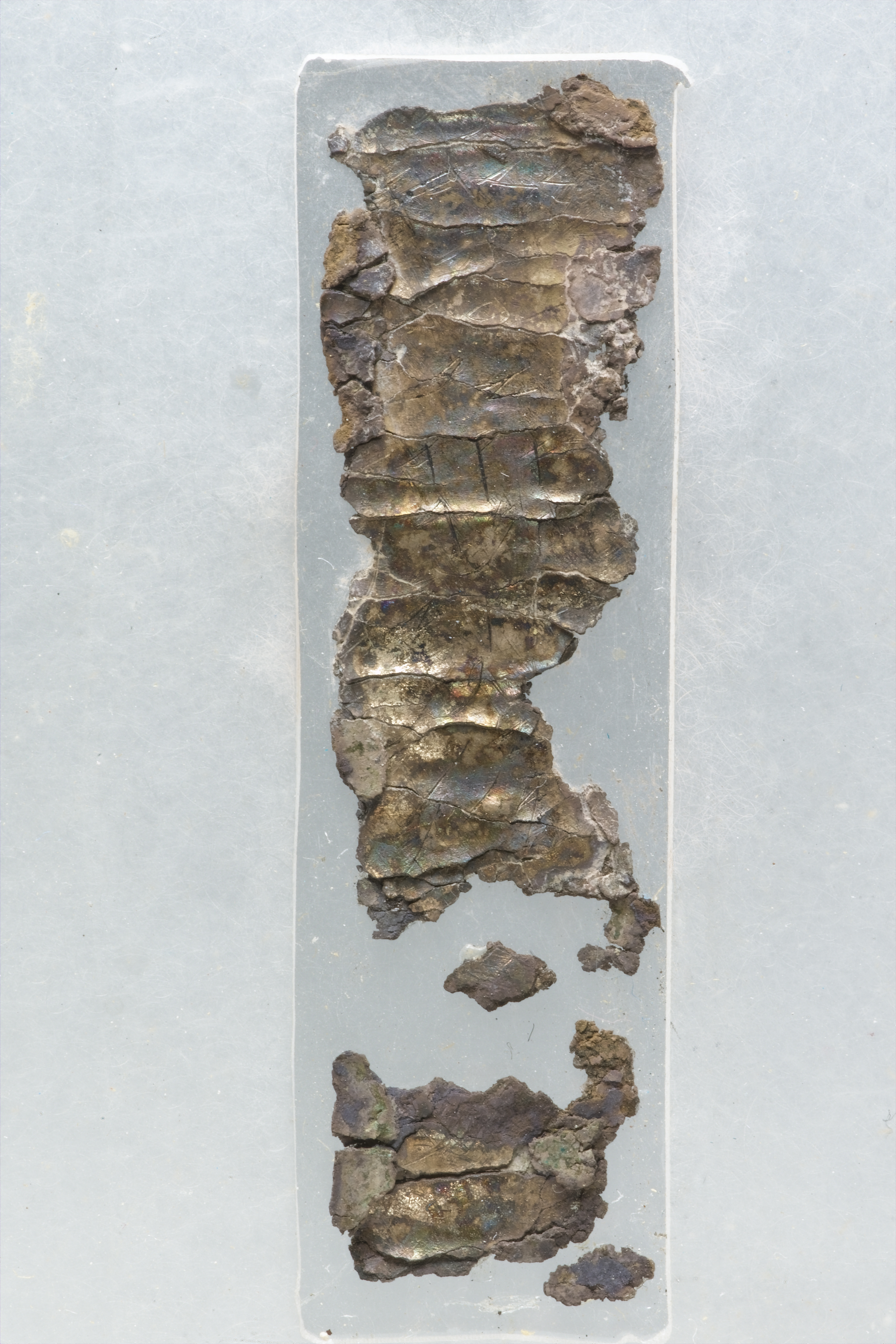
The Ketef Hinnom scrolls, from a Jerusalem burial cave, around 600 BC, carry a form of the priestly blessing of Numbers 6 — "May YHWH bless you and keep you" — on two rolled silver amulets, one 27 by 97 millimetres, the other 11 by 39. Oldest surviving biblical text, about four hundred years before the Dead Sea Scrolls. A form of the blessing, not a verbatim copy: they prove the blessing was in use, not that the book existed in final shape.
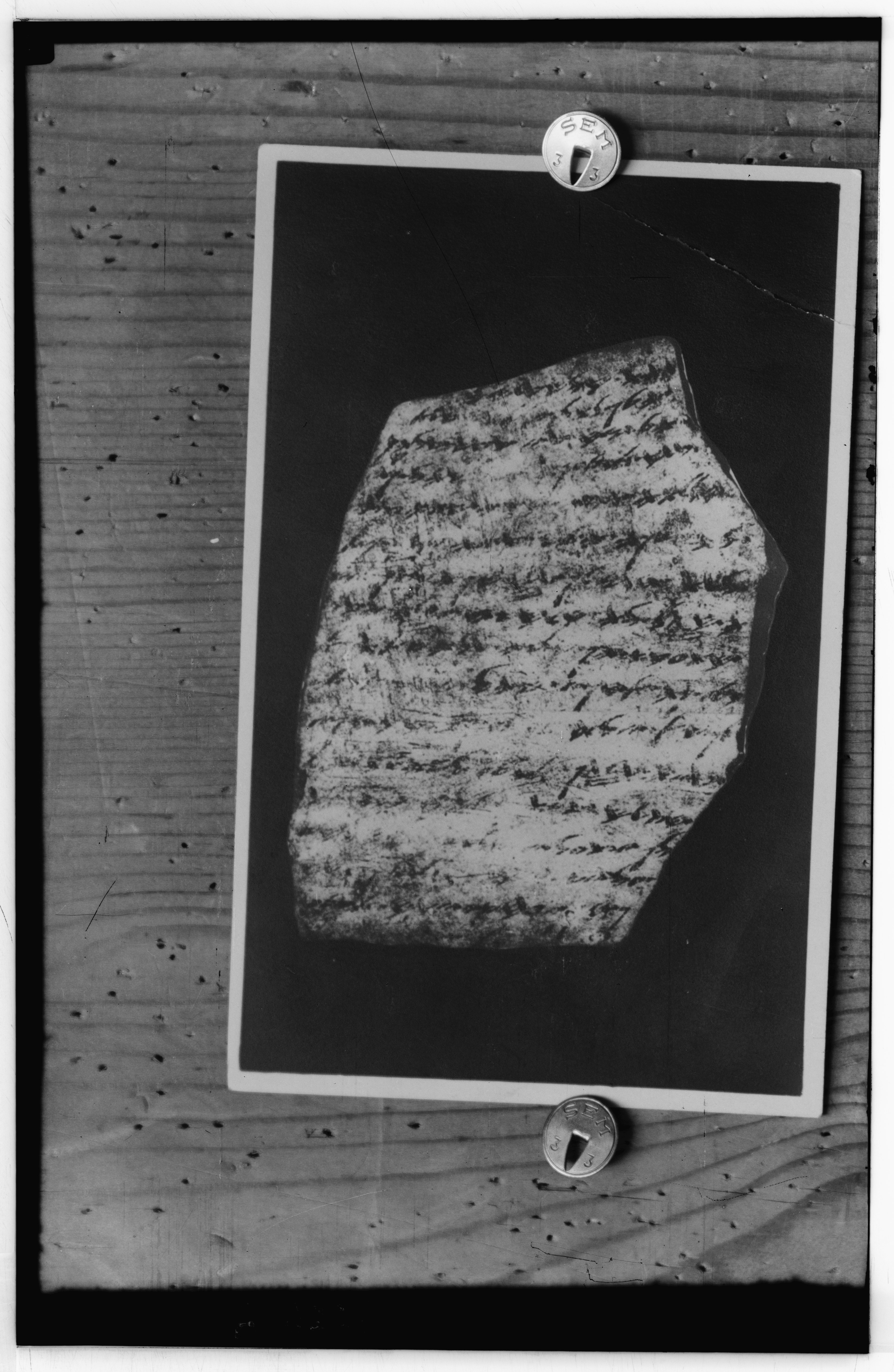
In the Lachish letters, around 588 BC, as Nebuchadnezzar's army closed in, Hoshaiah opens a report to his commander Yaush: "May YHWH cause my lord to hear news of peace today." Yahweh in the letterhead of army mail, written in the final campaign, when Lachish and Azekah were among the last fortified cities still standing (Jeremiah 34:7).
At Arad stood a shrine with standing stones and two limestone incense altars; residue analysis published in 2020 found cannabis on the smaller altar and frankincense on the larger, and an Arad note of the late seventh century lodges a man at "the house of YHWH." At Motza, a few kilometres from Jerusalem, a Judahite temple of around 900 BC operated while the First Temple stood.
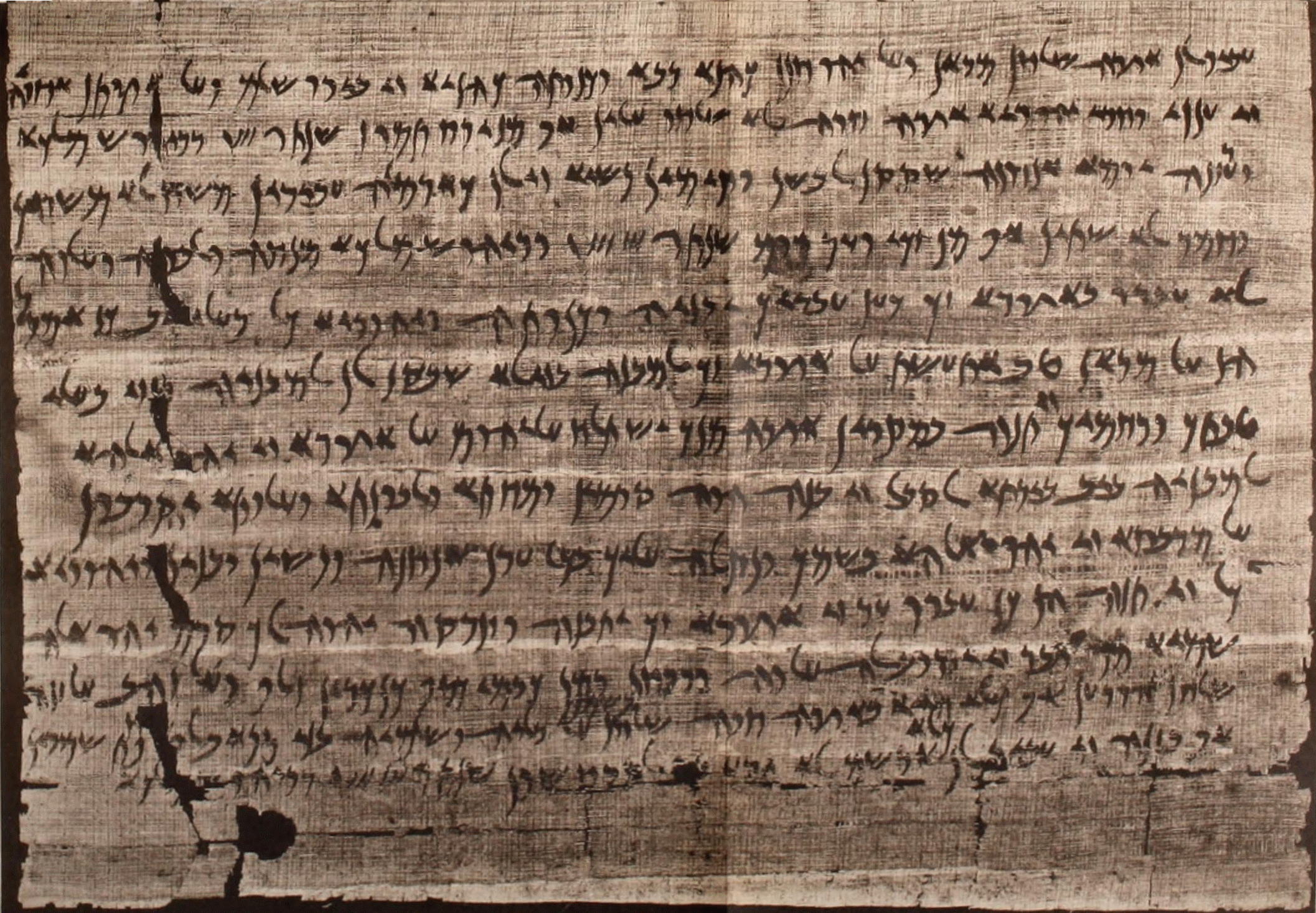
The colony's temple of Yahu at Elephantine stood, by its priests' account, before Cambyses conquered Egypt in 525 BC. Destroyed in 410 BC, it produced the Petition to Bagoas, dated 25 November 407 BC: Jedaniah and the priests write to the Persian governor of Judah asking leave to rebuild it "as it was built before."
The late turn
Ninth to eighth centuries: the demand for Yahweh alone. Around 622 BC: Josiah's reform clears the Temple of Baal and Asherah gear; how far it reached outside the text that celebrates it is contested. In 586 BC Jerusalem and the Temple are destroyed.
There, around 540 BC, in Second Isaiah, the claim changes kind. Not first among gods. Not for Israel only. "I am YHWH and there is no other; besides me there is no god." "I form light and create darkness, I make weal and create woe." Richard's earlier research on the exile period grades that contrast as hard at the level of text: those formulae have no pre-exilic parallel. Monolatry — one god worshipped — and monotheism — one god existing — are different claims, and in the surviving texts the first precedes the second by at least two centuries. Later theology, building on that exile turn across the following centuries, would go on to confess a God beyond time and space; that confession develops out of the exile's claim, and it is not a claim the Iron Age texts themselves make.
After the exile, the editing follows the theology. The sons of God in Deuteronomy 32 become the sons of Israel. The council becomes angels. Asherah disappears.
That is who Yahweh was to the ancient world. Not the only God from the beginning of the record — saying so anyway is how this subject got confused. A name in an Egyptian list of desert peoples, possibly a people's god long before it was written down. Then a nation's god, one among neighbours. Then the heir of El's household, wearing El's names and judging El's council. Then Baal's successor, speaking Baal's lines over the Sea. Blessed beside his asherah, carried on silver, housed in temples from Arad to Egypt. And at the end of the process, in exile, the God of whom it is finally said that there is no other.
The stones came first. The claim came last. The record runs in that order.
Sources
Primary sources: the Mesha Stele, c. 840 BC, Louvre AO 5066 (KAI 181); the Soleb name-list of Amenhotep III and the Amarah West copy (Grdseloff 1947; Redford, Egypt, Canaan, and Israel in Ancient Times, 1992); the Ugaritic tablets, KTU/CAT (KTU 1.4 VI 46; KTU 1.5 I); Deuteronomy 32:8–9 in its witnesses — Masoretic Text, 4QDeutj (4Q37, DJD 14), the Septuagint, and the Samaritan Pentateuch; Psalms 29, 68, 82; Isaiah 27 and 44–45; Exodus 6:3; Genesis 14, 17, 21; 2 Samuel 3, 12, 16; 1 Kings 2; 2 Kings 21, 23; the Deir Alla inscription (KAI 312).
Inscriptions and sites: Kuntillet Ajrud pithoi (Meshel, ed., Kuntillet ‘Ajrud (&Hdot;orvat Teman), Israel Exploration Society, 2012); the Khirbet el-Qom inscription (Dever, HUCA 40–41, 1969–70; Lemaire 1977); the Ketef Hinnom amulets (Barkay et al., BASOR 334, 2004); the Lachish letters (KAI 192–199; Torczyner, Lachish I, 1938); the Samaria ostraca; Arad ostraca and sanctuary (Aharoni 1981; Arie, Rosen & Namdar, Tel Aviv 47, 2020); the Motza temple (Kisilevitz & Lipschits 2020); the Elephantine papyri (Cowley, AP 30–32; Porten, Archives from Elephantine, 1968).
Black, Jeremy, and Anthony Green. Gods, Demons and Symbols of Ancient Mesopotamia. British Museum Press, 1992.
Blenkinsopp, Joseph. On the Midianite/Kenite hypothesis, 2008.
Collins, John J. Daniel (Hermeneia). Fortress, 1993.
Cross, Frank Moore. Canaanite Myth and Hebrew Epic. Harvard University Press, 1973.
Day, John. Yahweh and the Gods and Goddesses of Canaan. Sheffield Academic Press, 2000.
Fleming, Daniel E. Yahweh Before Israel. Cambridge University Press, 2020.
Hadley, Judith M. The Cult of Asherah in Ancient Israel and Judah. Cambridge University Press, 2000.
Hen, Yiftah. On the Soleb attestation, Entangled Religions 12.2 (2021).
Hess, Richard S. On the Asherah suffix, Religions 16 (2025).
Lambert, W. G. Babylonian Creation Myths. Eisenbrauns, 2013.
Lemaire, André. The Birth of Monotheism. 2007 — including Roland de Vaux’s verdict that the assimilation of YHWH with El “was done without a fight.”
Olyan, Saul M. Asherah and the Cult of Yahweh in Israel. Scholars Press, 1988.
Smith, Mark S. The Early History of God. 1990; 2nd ed., Eerdmans, 2002.
Smith, Mark S. The Origins of Biblical Monotheism. Oxford University Press, 2001.
Smith, Mark S., trans. The Baal Cycle. In Ugaritic Narrative Poetry, ed. Simon B. Parker. SBL, 1997.
Stavrakopoulou, Francesca. God: An Anatomy. 2021.
Tigay, Jeffrey H. You Shall Have No Other Gods. Scholars Press, 1986.
New Articles by Email
One email when a new article is published here. Nothing else — no spam, your address is never sold or shared, and you can unsubscribe any time.
Articles stay free to read whether you subscribe or not.
More antiquities research: Antiquities Research