The Working Files of a Quintessence Stillroom
A feature article. The Voynich manuscript (Beinecke MS 408) as a plant-extraction workshop record.
This is the fourth or fifth time I have come back to the Voynich manuscript. Each time I run the research all the way out — every source I can reach, every check I can run — and each time it ends in the same place. This time I wrote it up as a paper and published it, with the sources and the limits printed where anyone can check them. Here is what the evidence keeps saying.
The book sits in Yale's Beinecke Library as MS 408. Its parchment is dated 1404 to 1438. Two hundred and thirteen pages survive, written by several hands in a script nobody has read, filled with drawings of plants — some you can name on sight, the rest drawn in a hand that makes them hard to place — star charts, and naked women standing in tubs connected by strange plumbing. For six hundred years it has been called the world's most mysterious book, and the guesses have run from cipher to hoax to alien dictation.
My claim is plainer than any of that, and it is a claim about what kind of object the book is. It is not a book written for readers. It is the bound working files of a stillroom — the day-to-day job records of a small crew making plant essences for a living practice, in northern Italy, roughly 1410 to 1445. The files were gathered up and bound into one volume, out of their working order, by somebody who could not read them. That is why it looks like a book and behaves like a filing cabinet.
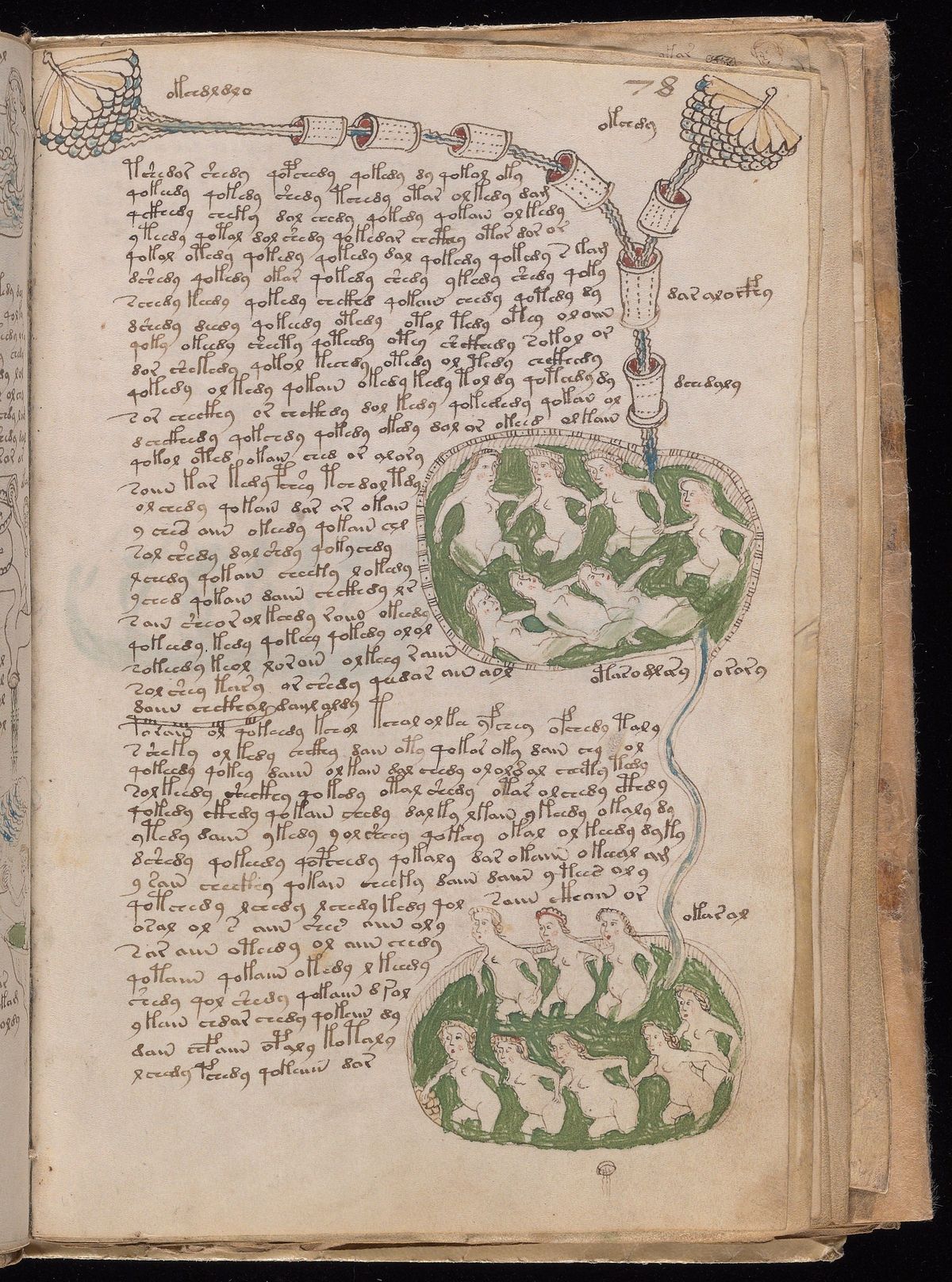
Folio 78r. Pages like this built the book's reputation for mystery. In the stillroom reading, this is a working file, not a riddle.
The work those files record matches one named tradition, step for step: the plant line of the quintessence medicine set down by John of Rupescissa in the middle of the fourteenth century. The core of it is older than Rupescissa — it stands already in the Testamentum tradition of 1332. Take a plant. Pound it with a tenth part of salt. Seal it in a vessel. Bury it in a dung bed and keep it there thirty to forty days, tending the bed. Then distil the plant in its own rot-water. Pour that water back over the dregs and distil again, and again, until the product tastes sweet and smells right. That cycle — pound, seal, bury, tend, distil, pour back, judge by the tongue and the nose — is the cycle the Voynich pages run, over and over.
For the paper I read five German copies of Rupescissa's book, cover to cover at the plant chapters. The plant line stands entire in all five. Even where the copies disagree, they disagree the way working copies do: one of them reads a fourth part of salt instead of a tenth at the seats for blood and flesh, while the plant seat holds at a tenth in every copy read. The counts agree too — the three-hour bound on charging a plant into finished spirit, the thirty and forty days, the hundredfold strength claimed for the product. Traditions that get copied by hand for a century and a half drift. This one drifts exactly where a workshop text drifts, and holds exactly where the work itself holds it.
Counting the work in the book gives the same picture from the other side. There are 561 completed work cycles in the surviving pages — bench records, treatise pages, stock pages — each one opened, run, and closed with a verdict. That is a production record. Stories do not keep count like that. Workshops do.
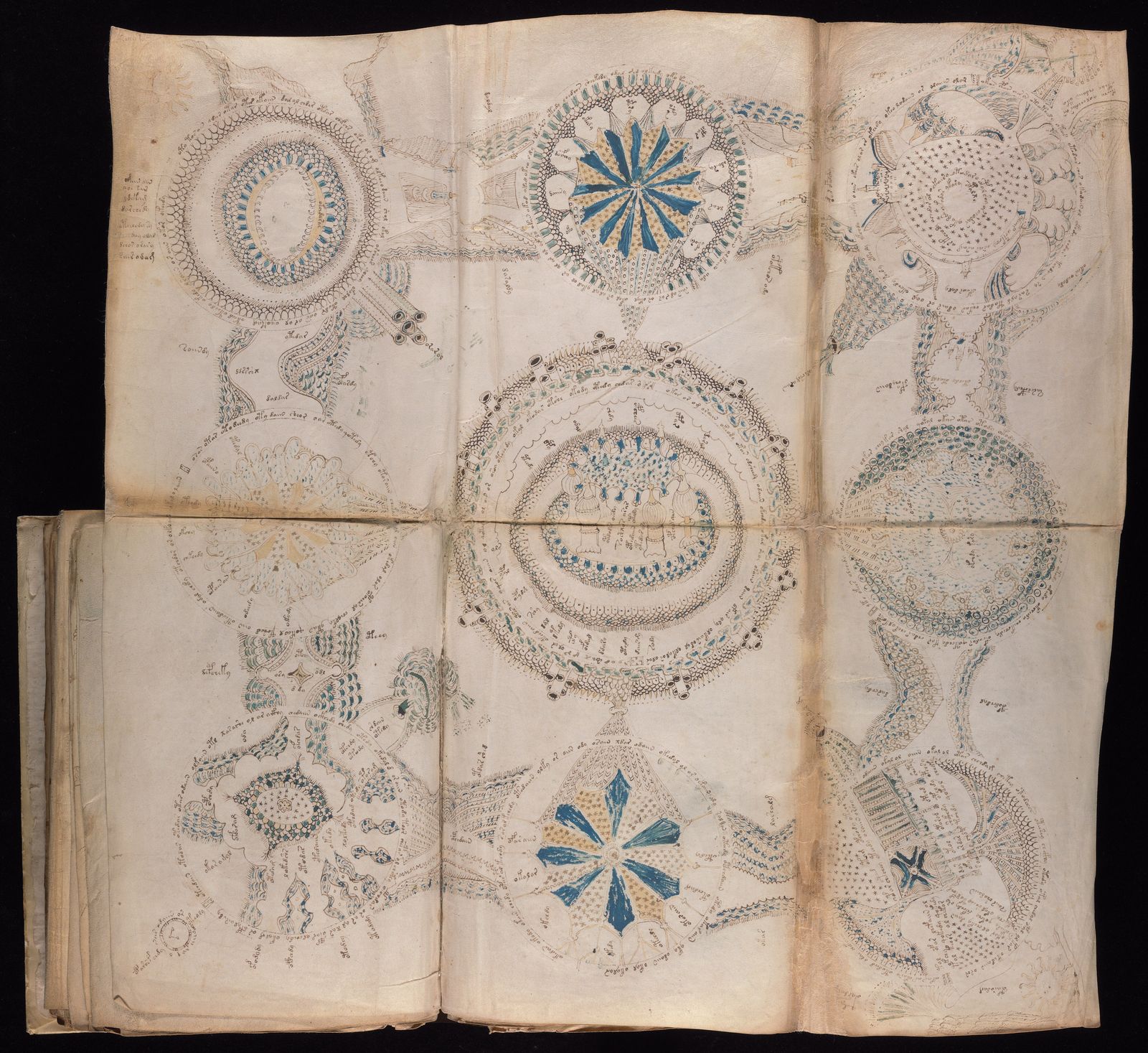
Folios 85v–86r, the rosette foldout — the book's largest sheet, spread across multiple leaves. A bench document, not a page for a reader's lap.
Inside the plant drawings there is a second hand at work, and it left a word behind. Under the paint, in the drawings themselves, stand colour directions written in German — on one page the word rot, red, written inside the plant's own stem, telling the painter what colour that stem was to be. A German speaker stood inside that Italian shop and directed the painting. The habit is not unique to this book: an alchemical herbal from Vicenza carries German colour words inside its plant drawings in the same position. Whoever the German was, his job in the shop is written in the stem of a plant.
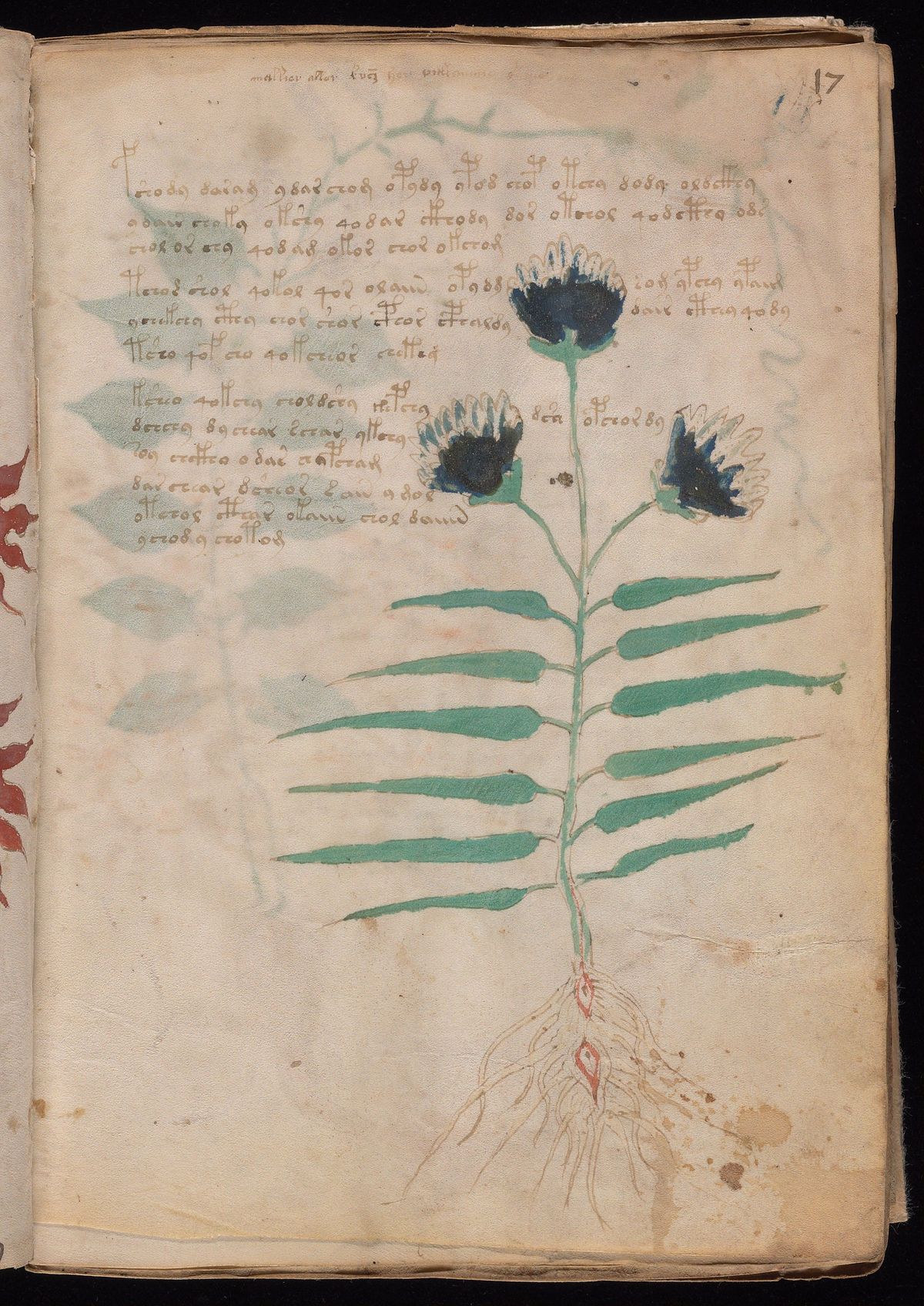
Folio 17r. The colour directions sit under the paint, in the drawings — production notes, made while the book was being made.
Now the two silences, because they are part of the case and the paper prints them as such. The first: no page of this book carries a quantity. Not in the text, and not in the margins — every margin of every page was checked, and there are no tallies anywhere. A workshop that ran 561 cycles counted something. The counts are not in the book because the counts were never kept in the book. The period kept running numbers on erasable things — wax tablets, counting boards, tally sticks — that sat beside permanent sheets and were wiped clean. That the counts lived on such a side-ledger is an inference, and the paper labels it as one. It is also priced: the job files are sealed off from each other to a degree chance does not produce, and reproducing that seal in simulation takes a real house discipline, sustained across all 561 cycles. The paper prints the size of that discipline instead of asking the reader to take it on faith.
The second silence explains the drawings. The book never names a plant in words a second time. Its 36 jar labels are 36 different words, none of them repeated — a write-once discipline, measured against what chance would give. The plant's name is its picture. The drawing is not decoration and it is not a puzzle; it is the label, hung where the plant itself would hang to dry. The tradition backs this from its own side: in all fifteen publicly readable copies of Rupescissa's treatise, there is not one plant picture. Vessels, yes, drawn again and again. Plants, none. The plant knowledge in that world moved by eye and by hand, not by picture books — and in the one surviving workshop record, the pictures are the names.
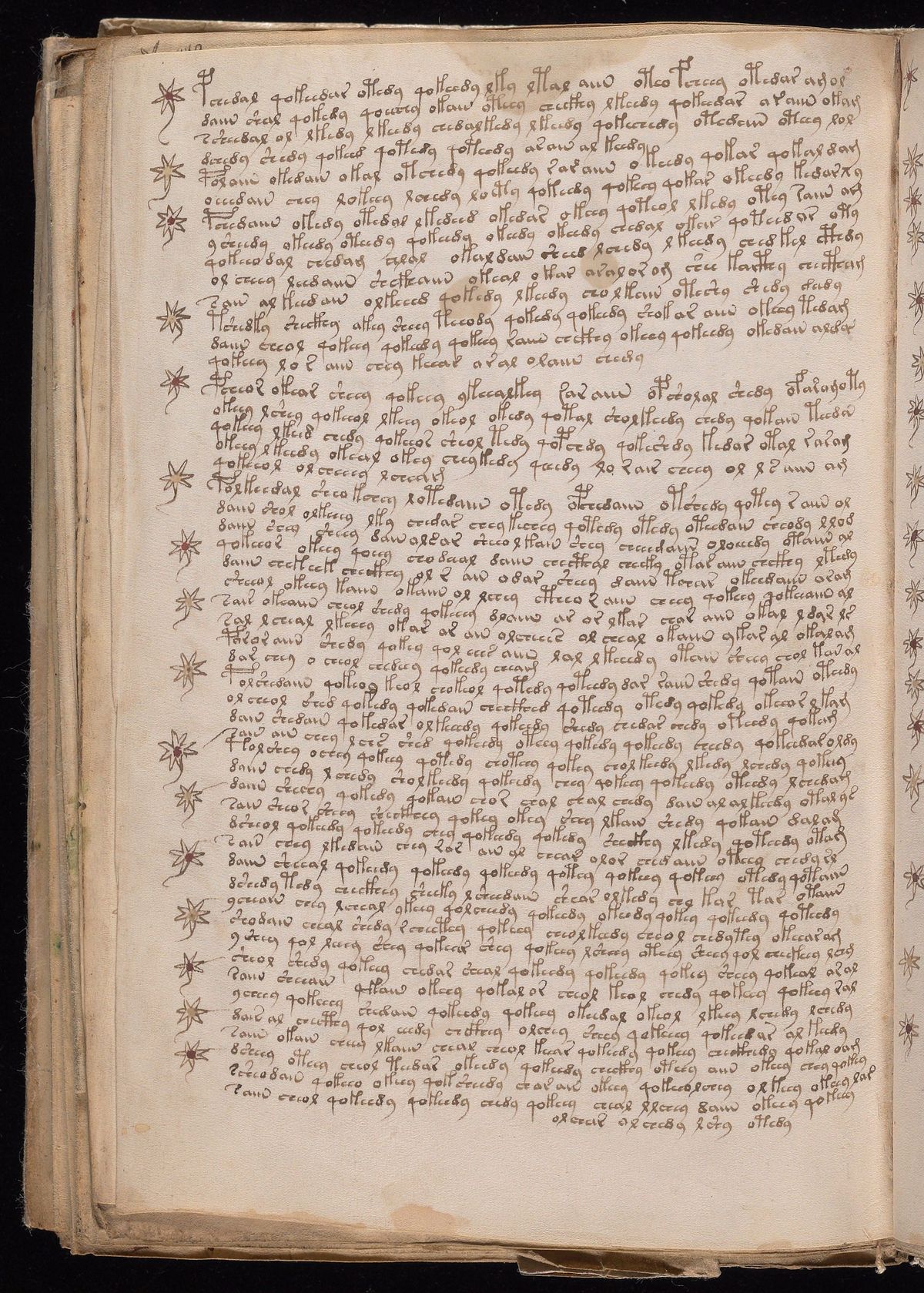
Folio 108v, a bench page. This is what the files look like up close — the same work grammar, cycle after cycle.
One word of the script is established, and it is exactly one. The word daiin — the word that opens the work, again and again, at the head of the bench records — means "take." It was established the hard way, against controls, and the paper prints its limits on the same page as the claim. One word is a pathway, not a solution. This is not a decipherment, and the paper does not call it one. The test the work set itself at the start — one plant and one process, pictured together in a source older than this book — has not been met, and the paper says that too, in plain words. What is claimed is what the evidence carries: what kind of object this book is.
The rival readings were given their best form and tested, and the paper reports them fairly. A coded ordinary herbal fails on the labels — herbal names repeat, these never do — and on the work cycles, which no herbal generates. A private memory system, one man's memory palace in picture form, fits three things genuinely: the missing key, the tier of the text that is never explained, the wheels. It fails on the crew — several hands dividing the labour by job, all writing one shared bench grammar is not one man's private system. A commercial distillery, the strongest of the three, breaks on the dung bed: tended dung heat as production equipment belongs to the pharmacy and alchemy family, and no commodity distillery in the record runs on it. What survives the tests is the stillroom.
So the answer has not changed, and I no longer expect it to. The locked book was never locked against readers. It was a crew's working files, written for the people who already knew the work, and it has been sitting in the wrong category for six hundred years. The full case — the five German witnesses, the counts, the silences, the rivals, and everything the paper does not claim — is published today: Richard Vigslist, "The Working Files of a Quintessence Stillroom: The Voynich Manuscript (Beinecke MS 408) as a Plant-Extraction Workshop Record," Zenodo, 25 October 2026. DOI: https://doi.org/10.5281/zenodo.23640488
Sources: the paper above, and the record it rests on — John of Rupescissa, Liber de consideratione quintae essentiae (c. 1351–52), read in five German witnesses (Heidelberg Cpg 233; Yale Mellon MS 16; Stuttgart HB XI 12; München Cgm 33; Nürnberg Cent. VI, 5) and the Latin printed tradition (Cologne 1573; Manget 1702); the pseudo-Llull Testamentum tradition (1332); the French line, Le Grand Éclaircissement (Paris 1628); Beinecke MS 408 and Mellon MS 12; the Vicenza herbal, Biblioteca Bertoliana MS 362. Manuscript images: Yale Beinecke Library, public domain.
— Richard Vigslist Research: nuviratechnologies.io
Nuvira Technologies conducts this research with AI assistance, cross-verified against the primary sources to scholarly integrity standards. Uncertain readings are marked; broken lines are left broken.
— Richard Vigslist, Founder, Nuvira Technologies
More antiquities research: Antiquities Research