The Philosopher's Stone
The stone that is not a stone — an idea traced from a Chinese court of 133 BCE, through Greek, Arabic and Indian hands, into the laboratories of Boyle and Newton.
The philosopher's stone is usually introduced as a thing of indefinite age: an ancient secret, Egyptian or older, passed hand to hand until it fades into legend. The surviving record tells a different and better story. The stone has dates. It enters writing at specific times, in specific places, under specific names, and those names change as the idea changes. What follows is the record in the order it happened, from the oldest evidence forward. Where a claim rests on documents, the documents are named. Where a claim is tradition — a story later ages told about earlier ones — the text says so.
The First Report: China, c. 133 BCE
The oldest dated report of the pattern that later produces the stone comes not from Egypt or Greece but from the court of Han China. The Shiji, the dynastic history compiled around 94 BCE, records a proposal made to Emperor Wu about 133 BCE by Li Shaojun, a fangshi — a "master of methods." The proposal runs in steps: make offerings to the stove, and spirits can be summoned; with their help, cinnabar can be transmuted into gold; make the gold into vessels for eating and drinking, and life is prolonged; live long enough, and a man may meet the immortals of Penglai Island in the sea and, in the end, not die (Pregadio, Great Clarity, 2006).
Two things in that report matter for everything after it. First, gold-making and life-extension are linked from the very first record. Second, the link is not yet a stone, and not yet a drink. Li Shaojun's gold is not swallowed. It is worked into cups and dishes, and the vessels carry the benefit. The substance that does the work is ordinary cinnabar, changed into gold by a process; the perfected thing is then used, not consumed.
The Chinese record keeps testing the idea, and keeps the failures. Around 60 BCE the Yantie lun reports, with hostility, the claim that immortals "had eaten of gold and drunk of pearl" — ingestion is at least being talked about by then, as a claim, not a recipe. Between 61 and 56 BCE the scholar Liu Xiang was given a rare book on gold-making, the imperial library, assistants, and unlimited funds, and set to make gold at court. He failed completely, and the Hanshu preserves the failure. A tradition that records its own failed state trials is a tradition writing history, not advertising.
There is no document showing that this Chinese pattern travelled west, or that the western pattern travelled east, in these early centuries. The two traditions solve a similar problem — a perfected substance that perfects what it touches — with different structures, on different substances, toward different ends. The parallelism is documented. Transmission between them is not.
The Craft Root in Roman Egypt
The line that actually leads to the stone begins later, in Roman Egypt, and it begins in the workshop rather than the temple. The oldest surviving alchemical writings are not about a stone at all. They are about dyeing metals.
The Four Books of pseudo-Democritus, written in Greek by an anonymous author of the second half of the first century CE (Martelli's edition, 2013, proposes c. 54–68), set out a programme in four parts: two books on dyeing metals gold and silver, one on stones, one on purple dye. The Leiden Papyrus X and the Stockholm Papyrus, recipe collections whose surviving copies date to the late third or early fourth century, give workshop instructions for alloys that imitate gold and silver, for imitation gems, and for dyes — and they state plainly that the products are imitations (Caley, trans., The Leyden and Stockholm Papyri). This is craft literature: surface transformation of metals by tinctures and alloys, practised inside Egyptian workshops.
The same early centuries also preserve the name of Maria the Jewess. She is quoted extensively by Zosimos and credited with apparatus — the kerotakis, a reflux device; the tribikos, a three-armed still; and the water bath that still carries her name, the bain-marie. She is documented as a textual figure; no biography survives, and her own dates are tradition rather than record.
What this layer has is a technique: metals can be treated as bodies that take a tincture, the way cloth takes dye. What it does not yet have is a single named substance that does all the work. That arrives with one writer, around the year 300.
Zosimos and the Stone That Is Not a Stone
Zosimos of Panopolis, from Akhmim in Egypt, flourished around 300 CE and is the earliest historically attested alchemical author (critical edition: Mertens, Les alchimistes grecs IV.1, 1995). In his treatise On Virtue he quotes a saying he attributes to Democritus:
> "Receive this stone which is not a stone, this precious thing which has no value, this polymorphic object which has no form, this unknown who is known to all… I am talking about aphroselin."
Zosimos then solves his own riddle. The "stone" is aphroselēnon, the sublimed vapour of cinnabar — mercury — which whitens copper. "The stone… is not a real stone," he writes. "Indeed, it is in its nature to flow." The first stone in the record is, by its author's own explanation, not a stone. It is a volatile tincture for metals, given a paradox for a name.
Zosimos presents the saying as older than himself, but the pseudo-Democritus writings that survive from the first century do not contain it, so the earliest surviving evidence for the word "stone" in this art is his, around 300. A later reference-book habit of saying "the philosopher's stone is first mentioned by Zosimos, c. 300" goes further than the text does: Zosimos uses no fixed term for a single perfected substance with the properties the medieval stone would gather. He has an antecedent — a transmuting tincture called, in a riddle, a stone.
The word of Zosimos's that mattered most to the future was not "stone" at all. He uses xērion — in ordinary Greek, a dry powder for drying wounds — as a name for what he calls the medicine of metals: a substance that cures a metal's imperfection and raises it to gold (Ball, Alchemy, 2025). That word travelled. Greek xērion became Arabic al-iksīr and then Latin elixir (Strohmaier, Al-Qantara 37.2, 2016). The history of the stone is, in large part, the history of that powder.
The Greek tradition also hands down the oldest recoverable framework for the work: a sequence of colour changes in the vessel — blackening, whitening, yellowing, reddening; in Greek melanosis, leukosis, xanthosis, iosis; in Latin nigredo, albedo, citrinitas, rubedo. And his Visions, dream-like accounts of a sacrificing priest flayed, boiled, and transformed in a bowl-shaped altar, are an allegorical presentation of laboratory operations, their imagery drawn from the Egyptian temple practice of his own time (Mertens; Escolano-Poveda, 2022). The allegory dresses the operations. It does not replace them.
The Elixir in China: Corpus and Cost
China's tradition, running on its own track, reaches its full written form in the same centuries. The Taiqing (Great Clarity) corpus, formed between the third and sixth centuries, holds the earliest surviving elixir scriptures — the Nine Elixirs, the Golden Fluid. Tradition says they were revealed to the fangshi Zuo Ci at the end of the second century; the revelation date is the tradition's own claim. Ge Hong's Baopuzi, completed around 320, states the system entire: its fourth chapter ranks the medicines for transcendence — cinnabar best, then gold, silver, and a descending list — and its sixteenth gives methods for artificial gold and silver. The Baopuzi lists 56 preparations. Eight of them are poisonous. Ge Hong states twice in the work that he never compounded an elixir himself; the greatest Chinese alchemical author is a compiler and theorist, and the record is clear about it.
The Chinese unit was never a stone. It was an elixir — dan, a pellet or preparation compounded in a sealed crucible through counted cycles and then eaten. The most prized forms, the Reverted Elixir (huandan) and the Golden Elixir (jindan), existed in many ranked versions, each made and consumed in the using. Transmutation stayed subordinate: proof of the method, a source of vessels or ingredients. The stated end was transcendence.
The cost of that structure is the best-documented part of the whole Chinese record. Tang-dynasty writers themselves list deaths and injuries from cinnabar, mercury, and lead preparations, and a text preserved in that tradition catalogues the symptoms of a working elixir — itching as if insects were crawling over the body, swelling, vomiting, violent headache — and instructs the reader not to be alarmed, since the effects prove the medicine is expelling hidden disorders. Emperors were not exempt. The deaths of Emperor Wuzong (r. 840–846) and Emperor Xuānzong (r. 846–859) by elixir poisoning are documented; those of Xianzong (r. 805–820) and Muzong (r. 820–824) are graded likely by the same scholarship (Pregadio, Encyclopedia of Taoism, 2008). Xianzong's documented story is precise: the elixirs deranged him, his rule became intolerable, and eunuchs assassinated him. An earlier emperor, Ai of Jin (r. 361–365), is recorded in the Book of Jin as poisoned by an overdose until "he no longer knew what was going on around him." The often-repeated claim that the first emperor, Qin Shi Huang, died of mercury elixir poisoning is not in the record: the Shiji records illness, not poisoning.
The Elixir Becomes a System: The Arabic Centuries
In the Arabic-speaking world the agent acquired a theory, and a theory is what turns a recipe into a stone. The enormous body of writings attributed to Jābir ibn Ḥayyān holds that every metal is sulphur and mercury in different proportions and qualities. Rearrange the proportions and the metal changes. The rearrangement is worked by al-iksīr, the elixir: a small amount of the perfected substance, projected onto the imperfect metal. Arabic usage also names the agent ḥajar al-falāsifa — "the stone of the philosophers," plural — the direct ancestor of the Latin phrase. A white elixir made silver; a red elixir, also called red sulphur, made gold.
The dating needs care, because the attribution runs ahead of the manuscripts. Tradition makes Jābir a disciple of the imam Jaʿfar al-Ṣādiq, who died in 765, and puts Jābir's own death around 806–816. Paul Kraus showed in the 1930s and 1940s that the corpus is the work of many hands, and modern scholarship dates most of it to about 850–950, possibly over an eighth-century core. The eighth-century Jābir is tradition. The elixir system as it can actually be read — late ninth to early tenth century — is documented (Kraus, Jābir ibn Ḥayyān, 1942–43). A generation later a named, datable author confirms the system independently: Abū Bakr al-Rāzī of Rayy (865–925), whose Sirr al-asrār (Secret of Secrets) classifies every working substance and treats elixir-making as practical laboratory work. Ibn al-Nadīm's Fihrist of 987 attests that al-Rāzī believed in transmutation and wrote twelve books on the art.
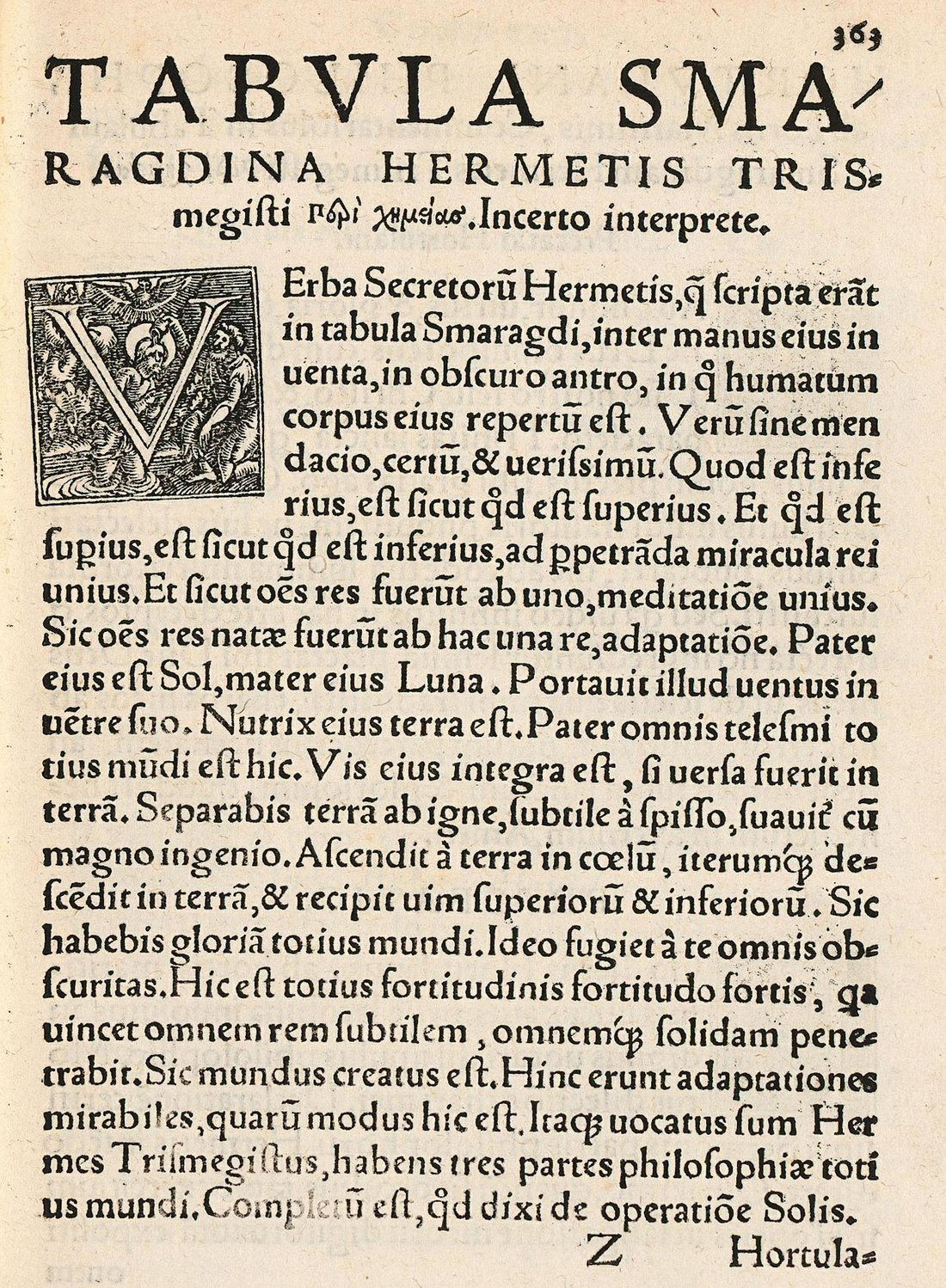
The same Arabic centuries produced the text that later ages would mistake for the oldest of all. The Emerald Tablet — the short Hermetic text beginning with the correspondence of above and below — has its earliest surviving evidence as an appendix in Arabic, in the Sirr al-khalīqa (Secret of Creation) attributed to Balīnūs, pseudo-Apollonius of Tyana, dated by its modern editors to the late eighth or early ninth century. That book also carries an early form of the sulphur–mercury theory. No Greek or Syriac manuscript of the Tablet exists. No emerald tablet has ever been found; the crypt in which a sage supposedly discovered it is the text's own frame story. Hermes Trismegistus, its supposed author, is a composite legendary figure, and the Greek Hermetica that do survive, from the first to third centuries, do not contain the Tablet. Even the famous four words "as above, so below" are not the ancient wording: the Latin text, in Newton's translation, reads "That which is below is like that which is above… to do the miracles of one only thing," and the compressed epigram was popularised in the nineteenth century, by Blavatsky's Isis Unveiled (1877) and after it The Kybalion (1908), a New Thought book, not a Hermetic one. The Tablet is a real and important text. Its real date is the turn of the ninth century.
Persia belongs in this section as a question the record leaves open. The personnel of early Arabic alchemy is heavily Persian and Iraqi — al-Rāzī is from Rayy, the Jābir legend attaches to Kufa and Tus — but they wrote in Arabic, and no alchemical literature in Middle Persian, the language of Sasanian Persia, survives at all. Older scholarship argued that Persia was one of the main channels by which Greek alchemy reached Islam, pointing to Persian loanwords for minerals and techniques (Holmyard). Modern scholarship gives more weight to Syriac Christian translators and to direct Greek-to-Arabic translation in Abbasid Iraq. A Persian channel is tradition; a pre-Islamic Persian stone doctrine is speculation, because nothing survives to carry it.
India: Mercury and the Paired Work
India's entry into this history comes in two stages, and the stages are separated by a word that changes meaning. Rasāyana, one of the eight branches of Āyurveda, is rejuvenation therapy — long life, memory, youthfulness — and its early formulations are plant-based: myrobalan fruits, milk, ghee. The Carakasaṃhitā, which puts rasāyana at the head of its therapeutics, is a layered compilation of the early centuries CE on the usual scholarly ranges. Neither it nor the Suśrutasaṃhitā uses mercury in its rasāyana recipes. A twelfth-century commentator's habit of reading the old word rasa as "mercury" cannot move mercury back into those early texts; rasa in them means juice, essence, flavour (Wujastyk, Asian Medicine 8, 2013).
Mercury enters Indian medicine by the early seventh century: Vāgbhaṭa's compendia contain the first certain medical mercury compounds and the first mercury rasāyana recipe. A seventh-century novel, Bāṇabhaṭṭa's Kādambarī, already jokes about a practitioner suffering from badly purified mercury — the substance, and the danger of preparing it wrong, were familiar enough to be comedy. No Indian source of mercury has been identified; import is inferred, and the route is undocumented.
The full Indian system is medieval. In the mature rasaśāstra literature, processed mercury — rasa, pārada, identified with the semen of the god Śiva, worked through a scheme conventionally counted as eighteen purifications and preparations (saṃskāras) — does two paired jobs. Lohavāda is the transmutation of base metals into gold or silver. Dehavāda is the transformation of the practitioner's body: disease and ageing removed, liberation in a perfected body. The Rasahṛdayatantra, around the tenth to eleventh century and the earliest surviving alchemical text on current scholarship, states the pairing in its own structure — chapter 18 transmutes metals, chapter 19 transforms the body. The Rasārṇava, eleventh to twelfth century, gives the maxim: "as in metal, so in the body" (White, The Alchemical Body, 1996). A preparation was proved on metal first, then used on the body. Al-Bīrūnī, writing about India around the 1030s, is an outside witness that a science like alchemy, called rasāyana, existed by his time.
India has no stone-equivalent, and the difference is structural. Processed mercury does both of the stone's jobs, but it is a substance class with many named preparations, not one reusable substance made once and kept. Tradition also gives India a founder, Nāgārjuna, but the record does not support a single man: more than fifty works circulate under the name by several authors, distinct from the second-century philosopher, and the manuscripts of the Rasaratnākara ascribe that work uniformly to Nityanātha Siddha, not to Nāgārjuna at all (Meulenbeld, A History of Indian Medical Literature; Wujastyk, 2013). Whether India's mercury doctrine connects to the Arabic elixir system or grew on its own is unsettled: the surviving system is structurally its own — tantric in framing, body-first in purpose — and first datable a half-millennium after the Arabic system it resembles. Contact for the import of mercury itself is plausible. A documented line of transmission for the doctrine has not been shown.
The Idea Enters Latin: 1144 and the Thirteenth Century
Latin Europe receives the stone on a date that can be given to the day. On 11 February 1144, Robert of Chester completed the Liber de compositione alchemiae, a dialogue in which the hermit Morienus instructs the Umayyad prince Khalid ibn Yazid — generally counted the first Arabic alchemical work translated into Latin (Stavenhagen, A Testament of Alchemy, 1974). In that book the word alchemia does not yet mean the art; it names the transmuting substance itself. The concept, including the doctrine of the one substance under the formula "the stone that is not a stone," is documented in Latin from 1144 (Pereira, Micrologus XXIV). Whether the exact phrase lapis philosophorum stood in the 1144 text in those words cannot be shown: no manuscript of that year survives, and the prologue in question heads two different treatises in the tradition. The meeting the dialogue narrates — a seventh-century hermit teaching a prince — is a transmission legend, not an event.
Within a few years Hugo of Santalla had translated the Emerald Tablet into Latin as well, around 1145–1151; it circulated narrowly at first and widely later, in a twelfth- and thirteenth-century compilation. The Turba Philosophorum, an Arabic assembly of ancient philosophers from around 900, reached Latin in the thirteenth century.
The thirteenth-century Latin writers who take the agent up argue about it, and they report tests. Albertus Magnus, in De mineralibus (c. 1250s–1260s), debated transmutation in Aristotelian terms and reported having alchemical gold tried by fire: it failed after six or seven firings. Vincent of Beauvais, around 1250, reports projected "gold" failing assay in the same way. Roger Bacon's authentic works of 1266–67 defend alchemy as real knowledge and give the elixir a medical role — a medicine to prolong life. The stone-heavy treatises that circulate under Bacon's name, the Speculum alchemiae and the Epistola de secretis operibus, are pseudepigrapha: later works under a borrowed name, a pattern that runs through the whole literature and that any honest account has to keep separating from the record.
The most systematic Latin theory of the agent comes at the end of the century, and it does not call the agent a stone. The Summa perfectionis of pseudo-Geber — shown by William Newman (1991) to be an original Latin work by Paul of Taranto, not a translation of the Arabic Jābir — calls it a medicina, a medicine for sick metals, and grades medicines in three orders: the first changes a metal's surface temporarily; the second changes it permanently but incompletely; the third alone completes the work when projected onto a metal. Later historians would gloss the third-order medicine as the philosopher's stone. The Summa itself does not use the name.
The Name Settles: 1330–1332
At the turn of the fourteenth century the phrase stops being a formula inside other men's books and becomes the subject of whole ones. John Dastin's letters argue over the stone by name in the first decades of the century (Theisen, Ambix 33, 1986). In 1330 Petrus Bonus of Ferrara completed the Pretiosa margarita novella, an entire treatise on the stone, printed at Venice in 1546 under a title naming the pretiosissimo philosophorum lapide — the most precious stone of the philosophers. Bonus's stone is a defined material agent: solidified mercury holding a special sulphur. He also argued that the art is partly natural and partly divine, and that the stone's generation had given the ancient philosophers foreknowledge of Christian doctrine. Close reading shows he keeps the stone and Christ distinct — the comparison is an analogy, not an identity (Paušek-Baždar, Prilozi 41/2, 2015).
In 1332, by its colophon, comes the Testamentum attributed to Ramon Llull. It states the stone's widened scope as a system: the elixir perfects metals, perfects gems, and maintains human health. Llull himself, in his authentic works, rejected transmutation; the Testamentum is the earliest of 143 alchemical texts that circulated under his name after his death. Around the 1350s John of Rupescissa carries the stone into the medicine of the quintessence.
This layering of properties is worth stating plainly, because popular accounts project the finished stone backwards. In the earliest Latin material, from 1144, the agent perfects metals. A named medical programme for the human body is an early-fourteenth-century development. The full immortality of the later legend — not cured disease, not prolonged life, but no death at all — belongs later still, and attaches to the stone through story rather than through any treatise.
The Literal Centuries
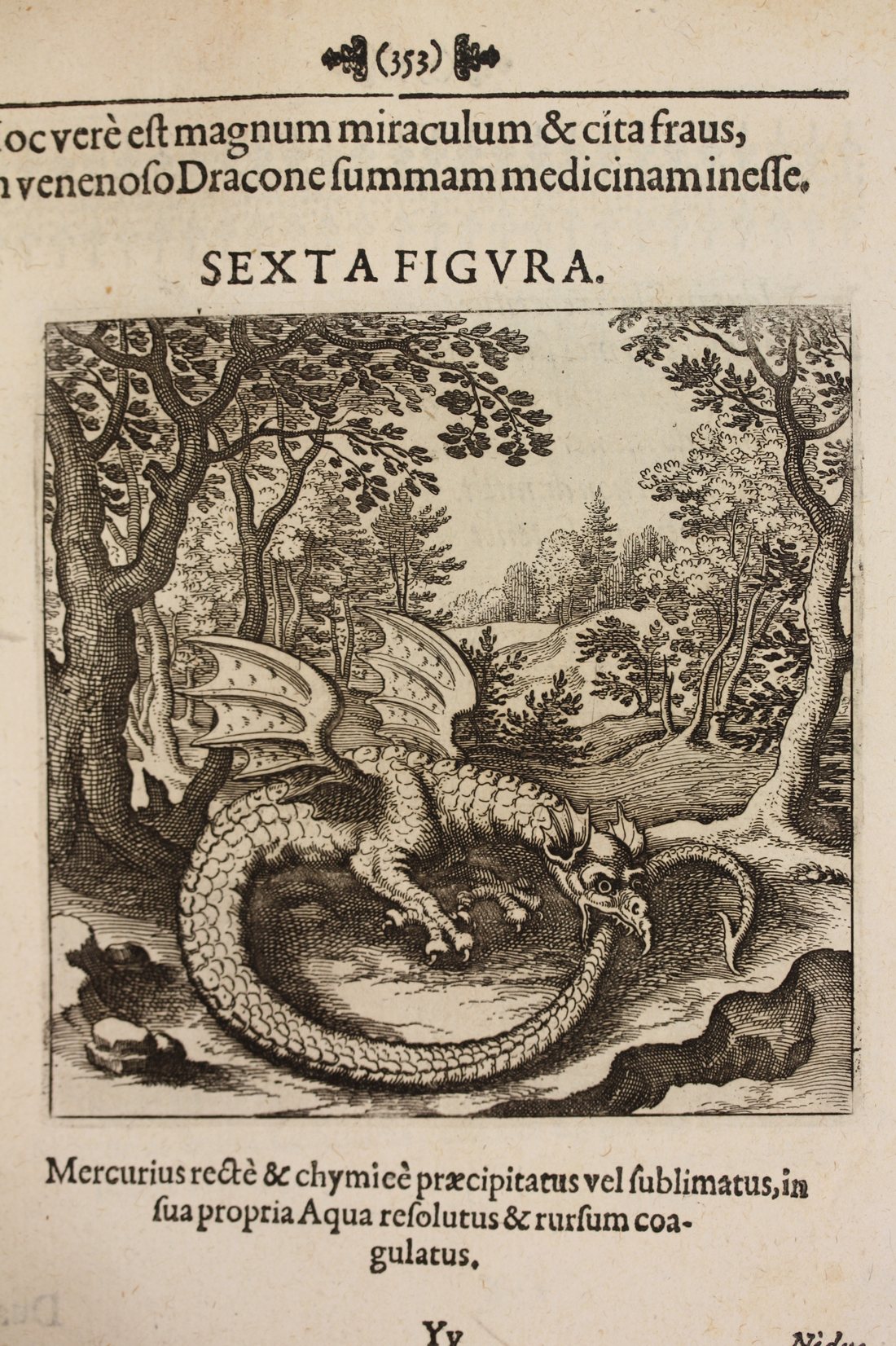
For roughly fifteen centuries, across the Greek, Arabic, and Latin traditions, the stone was a material goal. A substance was to be made in a furnace, projected in small quantity onto molten base metal — the white stone making silver, the red making gold — multiplied by re-dissolving it and repeating the work, and taken as a medicine that perfects the human body as it perfects sick metals. "Stone" never meant a rock: the product is described as a red or white powder, a waxy fusible solid, a tincture. Nor was the scheme only lead into gold; the texts work on imperfect metals generally, very often starting from mercury. Lead becomes the default example in later retelling.
The period's own record includes its scepticism. In 1317 Pope John XXII's decretal Spondent quas non exhibent condemned alchemists who promise riches they do not produce. Chaucer's Canon's Yeoman's Tale, from the 1390s, is a contemporary account of alchemical fraud and self-deception written from inside the culture that produced the stone literature. Patronage contracts specified deliverable gold; fraud law existed because men were paying for metal, not metaphors.
Paracelsus, in the early sixteenth century, shifts the art's centre to medicine — mineral remedies, prepared spagyrically — while keeping transmutation. The working tradition runs unbroken into the age of the scientific revolution, and its two most famous names are control cases for what the stone meant to serious practitioners. Robert Boyle pursued the stone for years and lobbied for the 1689 repeal of the English statute against multiplying gold; a man does not campaign to legalise a metaphor. Isaac Newton left roughly a million words of alchemical manuscripts and some thirty years of laboratory notebooks — weighed, recorded trials of coded recipes. No paper of Newton's claims a completed transmutation. Keynes's famous description of him as "the last of the magicians" is a collector's characterisation, written in 1942 by the man who had bought the manuscripts in 1936; Newman's Newton the Alchemist (2019) re-reads the same notebooks as quantitative laboratory practice.
Against that documented record stands the most famous stone story of all, and its date is the point. Nicolas Flamel, in the documents, is a Parisian public scribe who died on 22 March 1418 leaving a will that disposes of a property-based estate; no document of his lifetime mentions alchemy. The story everyone knows — the Book of Abraham the Jew bought for two florins in 1357, the journey to Spain, mercury turned to silver on 17 January 1382 and to gold on 25 April 1382, the elixir, the centuries of sightings of Flamel and his wife alive — appears first in print in the Livre des figures hiéroglyphiques, published at Paris in 1612, one hundred ninety-four years after his death. Étienne Villain showed in 1761 that the book is a seventeenth-century invention. The Flamel legend is real history — the history of a legend, dated 1612, not of events dated 1382.
A Second Reading Arrives, c. 1600
Medieval alchemical writing is saturated with religious language, and the record is clear about what most of that language is doing. One substance is named by many names and the names are scattered through a book: cover-names, a secrecy technology for knowledge with a market price. From the thirteenth century, writers also set the stone's making beside Christ's death and resurrection — the matter dies in the vessel and rises perfected — as an exemplum, a pattern that explains the process and defends the art. Christ explains the stone. The work is finished when the tincture projects onto metal, not when the adept reports an inner change. Ibn Umayl, writing around 900–960, already insists that the sages spoke in symbols and the texts must be decoded; his exegesis is about reading cover-names correctly, and it sits comfortably with a material stone at the end of the reading.
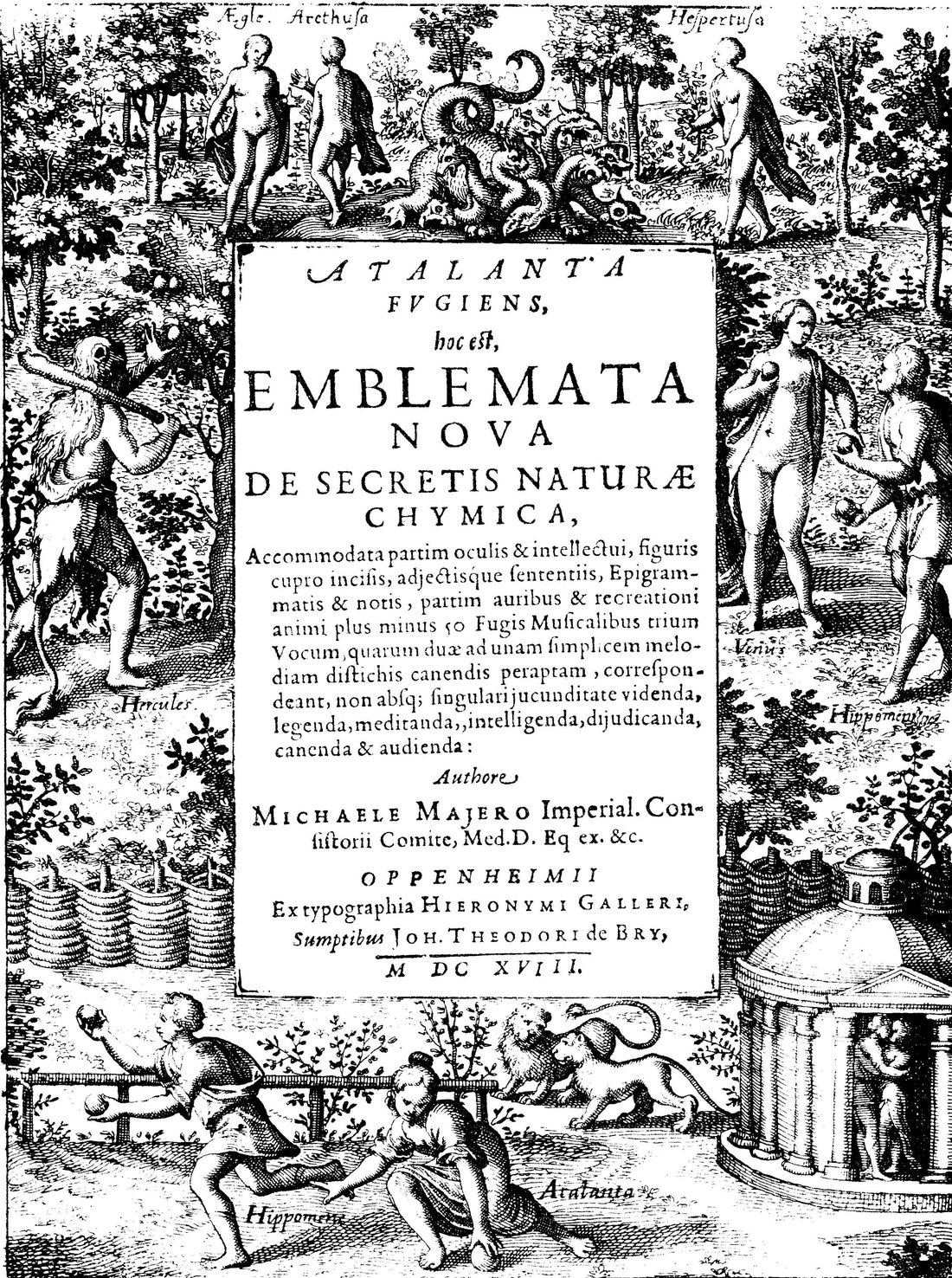
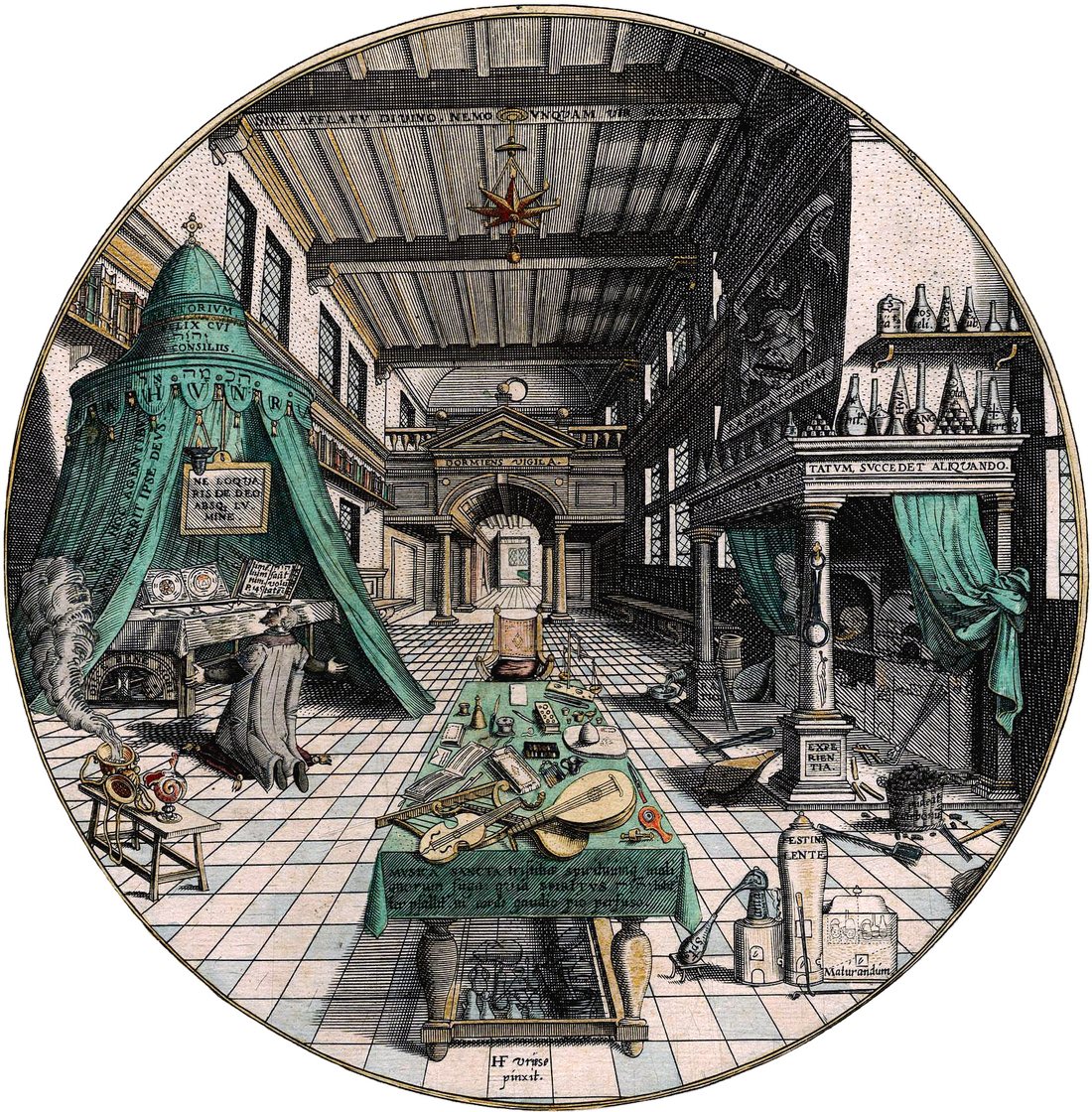
A genuinely spiritual reading — the adept's own rebirth placed inside the analogy, as a stated goal of the art — is first attested around 1600, in a German network of Radical-Reformation and Paracelsian writers. In texts attributed to Valentin Weigel, composed late in the sixteenth century, a three-way analogy is set out for the first time: the stone, Christ's Incarnation, and the believer's spiritual rebirth, the believer now a term in the comparison (Zuber, Spiritual Alchemy, 2021; the dating is Zuber's argument from the manuscript witnesses). Heinrich Khunrath's Amphitheatrum sapientiae aeternae (1595; expanded 1609) is the first clear printed case of the double reading. Its famous engraving shows the adept on his knees between an oratory and a laboratory — orando et laborando, pray and work — and Khunrath's stone is threefold: a stone that transmutes and makes gems, a medicinal stone, and a divine stone, "the Formula of our Spiritual and corporeal Regeneration" (Forshaw). It is an addition, not a substitution: Khunrath never gives up the furnace. Michael Maier's Atalanta fugiens (1618) layers meanings over laboratory doctrine its author practised. Jacob Boehme, in works of 1619–1622, develops the rebirth scheme into a system and makes the genuinely new move: in Zuber's characterisation, laboratory alchemy is demoted to a grossly material reflection of the spiritual work. Robert Fludd's Clavis (1633) gives the strand its name in print: Alchymia spiritualis, spiritual alchemy. Even here the goal is not modern self-development. It is the reversal of the Fall and preparation for the resurrection of the dead.
The Modern Overlay: 1850 to Jung
The claim in its popular total form — the stone was never about gold; the laboratory was always a cover for the transformation of the soul — has its own datable origin, and it is not medieval. Mary Anne Atwood's A Suggestive Inquiry into the Hermetic Mystery (1850) states it without qualification: "Man… is the true laboratory of the Hermetic art." Ethan Allen Hitchcock's Remarks upon Alchemy and the Alchemists (1855; enlarged 1857) argues that the stone stands for "truth, goodness, moral perfection," and that the material language was a disguise worn against heresy charges. The disguise theory is the load-bearing piece of the whole construction: it converts the absence of spiritual statements in the old texts into evidence for them, and so makes the claim impossible to test. Atwood's line of descent is documented — she and her father read the Behmenist manuscripts that carried Boehme's strand into England — but what changes in 1850 is scope: a marginal strand's reading of some alchemy becomes a claim about what alchemy always was.
The occult revival of the later nineteenth century normalised the reading. Herbert Silberer gave it a psychological mechanism in 1914 — alchemical imagery as the symbolism of the unconscious — and C. G. Jung gave it its present form in Psychology and Alchemy (1944): the stone as the Self, the work as individuation, the alchemists as men who projected an inner process onto matter they did not understand. Jung's route in ran partly through China: Richard Wilhelm had sent him The Secret of the Golden Flower in 1928, a text of Chinese inner alchemy, neidan — a genuinely inner tradition, native to China, with its own texts and lineages — and the inner reading native to that tradition was mapped onto the Latin stone.
The Record, Corrected
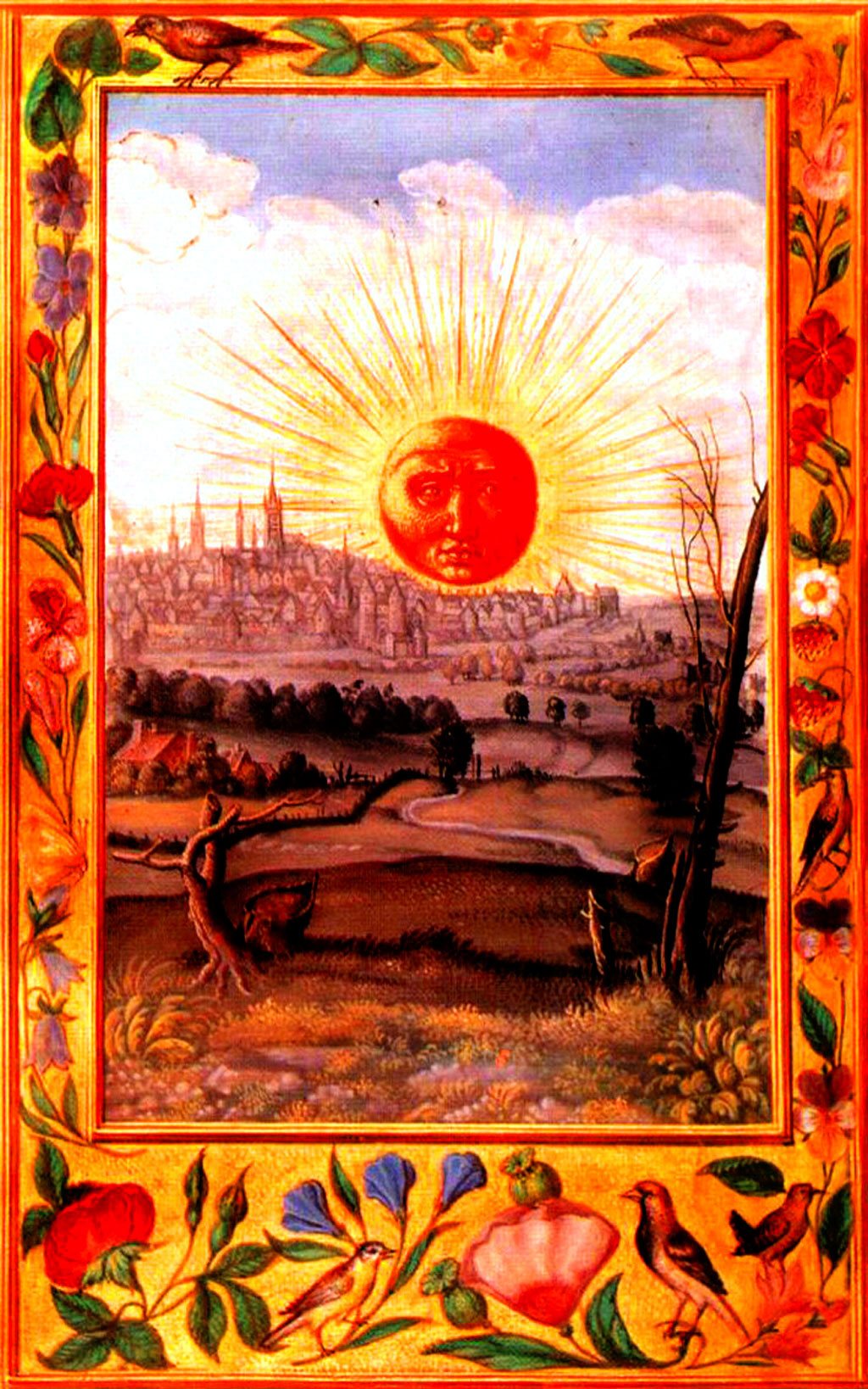
The correction, when it came, came from the laboratory as much as from the archive. Barbara Obrist (1982) showed that Jung's alchemy is an ahistorical unit assembled from texts of different centuries and treated as one timeless system. Lawrence Principe and William Newman (1998; 2001) traced the spiritual interpretation to its nineteenth-century occultist origin and stated their finding flatly: they find "no indication that the vast majority of alchemists were working on anything other than material substances toward material goals." Their evidence is experimental as well as textual: decode the cover-names in the notebooks of Starkey, Boyle, and Newton, and the texts yield laboratory procedures that can be repeated, with the results the texts predict (Alchemy Tried in the Fire, 2002). Mike Zuber's work (2021) refines the correction rather than reversing it: the spiritual reading is real, it begins around 1600, and it was always a narrow strand.
What the record supports, set out in order, is this. A pattern — a perfected substance that perfects what it touches — is reported at the Han court in 133 BCE, attached to gold vessels and long life. A craft of tincturing metals grows in Roman Egypt, and around 300 CE one of its writers calls the tincture, in a riddle he solves himself, a stone that is not a stone. Arabic writers of the ninth and tenth centuries build the elixir into a theory of metals. India builds a parallel mercury system, metal and body in one maxim, by the tenth and eleventh. The idea enters Latin on a February day in 1144 and gets its settled name — the philosophers' stone — in books of 1330 and 1332. For centuries after, men with furnaces, contracts, statutes, and notebooks chase it as a substance, and the most famous success story in the whole tradition turns out to have been printed in 1612 about a scribe who died in 1418. Around 1600 a second reading grows beside the first, in one German religious network, without displacing it. In 1850 that second reading is promoted, by two writers and then by Jung, into the claim that it was the only reading there ever was.
The stone was never found. The record of the search is one of the longest continuous documents in the history of experiment: workshop recipes that call their own products imitations, state trials that fail and are written down as failures, emperors poisoned by the medicine of long life, and a word for a wound-powder that travelled from Greek through Arabic into Latin as the name of the thing that would perfect the world. That record needs no antiquity invented for it. It is old enough, and strange enough, as it stands.
Works Cited
Atwood, Mary Anne. A Suggestive Inquiry into the Hermetic Mystery. 1850.
Ball, Philip. Alchemy: An Illustrated History of Elixirs, Experiments, and the Birth of Modern Science. Yale University Press, 2025.
Berthelot, Marcellin, and Charles-Émile Ruelle, eds. Collection des anciens alchimistes grecs. 1887–88.
Caley, Earle Radcliffe, trans. The Leyden and Stockholm Papyri: Greco-Egyptian Chemical Documents from the Early 4th Century AD. 1926; Oesper reprint, ed. William B. Jensen, 2008.
Escolano-Poveda, Marina. "Zosimos Aigyptiakos." ARYS 20 (2022): 77–134.
Forshaw, Peter J. Studies on Heinrich Khunrath and the spiritual-tradition question, incl. "Isn't Alchemy a Spiritual Tradition?"
Hitchcock, Ethan Allen. Remarks upon Alchemy and the Alchemists. 1855; enlarged edition 1857.
Ibn al-Nadīm. Kitāb al-Fihrist. 987.
Jung, C. G. Psychology and Alchemy. 1944. Collected Works vol. 12.
Kraus, Paul. Jābir ibn Ḥayyān: Contribution à l'histoire des idées scientifiques dans l'Islam. 1942–43.
Martelli, Matteo. The Four Books of Pseudo-Democritus. Ambix 60, suppl. 1 (2013).
Mertens, Michèle, ed. Les alchimistes grecs IV.1: Zosime de Panopolis, Mémoires authentiques. Les Belles Lettres, 1995.
Meulenbeld, G. Jan. A History of Indian Medical Literature. 1999–2002.
Needham, Joseph, Ho Ping-Yü, and Lu Gwei-Djen. Science and Civilisation in China, vol. 5, parts 2–3. 1974, 1976.
Newman, William R., ed. and trans. The Summa Perfectionis of Pseudo-Geber: A Critical Edition, Translation and Study. Brill, 1991.
Newman, William R. Newton the Alchemist. Princeton University Press, 2019.
Newman, William R., and Lawrence M. Principe. Alchemy Tried in the Fire: Starkey, Boyle, and the Fate of Helmontian Chymistry. University of Chicago Press, 2002.
Obrist, Barbara. Les débuts de l'imagerie alchimique (XIVe–XVe siècles). 1982.
Paušek-Baždar, Snježana. "The Nature and Role of the Philosophers' Stone in the Pretiosa Margarita Novella by Petrus Bonus." Prilozi za istraživanje hrvatske filozofske baštine 41/2 (2015): 325–342.
Pereira, Michela. The Alchemical Corpus Attributed to Raymond Lull. Warburg Institute, 1989; and "Projecting Perfection: Remarks on the Origin of the 'Alchemy of the Elixir,'" Micrologus XXIV.
Pereira, Michela, and Paolo Spaggiari, eds. Pseudo-Llull, Testamentum. 1999.
Pregadio, Fabrizio. Great Clarity: Daoism and Alchemy in Early Medieval China. Stanford University Press, 2006.
Pregadio, Fabrizio, ed. The Encyclopedia of Taoism. 2008.
Pregadio, Fabrizio. "Chinese Alchemy." Oxford Bibliographies in Chinese Studies, 2020.
Principe, Lawrence M. The Secrets of Alchemy. University of Chicago Press, 2013.
Principe, Lawrence M., and William R. Newman. "Some Problems with the Historiography of Alchemy." In Secrets of Nature: Astrology and Alchemy in Early Modern Europe, ed. Newman and Grafton. MIT Press, 2001.
Sivin, Nathan. Chinese Alchemy: Preliminary Studies. Harvard University Press, 1968.
Stavenhagen, Lee, ed. and trans. A Testament of Alchemy (the Morienus book). 1974.
Strohmaier, Gotthard. "Elixir, Alchemy and the Metamorphoses of Two Synonyms." Al-Qantara 37.2 (2016): 423–434.
Theisen, Wilfred. "John Dastin's Letter on the Philosopher's Stone." Ambix 33 (1986); and "The Letters of John Dastin," Ambix 55/2 (2008).
Weisser, Ursula, ed. Das "Buch über das Geheimnis der Schöpfung" von Pseudo-Apollonios von Tyana. 1980.
White, David Gordon. The Alchemical Body: Siddha Traditions in Medieval India. University of Chicago Press, 1996.
Wujastyk, Dagmar. "Perfect Medicine: Mercury in Sanskrit Medical Literature." Asian Medicine 8 (2013); and "Acts of Improvement." History of Science in South Asia 5.2 (2017).
Wujastyk, Dominik. "An Alchemical Ghost: The Rasaratnākara by Nāgārjuna." 2013.
Zosimos of Panopolis. On Virtue and the Authentic Memoirs, in Mertens (1995) and Berthelot & Ruelle (1887–88).
Zuber, Mike A. Spiritual Alchemy: From Jacob Boehme to Mary Anne Atwood. Oxford University Press, 2021.
Image credits
- Title page of Michael Maier, Atalanta Fugiens, Oppenheim, 1618. Public domain (Wikimedia Commons).
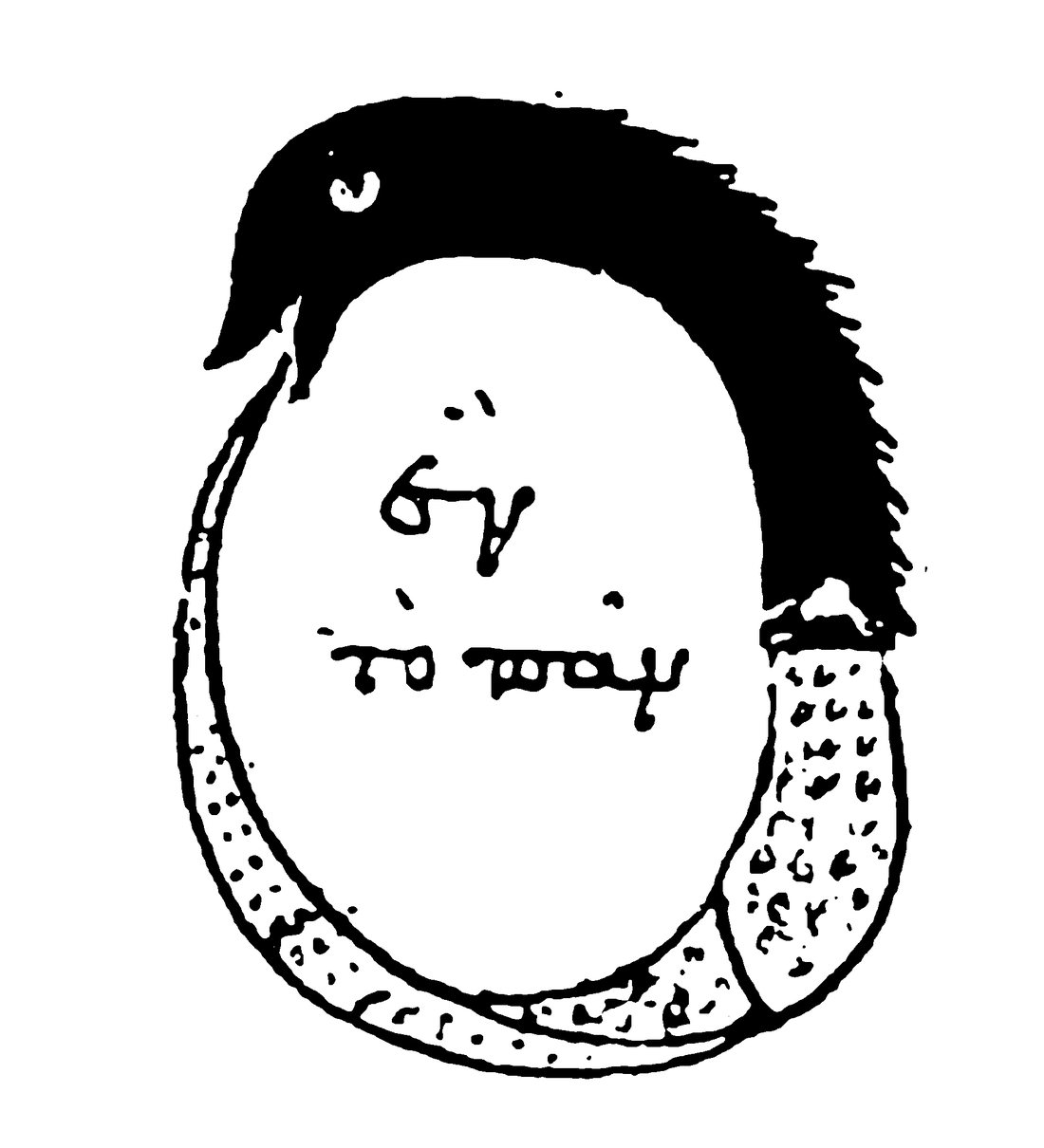
- Ouroboros of the Chrysopoeia of Cleopatra, Codex Marcianus graecus 299 tradition. Public domain (Wikimedia Commons).
- Emerald Tablet page, Johannes Petreius (ed.), De Alchemia, Nuremberg, 1541. Public domain (Wikimedia Commons).
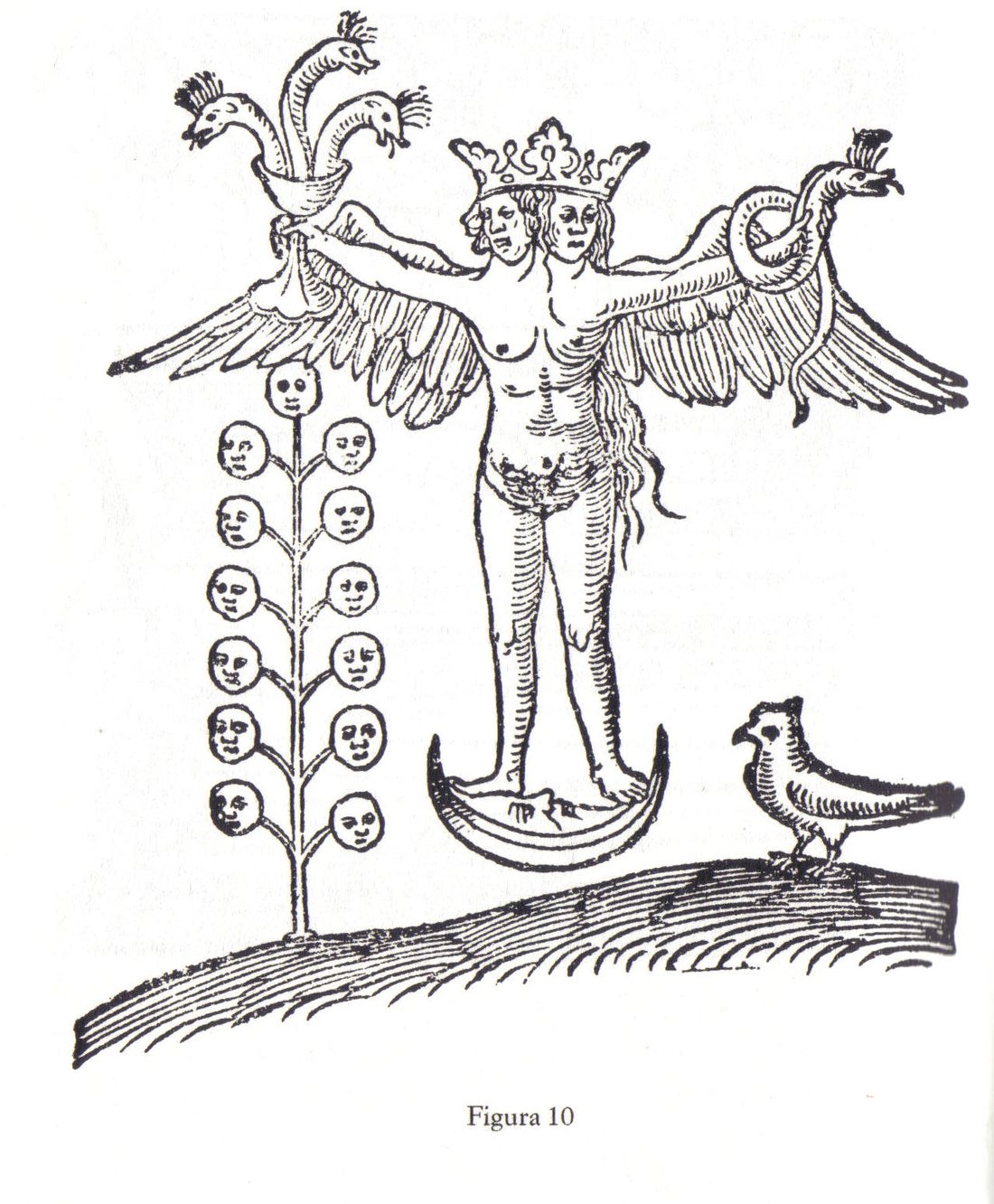
- The Rebis, Rosarium Philosophorum, Frankfurt, 1550. Public domain (Wikimedia Commons).
- Lambsprinck's dragon, Musaeum Hermeticum, Frankfurt, 1678, engraving by Matthäus Merian. Public domain (Wikimedia Commons).
- Khunrath's oratory-laboratory, Amphitheatrum Sapientiae Aeternae, 1609. Public domain (Wikimedia Commons).
- Splendor Solis, plate 22, 16th century. Public domain (Wikimedia Commons).
More antiquities research: Antiquities Research