The Paperwork of Meluhha
What the Indus script was for — and a theory of the language it wrote
The paper behind this article — "The Paperwork of Meluhha: What the Indus Script Was For — A State of the Evidence" — is deposited on Zenodo under my name, DOI 10.5281/zenodo.24018946. Every claim in it is graded. What follows is the same evidence in my own words, at the same grades. Nothing here goes past what the paper holds.
A stone the size of a matchbox
Start with one small object. It is a miniature tablet from Harappa, catalogued H-357, small enough to close your hand around, and it is written on three faces.
The first face carries a heading: three signs, standing at the head of the text the way a name stands at the head of a letter. That heading is not unique to this stone. It stands on thirty-one documents in the corpus, the commonest heading in the whole document layer.
The second face carries the tablet's quantity, and it carries it in the system's most fixed construction: the sign for a vessel, a cup, beside a numeral. Three strokes. Three.
The third face carries three dotted circles, and I will tell you plainly what I told the readers who saw this tablet when I posted it: we do not know what the circles are for. There is also a number painted on the stone — 1701 — and that one is not ancient at all. It is an excavator's number, painted on in modern times. Anyone who works with this material has to keep the two apart, the writing the carver cut and the writing the archaeologist added.
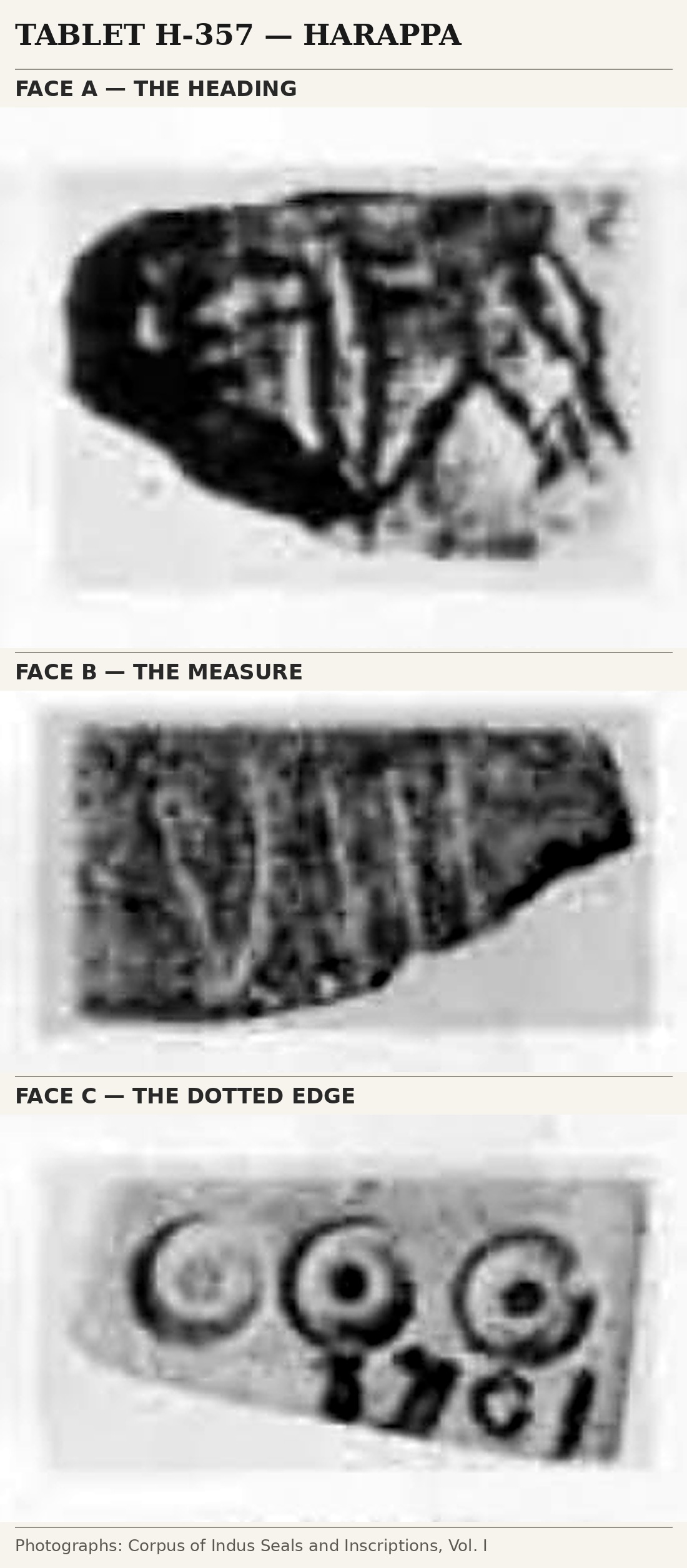
Here is what the tablet says, without a single sign being read aloud:
Consignment tag — issued under the Harappa heading. Three measures.
Sit with what is missing, because the missing parts are the finding. The heading's name cannot be read; nobody on earth can pronounce it. The commodity — what the three measures were measures of — is not written on the tablet, and it is not written anywhere else in this paperwork either, on any object, in any line. A civilisation ran a paperwork system for centuries and never once wrote down what the goods were. Whatever this writing was for, it was not for describing things. It was for certifying them.
Where this comes from
I came to the Indus Valley in 2011. The Dwarka investigations were the live argument then — S. R. Rao's marine excavations, the structures under the water off the Gujarat coast — and I went all the way down that hole. I left the subject and came back to it, left it and came back, for fifteen years. I am a writer, not a scientist. I would never call myself a scholar. The questions, the positions, and the theory below are mine, formed the slow way over that whole period, long before AI instruments entered any of it.
What the machines did in this campaign, they did under my direction: the corpus assembly, the counting, the plate reading, the verification. I brought everything to the table. AI helped me with the research. That division is stated in the paper's provenance note and I am stating it again here, because everything that follows depends on the reader knowing which parts are measurement, which parts are inference, and which parts are one man's theory. The paper keeps them apart; so will this article.
The paperwork
Begin with what carries the writing at all. Roughly eighty percent of everything inscribed in the Indus world belongs to one apparatus: seals, the clay sealings those seals were pressed into, and the tablet classes that imitate them. There is no archive. There is no ledger, no list, no letter, no document longer than seventeen signs on a face, anywhere, in any durable medium. The quantities of that economy were kept in its weights — a beautiful system, binary from 1 to 64 and then decimal up to 12,800, on a unit of about 0.87 grams, interoperable with the standards of Ur, Dilmun and Magan. The writing itself did something else. Its centre of mass is identification: whose this is, under whose authority it moves.
The documents — the part of the system that comes closest to talking about things — have a precise anatomy, and it is the same anatomy H-357 wears. A document is a heading and a satellite. The heading is the issuer's legend: free in form, drawn from the general stock of seal legends. Under the heading, on the second line or the second face, sits the satellite: a numeral and the cup sign, in a construction so fixed that the whole corpus holds only sixteen distinct spellings of it. The values run 1, 2, 3, 4 — never 5, in either edition we count in, at any scale we can reach. The satellite is struck exactly once per document — one exception in 181 carries it twice. And the two parts do not behave like two halves of a sentence. No single sign in the heading predicts the value. But the value does vary, document by document, under the same heading — which is the single most important mechanical fact in this article, so I will put it plainly: the quantity was filled in at the moment of use. The heading was the stamp. The number was the occasion.
The heading population tells the same story from the other side. Across the document layer there are 217 distinct headings. The commonest holds thirty-one documents. Four out of five headings occur exactly once. That is not what an administration looks like. That is what a crowd of issuers looks like — many parties, each certifying their own consignments under their own mark. For the headings as a class, the grade is formula: a construction filled from the common stock. For the lead heading alone — one fixed form, and across its thirty-one documents a skewed value profile: 3 twenty times, 4 nine times, 2 twice, and 1 never — two readings fit — a title, or an institution's mark — and no test we have separates them. They are stated unresolved.
Now the reading this system is usually given, and why it fails. The strongest published alternative reads the tablets as fiscal instruments — tax tokens, their numerals as rates, their texts as encoded tax content. It is serious work, stated at its strength in the paper. It fails on the objects. A tax token is a denomination: its value is fixed by its type, the way a coin's is. But under one repeated heading — the document class's most repeated document, a three-sign heading over "three measures," standing eighteen times — the same heading recurs over twenty-eight tablets cycling the values 3, 2 and 4. A denomination does not change its value from striking to striking. The fiscal reading also needs the texts to have been engraved in advance, encoding no per-occasion quantity — and the satellite, the one part that varies per occasion, is exactly the part that model needs to be fixed. And the content the reading requires is absent at every seat: no sign in either line of any document behaves as a commodity term, so the encoded fiscal content has nowhere to stand. The tax reading is dead. A softer trade-licence variant survives, strained, against the sealing evidence — no better than that.
The sealing evidence is the other published reading, and it survives contact. Daniele Frenez reads the clay sealings — lumps pressed over cords and container closures, broken where goods were opened — as records of local storeroom and container access: the sealing certifies a closure, breaks at the opening, and its fragments accumulate where the opening happened. That is the deposition pattern we measure independently. His work also corrected us: the famous dump of broken sealings at Lothal was glossed for years, including in our own earlier files, as the receiving end of a shipping lane; on his evidence it is the warehouse's own access records, and the paper prints the correction against ourselves.
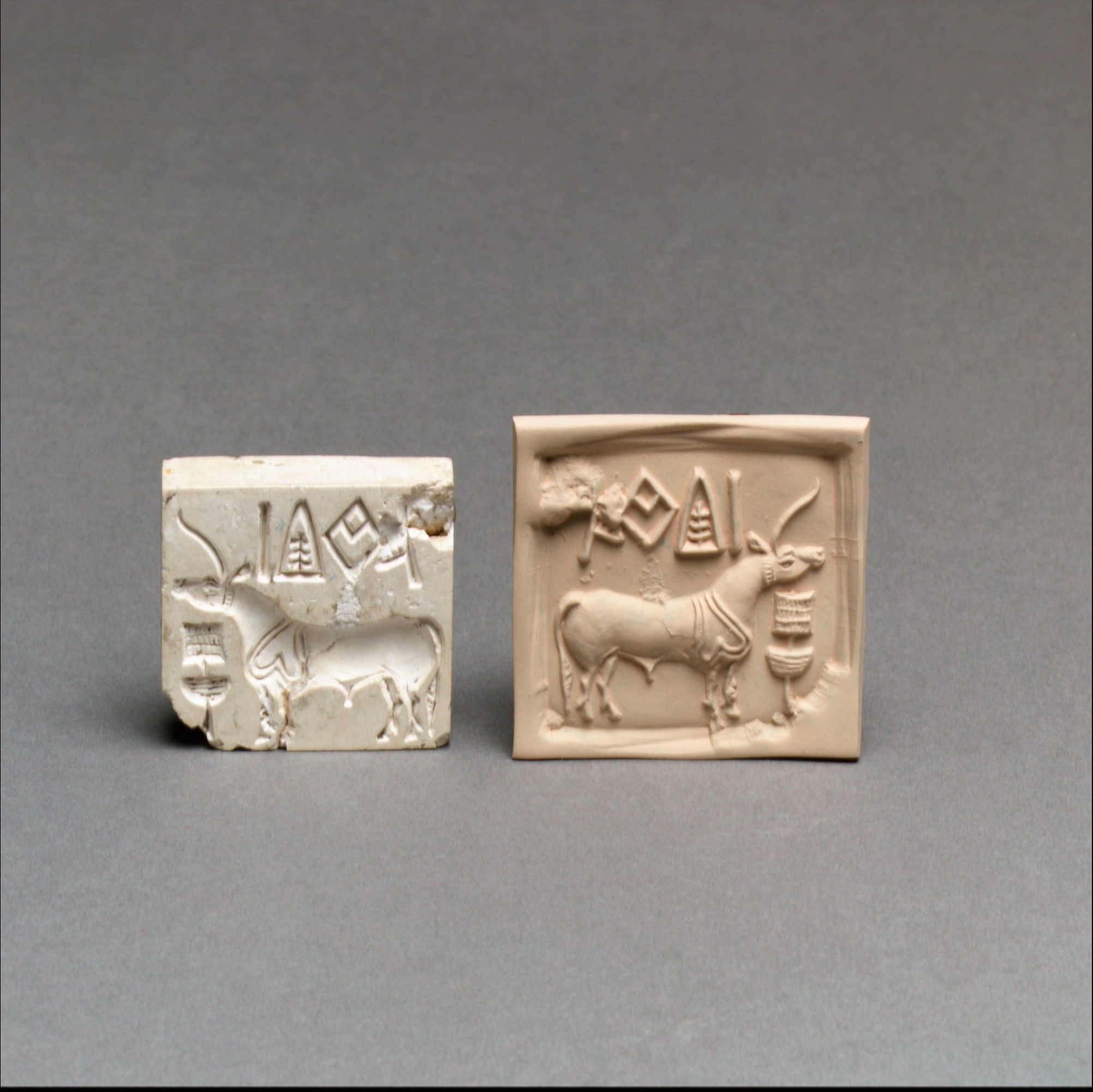
What is left standing, at the grade the objects support, is this: seals that travel with goods and are impressed at handling points; sealings that certify a consignment until they are broken; and miniature tablets — H-357's class — that keep the same document in durable form, the kept side of the transaction. A receipt, not a coin. The reading consignment tag is graded inferred in the paper, and inferred is the strongest grade a claim about function can earn in material like this. It is carried by the value-cycling evidence, not by resemblance.
And it is not accounting. The comparison that fixes the shape comes from next door: Proto-Elamite accounting, the Indus world's western contemporary, runs heading, entries, and a total. The Indus document matches the first two joints and is missing the third across every one of the 181 frame texts in the base edition. No totals. No dates. No goods words. This paperwork tags; it does not sum. Could the summing half have lived on perishable media — palm leaf, cloth, wood? It could. That possibility is printed in the paper in the same paragraph as the negative, priced as what it is: an argument from silence, unspent in everything that follows.
The district
Lay the documents on the map and the system turns into a place.
The frame document — heading over numeral-and-cup — is Harappa's instrument. In the base edition, 178 of its 181 texts are Harappa's, against two at Mohenjo-daro and one at Kalibangan. In the enlarged counts, 97.1 percent of frame objects are Harappa's. Inside Harappa, nearly two-thirds of multi-line texts carry the frame; at Mohenjo-daro, one in seventy does. And Harappa's documents have addresses. The lead heading's located copies stand twenty-four of twenty-nine in a single trench — F Trench I — and repeated documents cluster by trench across the city's tablet population. Batches were filed, or dropped, in named places, by whoever ran that desk.
Mohenjo-daro is the mirror image. It holds the largest legend corpus in both editions and bulk sealings — the carrier class was there in force — and it ran zero documents. Not few. Zero, in fifty-six distinct sealing texts and the whole tablet population, while the form itself was known there: two document-shaped texts stand on prestige objects at Mohenjo-daro, trace-level, the way a form is known in a place that does not run the practice. What Mohenjo-daro shares with Harappa is the legends: sixty-five distinct strings bridge the two cities, against sixteen for the next largest bridge anywhere. The legends travelled. The documents stayed home.
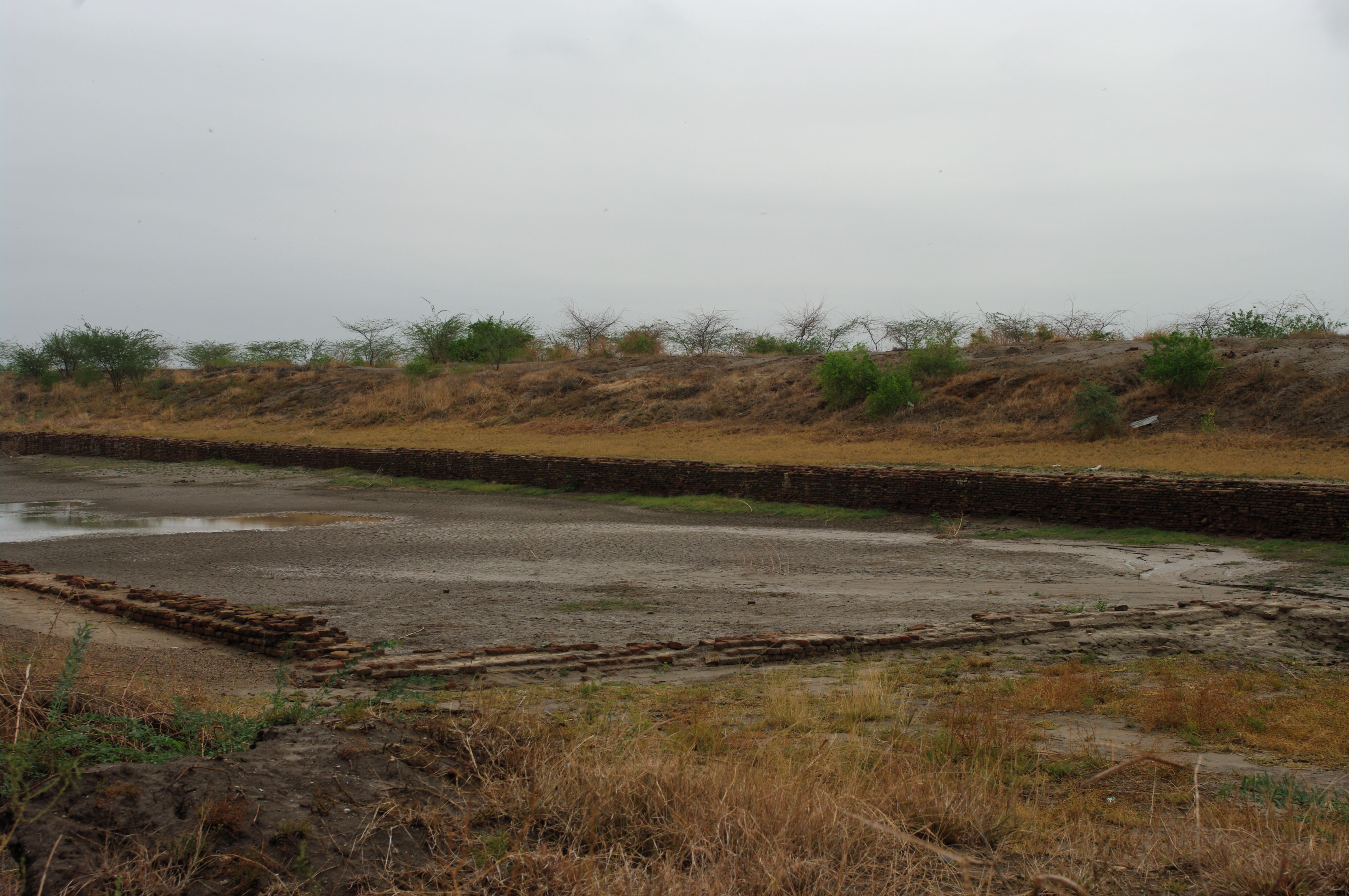
Lothal, the port, completes the shape. Sealings are 45.5 percent of its inscribed objects, the highest share at any site — the sealing practice ran there at full strength — and a position-blind scan of all 198 of its inscription lines finds zero frame pairs in any seat, against roughly twenty documents expected if Lothal's sealings carried them at Harappa's rate. Lothal ran the legends and none of the paperwork. Goods arrived sealed; the clay was broken and thrown in the dump Frenez studied; the tagging desk was never set up there.
Priced as a district: Harappa, checkpoint — supported, on documents and sealings together at scale at exactly one, upstream site. Mohenjo-daro, forwarder — supported on its textual legs. Lothal, endpoint — supported. And now the discipline, because the next sentence is the one other writers would skip: the flow direction between the great cities is unproven. The textual evidence is symmetric. My river model — goods gathered and certified at Harappa, forwarded through Mohenjo-daro, shipped from the coast — fits the priced pattern at every point where the pattern can be checked. It is carried in the paper as a model that fits. It is not a finding, and I am not going to dress it as one here.
Two more results fix what kind of thing travelled. First: the system travels; the texts do not. Seal legends repeat across sites at better than sixty percent; the clay tag class repeats at one in ten. The one Indus sealing found as far away as Umma, in Mesopotamia, carries a string that exists nowhere at home — which is what a practice looks like when people carry it in their hands rather than paperwork that circulates. Second: the destination is written all over the artefact, and nowhere in the text. Abroad, the artefact population transforms — round stamp seals, a Gulf workshop product, run at two-thirds of stamp seals overseas against under one percent at home; the cylinder seal, a format the Indus never used domestically, carries Indus content at Susa, Ur and Tell Asmar. The workshops adapted everything about the object to the foreign customer. And across forty genuine Indus legends found abroad, there is no destination element, no address, nothing written to the recipient at all. A modern exporter puts the adaptation in the label. This system put it entirely in the object's shape.
The cup
One sign in this system can be settled outright, and it happens to be the one the whole paperwork turns on: the cup, the vessel-measure of the frame.
Its identity had two lives to reconcile — inside the frame, where it is counted, and free inside ordinary legends, where it appears as one sign among others. We tested that identity the only way it can be tested: by photography, specimen by specimen. The corpus holds 126 objects carrying the free cup. Fifty-one have been reached by photograph — fifty on the published plates, and one, a round Indus seal in the Louvre from Susa, in museum photographs. Of the fifty-one, thirty-seven are legible, and every legible specimen is the same shape: a deep open trough, drawn now as a V, now as a U, varying freely between the two profiles, across moulded, incised and carved work, in both great cities and at Lothal, Kalibangan, Kot Diji and Banawali. Fourteen are unreadable at plate scale. Across the first photographic pass and a blind re-read of the reached population, captions stripped, forty shape reads stand — and all forty are troughs. No contrary vessel shape has been found in any specimen, or in any of the four drawn sign lists. One exception stands named in the paper, because a zero-contrary claim should never be quoted without it: a single tablet, M-1400, carries a solid filled vessel silhouette on a face whose transcription assigns it no cup. It is unassigned, and unresolved, and it is printed.
The cup is one grapheme, confirmed at the reached population. The seventy-five unreached specimens stand where the paper says they stand: most of them behind the plates of the third CISI volume, which is not among the sources available to us, and which I declined to purchase at the price asked. The wall is named, the count is stated, and the claim is scoped to what was actually seen.
Around the cup sits the only part of the script whose values are proven, and the proof is not a decipherment — it is closure, the strokes bridging between editions on plate-verified specimens until the counts lock. The stroke signs are the values 1 through 5. But watch what the practice does with its own notation. The share of each sign's tokens that stand in the counting seat climbs with the value — four percent for 1, twenty-two for 2, thirty-five for 3, seventy-three for 4 — and for 5 it is zero, out of thirty-six tokens, in every organised counting construction in either edition. The sign for 5 exists. It lives welded inside legends. It never counts anything. The notation's ceiling is 5; the practice's ceiling is 4. The favoured explanation, at strength, is construction, not survival: what the frame counted came in ones, twos, threes and fours — a four-unit measure. The alternative stands open beside it, as the paper keeps it: in their legend seats, the high stroke signs may be homographs rather than numerals. H-357's three strokes sit in the middle of that system, doing exactly the job they were cut for.
The signary as a whole was audited the same way, pair by pair, under the field's own rule: two signs are one only when their replacement patterns prove it, split by default. Across 377 candidate pairs: two firm merges, forty splits that hold, and — the real headline — 327 pairs the surviving corpus cannot decide at all. Where the drawn lists disagree decidably, they back their splits eighteen to five: if the lists err, they err by splitting. I expected more of the drawn series to collapse once the whole corpus was run at once. Some did. Most of the collapse lives where the texts are too rare to prove it. The count stands where it stood: an estimated 390 to 420 graphemes, behind roughly 710 attested written forms.
The people
Who were they, these clerks with their tags and troughs?
They were not newcomers in their own land. Farming at Mehrgarh, at the foot of the Bolan Pass, runs from about 7000 BCE. The zebu was domesticated in the greater Indus region. The genetics of the last decade gives the population a profile: the Indus Periphery cline, eleven individuals from the trade's far stations dated 3300 to 2000 BCE, a mixture formed in place between an early-split Iranian-farmer-related line and the subcontinent's own hunter-gatherer ancestry — with no Steppe ancestry in it, and none in the region's record before 2000 BCE. The one genome recovered from an Indus city itself, a woman from Rakhigarhi, sits on the same cline. The civilisation rose from this population, in this place, over four thousand years of village life. There is no takeover horizon in the material record. The invasion model of the cities' end — the old story of outsiders destroying them — is dead on every leg that can be measured: genes, burials, and the absence of any destruction horizon.
What came after the cities was a gradient, not a replacement. Steppe-related ancestry enters the northern record with a mixture clock dated around 1900 to 1500 BCE — after the fall, not before it — and tops out around thirty percent; the Indus Periphery profile remains the majority component of present-day South Asians. The two poles of the modern subcontinent's ancestry — ANI and ASI, in the literature's shorthand — both finish forming after the fall, not before it. They are the mixtures of the cities' descendants, not the cities' own population.
The dead carry the same verdict, at the scale of custom — and the burial map deserves its own passage, because it is a map. Across the Punjab and the Ghaggar plain, and down at Lothal on the Gujarat coast, the Mature cities buried their dead one way: a designated cemetery outside the settlement, the body extended on its back, head to the north, pottery furnished in quantity. One burial grammar, holding the full length of the civilisation wherever a cemetery population exists to show it.
Harappa's ground shows what time did to the grammar. R-37, the great Mature cemetery — 209 excavated burials, extended, head north, goods averaging eighteen pots a grave — is rich and standardised. Above it, Cemetery H runs poorer and mixed, and its upper stratum, dated about 1700 to 1300 BCE, holds 135 urn burials with some partial cremation. Read as replacement, that sequence would be an invasion in miniature. The bioarchaeology reads it the other way: dental biodistance shows no discontinuity across the transition — the same population, burying poorer and differently under post-urban stress. Local evolution, priced by the literature itself. The urn rite that ends the sequence has no external source to import it from: adult cremation with urn collection at population scale exists, in the core window, in exactly four places on the comparative map — Anatolia, the Fedorovo steppe, Swat in its second phase, and Harappa's upper stratum — and Swat's urn phase opens around 1400 BCE at the earliest, some three centuries after Harappa's, which removes the one corridor-adjacent candidate on sequence alone. The urns are local.
The grammar breaks at its two ends, in opposite directions. Mohenjo-daro, the type city of Sindh, has no formal cemetery at all — forty-one scattered individuals across the whole excavated city, the civilisation's largest city with its dead unaccounted for in any ground yet found. Dholavira built the opposite answer: thirty-six cemetery monuments, elaborate, standing over offering pits furnished with pottery, beads and gold — containing no human remains at all. One city lost or hid its dead; the other monumentalised their absence. And at Lothal, where the grammar holds in a small ground of twenty-one graves, three are double burials, each a man and a woman laid together. The excavator's era glossed those three as sati. That gloss is a period interpretation laid on the bones, not a finding from them, and it is filed here as exactly that.
One caveat rides on all of it: the formally buried at Harappa and Farmana were, on isotope evidence, almost entirely first-generation immigrants. The flourishing cities ran on newcomers. A city of incomers is the normal state of this civilisation, not a symptom of its end.
The fall itself is a braid with one load-bearing strand. The urban system — planned cities, the script, the standard weights, the seal-and-document apparatus — runs at full form from about 2600 to 1900 BCE and comes apart across the six centuries after. River failure is load-bearing: the Ghaggar-Hakra, the river the cities sat beside, was monsoon-fed, and its slow failure draws the abandonment map — in Cholistan the site count falls from 174 to 50, re-clustered on the one reach still fed. Monsoon weakening is load-bearing with it: the Kotla Dahar record steps abruptly around 4,100 years ago, on a long aridifying trend — the two are one water complex, the spine. Trade loss contributed: Ur, the great customer, fell in 2004 BCE, a century before the onset, and Marhashi, the corridor's middle land, leaves the record first, around 2004 to 2000 — the trade's last century ran on the sea leg alone. But Dilmun's entrepôt trade flourished through exactly those centuries, so part of the loss is the Indus supplier vanishing from a living market; trade loss as prime mover is dead. Disease and internal stress contributed as register and amplifier — the trauma and infection loads rise across the transition — and as causes they grade weak. No single blow killed these cities. The water went, the partner went, and over six centuries a civilisation became a countryside.
The god
One image dominates this civilisation's religious record, and it is the image most readers will know: the horned figure of seal M-304, seated heel-to-heel on a low throne, horns with a branch centrepiece, attended by elephant, tiger, rhinoceros and wild buffalo, with a pair of horned goat-antelope beneath the throne. In 1931 John Marshall identified him as a proto-Shiva — the yogic posture, the Lord of Animals, the three faces — and that identification has organised ninety years of discussion.
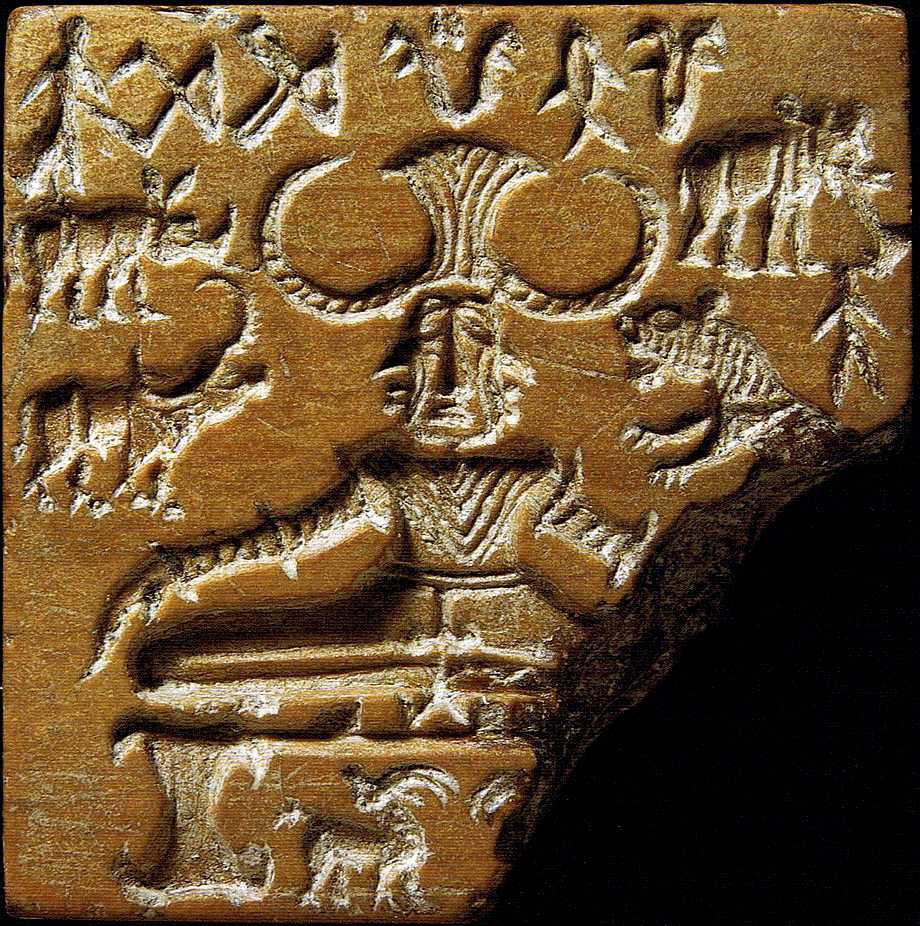
Priced as a package, it fails, and the components fail one by one. The three faces: no look at the carving sustains them, and no Indus artist ever carved three faces on a human head. The ithyphallic reading: the feature is the endpiece of a waistband, hanging in the identical place on seated figures nobody reads that way. The trident: a headdress centrepiece read toward a hand-weapon across two unattested millennia. The animal surround is real as carving and fails as argument — the Vedic word it is hung on names the domestic herd, and this court is wild. The posture survives, as what it is: a formal cultic seat. And the horns, the figure's most distinctive feature, argue against the claimed identity itself. In that world, horns are a divinity code. Shiva, in every period of his iconography, wears no horns.
So we stopped testing his supposed name and tested his composition instead. Reduced to a five-point profile — the heel-to-heel seat; horns worn as the head's own feature, not as crown tiers; a branch centrepiece; a court of wild beasts; mastery expressed without grasping, combat or killing — he was compared against thirty-one horned figures from seven cultures across 2,500 years. The full profile is matched nowhere. Mesopotamia's beast-lord is a different sentence altogether — a standing hero who grasps two beasts — and that figure demonstrably travelled into the Indus as a recognisable import, separately from M-304. The nearest full-profile match in all of ancient art is Cernunnos, and he is two thousand years too late and a continent away, and he grasps a torc and a serpent where the Indus figure grasps nothing. A parallel, independently invented. It measures how few ways there are to draw the one the beasts gather to.
Every animal of the court is local on the bone evidence, itemised: rhinoceros attested at Harappa itself, elephant at six sites, tiger, and wild buffalo caught in the middle of domestication — and the pair beneath the throne is goat-antelope kind, not deer. The figure watches the buffalo hunt; he does not kill. Ranked as a category, he is a god and not a king, and the margin is not close — the one horned king of the age, Naram-Sin, is horned as a god. And he is old. A painted motif from Kot Diji puts the horned figure at roughly 2800 to 2600 BCE, before the cities. His court is one hundred percent wild, on the seals of cities that ate about eighty percent domestic stock; a city-invented god would be attended from the byre. No temple for any Indus god has ever been identified, and that is normal for a wild god, whose cult lives at groves and springs and open-air altars. The reading the paper carries is the one the whole stack supports: their own god, an inherited god, the pantheon's senior figure, older than the cities that carved him best.
We went looking for his name where it should live if it lives anywhere — in the cult legends, the texts carved on cult objects, on the principle that people wrote honouring gods seriously and region-wide. The test set, built by device at the campaign's final coverage, holds 71 objects and 48 distinct strings of three or more signs. Forty of the forty-eight occur exactly once. The strings that do recur are label-shaped, whole-text only — issued designs, like the one standardised legend that stands on fourteen Mohenjo-daro copper tablets, an issued design paired with one figure class. No recurring cult legend is shaped the way a name is shaped. M-304's own legend occurs once. The verdict is counted and plain: what recurs on cult objects is issuance, not devotion. If the god's name is written anywhere in this corpus, it is written once, in the open field of an ordinary legend, unmarked as sacred — which is where names live in this system in any case.
The name
The people themselves have exactly one name in the ancient record, and it is not theirs. It is their customers'.
Meluhha, in cuneiform, names the land and the people from about 2350 to about 1760 BCE: 191 texts carrying the goods — carnelian, ivory, woods, a speckled dog, the black francolin the scribes glossed "the black one" — the boats, the courier office, an interpreter's office, held by a man named Shu-ilishu, whose own seal certifies that Meluhhan was a spoken language foreign to the Akkadian court.
And the goods deserve their own passage, because the trade was not an abstraction. What the home side made, it made at scale. Cotton is the Indus's own: fibres mineralised inside a copper bead from a sixth-millennium-BCE burial at Mehrgarh are the earliest cotton use known anywhere, a woven cotton fragment survives from Mohenjo-daro, and the cities clothed themselves from their own fields — whether the cloth itself was ever exported, no text says; Mesopotamia wore wool and linen. Shell was the heavyweight industry: whole settlements on the Gulf of Kachchh existed to work it, and chank bangles come out of burials and hoards from the coast to the Punjab, hundreds of kilometres from any sea — shell working at industrial scale, the civilisation's most widely distributed wild-harvested material. Carnelian came out of Gujarat's stone country and crossed with its origin written on it: the texts book Meluhhan carnelian, Meluhhan woods, Meluhhan birds by name. Ivory is the exception that shows how the archive worked. Ivory moved through that world in quantity, and its worked forms travelled the Gulf — but across every text the trawl covered, the number of direct bookings of ivory to Meluhha is zero. The paperwork names the last seller, or no seller at all. A raw tusk carries no signature. What crossed was forms. What never crossed was names — not the goods', and not the people's either; the thirteen renamed men below are the same fact wearing a human face. Thirteen Meluhhan men are named across five centuries, and every one of them is renamed in the host language. Not one securely Meluhhan personal name survives in its own phonetic shape. The archive renamed foreigners as a matter of course; the one candidate, Lu-sunzida, is claimed as a translation — a name whose meaning crossed over and whose sounds were lost in the translating. After about 1760 BCE the name goes silent for a millennium and is later re-posted onto Kush and Nubia. In one place it never moved: a hamlet at Guabba, in Sumer itself, still drawing its fat ration in 533 BCE under Cyrus — a village keeping the name twelve centuries after the trade that named it died.
No second tradition preserves them under a proper name, and that negative was earned at coverage. The entire surviving Bronze Age Elamite corpus — about fifty-eight texts — was trawled whole: no Meluhha, no Indus ethnonym, nothing. Egypt never named them at all. When Elamite finally names the Indus country, twelve centuries later, it does it in Persian dress — Hinduiš, off the river name Sindhu — a satrapy label, not a memory. In the Indian traditions the name survives, if it survives, degraded: mleccha, milakkha, generic words for foreigner and foreign noise from their first occurrences. The descent of mleccha from Meluhha is graded claimed, unusually strong, and contested: the consonant step holds exactly where it should, the vowel step is weak, and the Sanskrit ending is unexplained by any camp. What both rival scholarly camps agree on is worth more than their disagreement: the stem behind the name was a self-designation, something the Meluhhans called themselves, taken from living mouths by scribes who had no etymology for it. They are called, in the paper and here, what the ancient world called them — the people of Meluhha, the Meluhhans — because that is the name the record holds.
The theory
Everything above this line is measurement, inference, and priced alternatives. What follows is my theory. The paper fences it in its own section so no reader has to guess which sentences are which, and I am keeping the fence here.
The language of the Indus cities was the Indus people's own elder language — older than Proto-Dravidian as a distinct stage, present in the land since the farming world of Mehrgarh. It was not Dravidian's ancestor. It was not its cousin at any distance the record can price. And the resemblances between its residue and Dravidian run substantially the other way from the usual assumption: Dravidian received words from it. The matches the contact record actually holds are scattered and trade-flavoured because that is what a donor leaves in a trading partner's mouth — a measure word, a commodity name, a boat's name. The systematic resemblances are areal, the shared habits of a region, of the kind neighbouring languages exchange without kinship.
Three positions exhaust the field, and the paper grades all three with their costs printed. Ancestor — the Indus language as early Dravidian — stands live and strained. Deep cousin — a remote common ancestor — stands live and weakened. Both lean on the same prop: McAlpin's Elamo-Dravidian hypothesis and its 117 word pairs, which we priced item by item. Thirty-six hold at depth. Sixteen hold shallow. Sixty-five fail. And the thirty-six that hold are short action verbs — there is no body-part word among them, and no kin term. A depth instrument that returns only action verbs is not measuring depth. Unrelated elder — my position — stands as best fit at face value, with its cost printed in the same table: the only testable slots the record supplies are paperwork slots and a trade list, so the margin is measured inside a trade-shaped bias, and the paper records that instead of banking it.
The two word-lines show the method working. Sesame — Sumerian ili, Akkadian ellu, South Dravidian eḷ, the contact record's strongest single match, for a South Asian domesticate established in the Indus world by 2500 to 2000 BCE and spread west before 2000 — prices donation-in as the better direction: inheritance requires the Dravidian family to have lost the word in three branch groups while keeping it beside its own surviving doublet, while donation needs only the cheap post-urban window. The verdict stands contested overall, with its rivals priced standing, and I am not going to upgrade it in an article. And the cup word: Proto-Dravidian *kal-, "vessel," whose Tamil reflex kalam does the frame's exact job — a grain-capacity measure counted in the numeral-plus-measure idiom, "three kalam," the very sentence H-357 speaks in structure. It is the one candidate word we hold. Its direction is undecidable — it stands at the same depth whether it arrived by inheritance or by loan — and its grade is low: a play-candidate, its sound value weakened by the tests it was put through. The only observation that could decide it is a won sound value for the cup sign itself. That does not exist.
The theory carries its debts on its face. The name Me-luḫ-ḫa contains a velar fricative that Proto-Dravidian natively lacks; every Dravidian-shaped reading of the name inherits that debt unpaid, and the one account that could have carried it — Elamo-Dravidian, Elamite having the sound natively — is the account the audit closed. And not one Meluhhan sound survives anywhere: the theory, like every rival, is built without a single attested word of the language it describes. The one certain word-form in the corpus is a shape, not a sound — a unit that stands embedded in 116 distinct strings across seven sites, never as a whole text, behaving the way a name behaves. It has no pronunciation and no meaning. Its reading as a name-core is a leading interpretation. It is the strongest single object the hunt holds. It is not enough, and the paper says that too.
And the theory names its own executioner, because a theory that cannot lose is worth nothing. Its standing prediction is that matches keep arriving scattered and trade-flavoured, never as a core-vocabulary system. If a core-vocabulary system match ever appears — kin terms, body parts, basic verbs patterning together — it wounds this theory, and I will print the wound myself. What would promote any position in the table is named as precisely: a bilingual object, and we even know its shape — a round Gulf-workshop seal of about 2100 to 1900 BCE carrying the same owner's name in an Indus legend and in cuneiform or Linear Elamite, from the one workshop milieu documented filling its legend slots from three different scripts across its production and never two on one body. Or a won value for any sign. Or a third coronal series in the sign families, which is a prediction Dravidian makes and the elder line does not. None of it is in hand. Until one piece of it exists, the candidacy stands as graded.
A note on method
One passage on method, and only one, because the method is not the story — the findings are.
The research behind the paper is exhaustive, and it runs under specific protocols that do not bend for a good result. Every claim in the work carries a grade, printed with the claim, and a claim that cannot carry its grade does not proceed in its old form. Finished research in this programme passes through a calibration system built for exactly that purpose: 9 PHC, the 9-Point Hallucination Calibration — Nuvira Technologies' in-house system, run on its research projects as the audit the AI-assisted work has to survive before any of it is stated as ours. Nuvira is an AI laboratory and does not hide its instruments; the calibration exists so that no machine's invention reaches print wearing my name. How the protocols work internally is the working instrument of a decipherment still in progress, and it stays unpublished for the same reason the apparatus does.
The paper was attacked before it was published, by instruments instructed to kill its claims. It stands as published.
Where it stands
Proven translations: zero. No sign in the paper is given a sound. No string is given a defensible meaning. Two of our tests stand exactly where their floors left them — one unpowered, one parked — and their shortfalls are counted in the paper instead of smoothed over. The seventy-five unreached cups, the remaining prism carriers, and 1,375 inscriptions whose pictured devices stay unread stand behind the third CISI volume, behind a price I declined to pay; the record names the wall rather than pretending it is not there.
And the work continues. The next plate campaign is sized and queued. The corpus grows by routes that are named, not wished for. We are actively working on deciphering the rest of the language, and I make no claim about when that finishes — a decipherment announced on a schedule is a decipherment that has already started lying. This paper is what its subtitle says: a state of the evidence. The paperwork of a people who certified their goods and never wrote down what the goods were, who raised a god older than their cities and never wrote his name where it repeats, whose own name for themselves survives, if it survives anywhere, inside the word their neighbours' descendants came to use for foreign noise.
They were called the Meluhhans. What they called themselves is still in the stones, unread. We are going back for it.
The Paperwork of Meluhha: What the Indus Script Was For — A State of the Evidence, by Richard Vigslist — Zenodo, November 2026. DOI: 10.5281/zenodo.24018946 · CC BY 4.0. The working apparatus behind the paper is being prepared for release; no date is set. The decipherment work continues.
Image Credits
All photographs are real images of real objects and sites. No AI-generated or AI-altered imagery is used on this page.
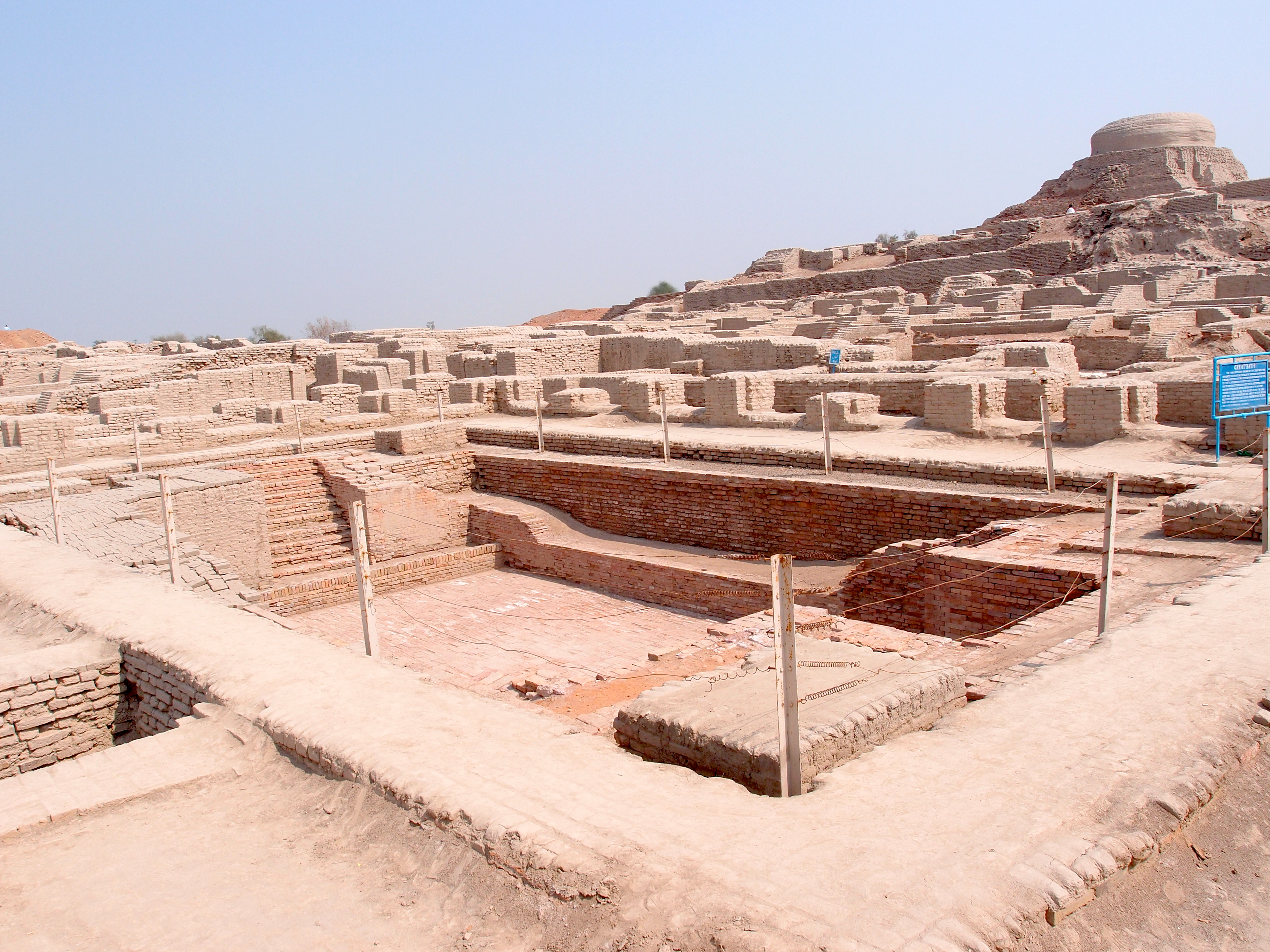
- Mohenjo-daro from the west (Great Bath and stupa mound) — photograph by Saqib Qayyum, CC BY-SA 3.0, via Wikimedia Commons.
- Tablet H-357 of Harappa — Seal H-357. Image: Nuvira Technologies research files.
- Indus stamp seal and modern impression: unicorn and incense burner — The Metropolitan Museum of Art, New York, Open Access (CC0).
- The dock basin at Lothal, Gujarat — photograph by Emmanuel DYAN, CC BY 2.0, via Wikimedia Commons.
- Seal M-304, Mohenjo-daro — public domain, via Wikimedia Commons.


More antiquities research: Antiquities Research