The Kaptara: The People the Ancient World Knew by Name
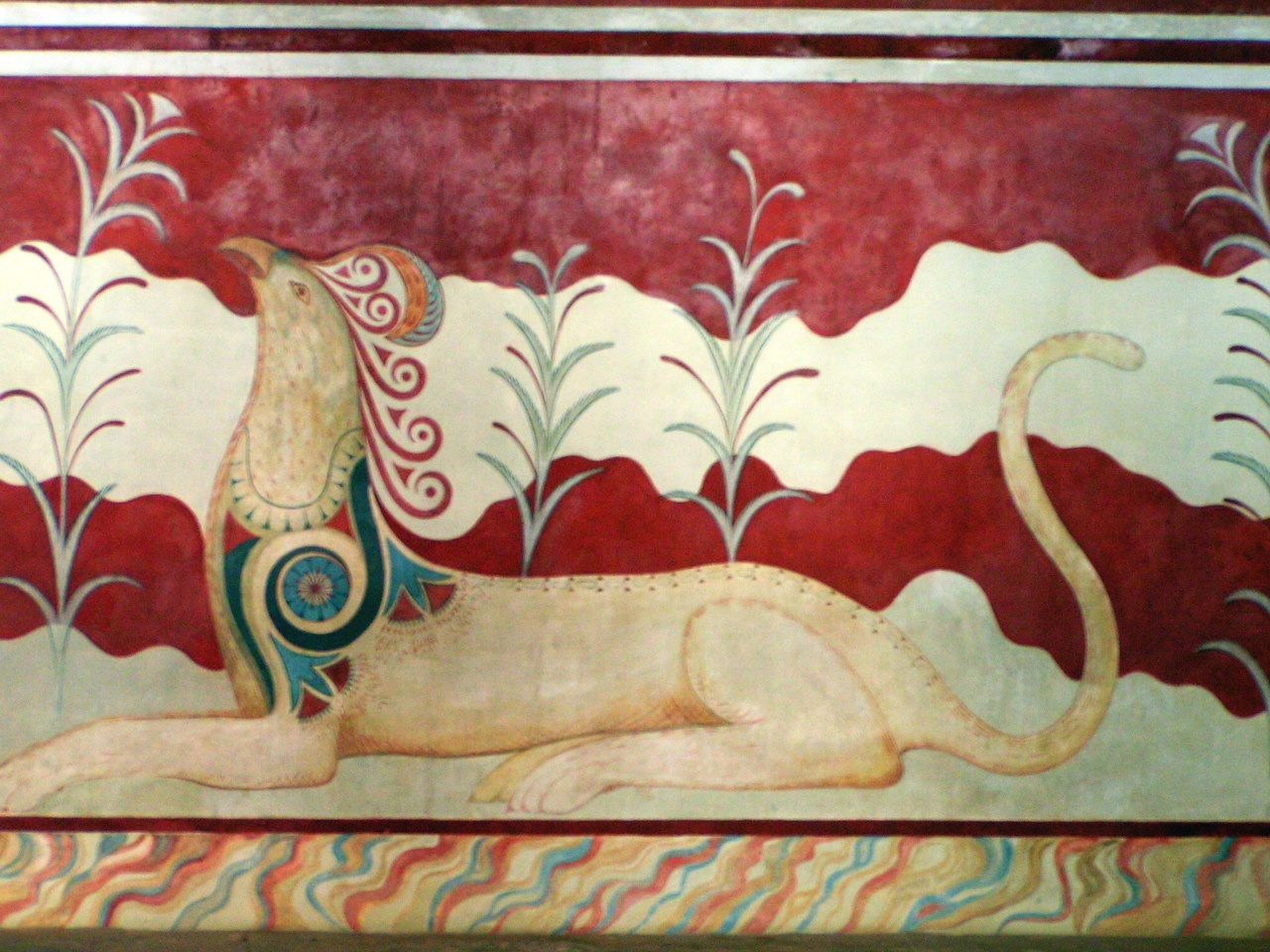
In 1900, Arthur Evans began digging at Knossos on Crete and gave the people he found there a name of his own making: Minoans, after Minos, the king of Greek legend who kept the Minotaur in a labyrinth. The name is an invention. No ancient text calls these people Minoans, because the ancient world already had a name for them, and used it for the better part of a thousand years.
They were a pre-Greek people. Their language was not Greek, their name was not Greek, and their gods were not Greek gods. Greek speakers were the newcomers to their island — traders first, then settlers, then, in the end, the clerks who wrote the island's books in a new language and a borrowed script. Everything in this article rests on records written while the Kaptara were still the Kaptara: the archives of Mari, the tomb walls and annals of Egypt, the texts of Ugarit, and the tablets, graves, and genes of Crete itself. Four archives, four languages, one people moving through all of them. Specialists built each piece of what follows, one archive at a time; what this article does is assemble the pieces into the single continuous picture they form when read together.
The Name
The oldest written form of the name comes from Mari, a kingdom on the middle Euphrates, in texts of the reign of Zimri-Lim, around 1765 BC. There the island and its people are Kaptara. Egypt wrote the same name Keftiu — kftjw in hieroglyphs — across three centuries of processions, annals, and town lists. Ugarit, the great port on the Syrian coast, wrote it kptr. The Hebrew Bible wrote it kptwr, Caphtor, and remembered it as a homeland: "the Caphtorim, who came from Caphtor, destroyed them and settled in their place" (Deuteronomy 2:23); Amos has the Philistines brought up "from Caphtor" as Israel was brought up from Egypt (Amos 9:7).
The Hebrew passages carry one more piece of information, in what they do not distinguish. The migration they remember — the Philistines' arrival on the Canaan coast — belongs to about 1175 BC, some three centuries after the palaces burned. The genetics separate the two peoples of the Aegean at the start: the islanders' ancestry ran to the first farmers of Anatolia, with a Caucasus-related strain and, in the palace-era samples, no steppe component at all; the mainlanders carried a steppe-related ancestry that reached roughly half of some northern populations (Lazaridis and colleagues, 2017; Clemente and colleagues, 2021). Close kin and near neighbours, the two peoples intermingled across the takeover centuries — the steppe signature enters Crete gradually, with no replacement at any horizon (Skourtanioti and colleagues, 2023) — and the Philistines sailed out of the blended, mainland-ruled Aegean that resulted. Kaptara-descended blood was in all likelihood among them. They were not the Kaptara. That civilisation — the unfortified towns, the collective graves, the island of Eileithyia — had dissolved into the new order generations before; what left the Aegean in 1175 was a diaspora of the world that had replaced it.
The consequence has run through every century of Bible reading since: the people of Caphtor enter the text as conquerors who destroyed the Avvim, and readers have pictured the island's people accordingly. The verses describe the land correctly, and the diaspora fairly. Of the island's own people — unfortified, unwarlike, absorbed by inches over centuries until their language left the ledgers and their name left the world's live records — the Bible, compiled from later tradition, says nothing at all. Egypt's scribes, dealing with the Aegean in real time, kept a live file, filing Keftiu and the successor land Tanaja side by side in the years when both existed. The Hebrew record kept the fossil. The name outlived the civilisation in both archives; only one of the two archives registered that the civilisation had ended.
Four writing systems, four different ears, one skeleton of sound: kap-…-t-r. Egyptian had no letter for the foreign p and rendered it f; the -jw at the end of the Egyptian form is Egyptian dressing, a plural ending. Strip the local spelling habits away and the same word stands in all four. What the word meant, nobody knows. It is a borrowed name in every language that carried it — no Akkadian, Egyptian, Ugaritic, or Hebrew etymology accounts for it. The name was already old, and already foreign, the first time any surviving scribe wrote it down.
At Mari the name had already worn smooth with use. The Akkadian dictionary records a denominal adjective, kaptaru, feminine kaptarītum — "Cretan" — attested at Mari and attached to gold and silver cups, bowls, weapons with inlaid eyes of gold and silver, pairs of thick-soled leather boots, a belt, and finally to a boat built a thousand kilometres up the trade road from the sea. Place-name adjectives for fine goods were a standing scribal habit — the same dictionary gives karkamišum, "of Carchemish," as a vessel designation — but Kaptara's is the only such adjective whose homeland lay across the sea. The name had detached from geography and become a grade of workmanship.
The People
People were living at Knossos by about 7000 BC. The founding settlement's radiocarbon dates (Douka and colleagues, 2017) may run a few centuries earlier than the mainland's first farming villages, and the founding package — emmer and einkorn wheat, barley, lentils, sheep, goats, pigs, cattle, none of them native to Crete — arrived by sea from Anatolia, carried by pioneer parties of perhaps a few hundred people. The genes agree with the spades. Mitochondrial DNA from 37 individuals in a Bronze Age ossuary on the Lassithi plateau (Hughey and colleagues, 2013) found 21 maternal lineages, none characteristic of African populations, the closest matches among Neolithic and modern Europeans — Evans's idea of an Egyptian or Libyan origin does not survive it. Genome-wide data (Lazaridis and colleagues, 2017) put the picture in full: the Kaptara drew at least three-quarters of their ancestry from the first farming populations of western Anatolia and the Aegean, most of the rest from populations related to those of the Caucasus and Iran.
On that stock the palaces rose, around 1900 BC — at Knossos, Phaistos, Malia, Zakros, and lesser centres — and they were built without fortifications. Crete's first writing, the Cretan Hieroglyphic script, and then, from about 1800 BC, Linear A, served an administration whose surviving records are accounts: deliveries, issues, personnel, offerings. The corpus that survives — 1,721 records from 53 sites — is the paperwork of a working economy, and one part of it can be read in full today. The numerals are decimal, and they are proven by closure: where a tablet's entries and its stated total both survive legibly, the entries sum to the total. On one tablet from Hagia Triada, three entries of 45½, 20½, and 29 are closed by the word KU-RO — the account's total word, its function proven by arithmetic — at 95. On another, two blocks of 156 and 136 are closed at 292. Across the corpus the totals are exact on complete accounts, with two named exceptions where the scribe himself slipped, by a unit and by three-quarters of a unit. The words around those numbers remain unread; the mathematics is not in doubt. We can audit a Kaptara ledger the way an auditor reads books in a language he cannot speak — every figure checked, every column's job known.
What the ledgers administered was a civilisation of makers. Its exports were skill embodied in objects: metal cups fine enough to be weighed and inventoried by foreign treasuries, inlaid weapons, leatherwork, cloth, painted walls. Its towns kept their wealth in store-rooms rather than behind walls. The picture the four archives give, independently and in agreement, is of a people whose standing in their world rested on what their hands could do.
The Web
Crete sat at the centre of a mapped exchange network of thirteen relationships documented on hard evidence: Egypt, Byblos, and Ugarit on the Levantine coast; the south Levantine ports; inland Syria; Mari and Mesopotamia at the end of the tin road; Cyprus; the Anatolian coast; mainland Greece; the Cyclades, Kythera, and the Dodecanese; the north Aegean fringe — with feedstock flowing in from farther still: Baltic amber, Afghan lapis, Central Asian tin, and copper whose earliest bulk ingots match ores in the South Urals and its later ones Cyprus's Apliki district. It was a peer network with chokepoints, not an empire with provinces, and the Kaptara's place in it was earned at a specific address.
That address was Ugarit. In the summer of 1765 BC, Zimri-Lim of Mari travelled to the coast, and his palace accounts record the disbursements (ARM 23 556): tin to the "Man of Crete," and a third of a mina of tin — 166 grams — to the interpreter, a man the text titles "the chief merchant of the Caphtorites in Ugarit." One man held both offices: he headed a resident community of Cretan merchants in the port, and he was its interpreter, a salaried officer of the interface between the Kaptara language and the languages of the coast, paid in strategic metal by a foreign crown. A second Mari account enters the Caphtorite on a royal tin list alongside the kings of Hazor and Qatna — at Ugarit, his dragoman paid beside him. No text calls the station a kārum, a trading colony, or records who appointed its chief. What the paperwork shows is an institution: staffed, titled, paid, and routine a generation after Cretan gold was already old stock in Mari's stores.
The respect the Kaptara held in this world is measurable, and it runs in several independent currencies at once. In Egypt, the goods their delegations carried were inw — the gift-exchange of peers, in the reading the evidence supports (Kilani; Matić) — whatever the tomb captions, written for Egyptian glory, said about submission. No Egyptian text claims a campaign, a garrison, a tax, or an official in Keftiu. When Thutmose III's Annals mention Keftiu at all — exactly once, in year 42, about 1437 BC — it is to record a silver jug "in the workmanship of Keftiu," delivered as a gift by the chief of Tanaja and weighed on receipt at 56 deben 3 kite — about 5.1 kilograms for the set. Egypt weighed the jug because the Aegean side of the counter kept no weights in its books; the weighing is the border between two bureaucracies, and the brand is what crossed it.
Ugarit's testimony is of a different order. Ugarit had a craftsman god, Kothar-wa-Khasis, smith and artificer of its pantheon, who builds palaces and fashions the weapons of the gods. In the epics his address is given, again and again, as a pun-paired double residence: kptr — Caphtor — and Memphis in Egypt (KTU 1.1, 1.3, 1.4). Caphtor is "the throne of his dwelling." A people's mythology places things where its imagination already believes they belong. When Ugarit imagined where divine craftsmanship lived, it pointed across the sea at this island — at the same workmanship Mari's scribes were grading with their adjective and Egypt's annals were weighing in silver. No Kaptara god travelled the other way; what travelled was the reputation of Kaptara hands, until a foreign pantheon housed its maker-god at their address.
Skill also travelled in person. Palaces at Tel Kabri in the 17th century BC, at Alalakh, at Qatna, and at Tell el-Dab'a in Egypt carry wall paintings in Aegean technique — true fresco, Aegean colour, Aegean motifs — executed on the spot. Painting technique cannot be copied from a finished object; the painters had to go. On the island itself, crushed-murex dye installations run at industrial scale from about 1800 BC, centuries before comparable Levantine installations: purple production is proven on Crete.
Five centuries after Zimri-Lim's journey, the Ugarit run was still a franchise worth a king's favour. A royal decree of Ammishtamru II exempts Ugarit's merchant prince Sinaranu, son of Siginu, on his ships' return from Caphtor: "exempt from duty; his grain(?), his beer, his oil shall not enter the palace" (Strange, 1980; the dedicated study is Heltzer, 1988). The palace waived its in-kind levy on every Caphtor voyage. What his ships loaded at Caphtor, no surviving text itemises — the record gives the tax, not the freight.
One fact runs through all of it, and it is the strangest in the record. Across Mari's 37 Kaptara entries, Ugarit's archives in two scripts, and Egypt's annals, tomb registers, and town lists, no Kaptara individual is ever named. The Kaptara appear as a land, a people, an office, an adjective — never as a person. The world's paperwork preserved their name for their island and their work. It did not preserve one of theirs.
The Boat
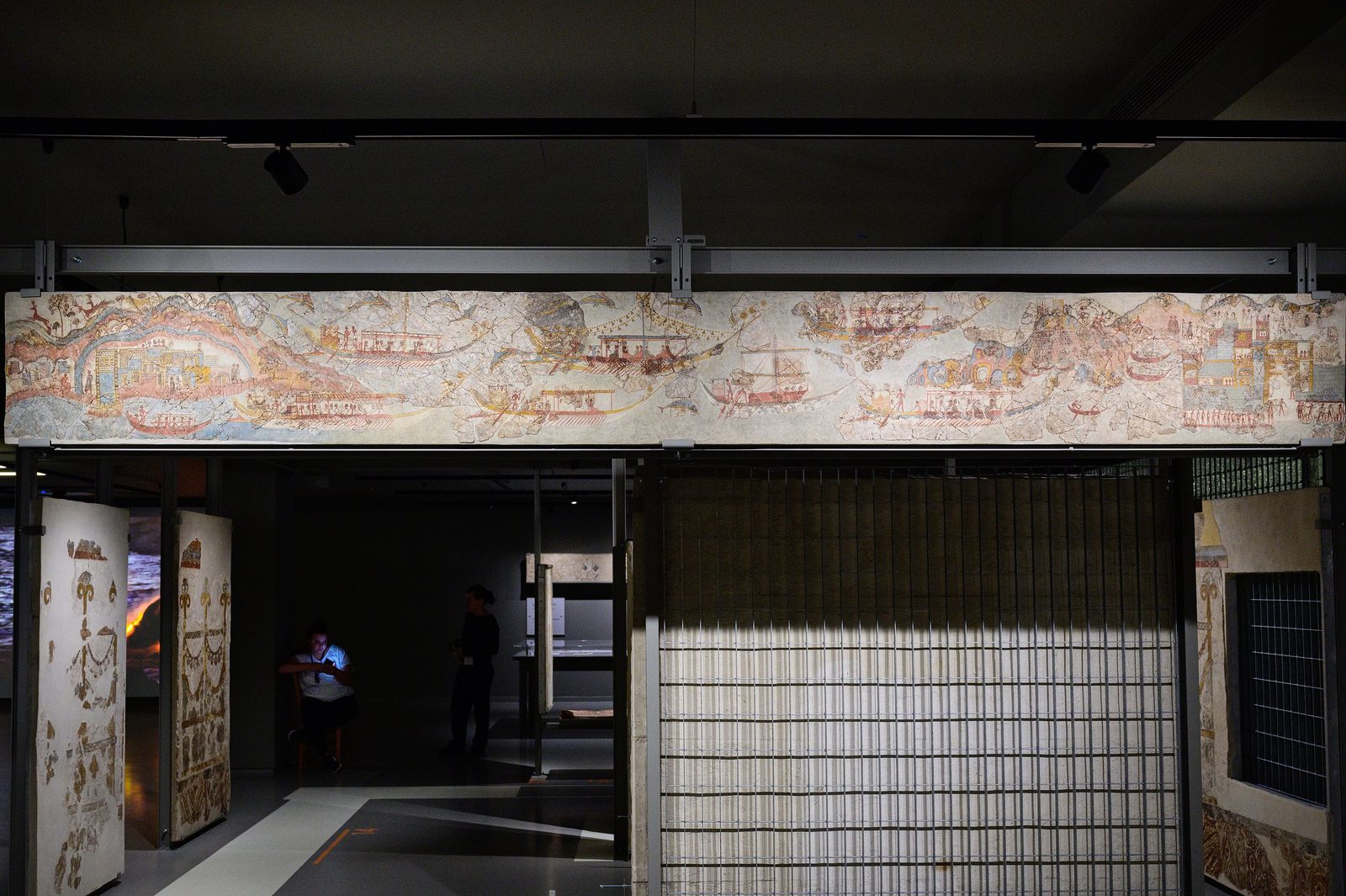
In 1765 BC Zimri-Lim came home from the coast. He had spent a month at Ugarit, where Cretan ships lay in the harbour of Mahadou — hulls intricately decorated, large cabins amidships hung with Aegean-patterned textiles, and at the stern the ikria, screened structures of hide that the Akrotiri fresco also preserves. Soon after his return, Mari's chief of stores, Mukannishum, sealed a receipt (M.10374): 20 minas — 10 kilograms — of lapis lazuli, received from the leading merchant Iddiyatum, "when they made the small Cretan boat."
Lapis came from one place on earth, Badakhshan in Afghanistan, at the far end of the same road system that brought Mari its tin. Palace G at Ebla's destruction level held about 22 kilograms of unworked lapis — a great palace's entire raw stock was roughly twice what Mari spent dressing one small boat. The boat's decoration outweighed the largest Cretan treasure-set in Mari's stores — six gold cups of the previous reign, 1.33 kilograms — seven times over, and weighed sixty times the interpreter's fee that had bought the king his conversations at Ugarit.
The boat was built at Mari, by Mari's own palace workshops. No Cretan boatwright, ship, or crew is attested at Mari in any text — the palace's craftsmen worked from a harbour visit, a king's memory, and whatever Cretan goods lay in the stores to copy from. And they copied in the material of their own world: Aegean boat adornment itself used faience and artificial blue, because real lapis was too far-travelled for the islanders to spend on hulls. The inland copy out-spent the original in the one material the original's makers could not afford to use that way. The receipt assigns the boat no purpose, and the paperwork supports one reading above the others: a showpiece, the harbour wonder of Ugarit rebuilt on the Euphrates as a trophy of the journey. No text says it ever carried anything. It did not have to. It was the cargo.
The Goddess
Of the Kaptara's own religion, their unread tablets presumably speak constantly, in sign-groups that cannot yet be told from ration lists. What survives in writing survives because foreign scribes wrote it down, and one name survives whole — document, place, and function together.
At Amnisos, the harbour town of Knossos, a cave sanctuary faces the sea. It was in cult use from the Neolithic period through the Classical age, its focus a stalagmite that drew votives across that whole span. The cave belonged to Eileithyia, goddess of childbirth. Her name has no Greek etymology and is classed as pre-Greek: it is the island's name for her, not a Greek coinage. Greek tradition itself kept her Cretan — the Odyssey (19.188) still knows "the cave of Eileithyia" at Amnisos as a landmark, and Pausanias reports the Cretan claim that she was born there. Her function matches the island's older cult record of anatomical votives — models of limbs and bodies, with a marked birth-related cluster at the peak sanctuary of Petsophas — carried into caves and up mountains for centuries.
Then the island changed hands, and the new administration went on paying her. The Greek-language tablets of Knossos record, in the palace's own accounts (KN Gg 705): "Amnisos: one jar of honey to Eileithyia, one jar of honey to all the gods." She is the only named recipient at the place, paid on the same line as the entire collective pantheon. Three further tablets (KN Od(2) 714 to 716) record offerings of wool to her — read by Killen as women weavers' thanks-offerings for safe delivery: the palace's own textile workforce, her congregation. The new regime paying the old goddess is not an inference from pottery styles. It is a budget line.
The same offering lists preserve one more figure, at a scale that states her rank in the palace's own arithmetic. KN Gg 702 gives one amphora of honey "to all the gods," and one amphora "to the Mistress of the Labyrinth" — her portion equals the whole pantheon's combined. The title is Greek, a potnia, a mistress; the seat is Cretan, built on the substrate word labyrinthos; the name underneath was not written. A role survived the takeover at the highest level of payment, and the name that belonged to it did not. A third name is written down a thousand years after the palaces, graded here at the strength the evidence carries — a survival-candidate: Britomartis, of whom Solinus states plainly that the name is Cretan, not Greek, and Hesychius's lexicon glosses the Cretan word britý as "sweet." The Greeks themselves flagged her as the island's, not theirs.
The Long Takeover
The genetics describe the beginning and the middle of the end. On the mainland, a steppe-related ancestry component arrived in northern Greece around 2600 to 2000 BC, reaching roughly half the ancestry of some populations (Clemente and colleagues, 2021). On Crete the same component appears gradually across the 17th to 12th centuries BC, tracking mainland influence, with no population replacement at any sampled horizon (Skourtanioti and colleagues, 2023). The two peoples were close kin to begin with — both mostly descended from the same Anatolian farming stock — and they mixed over centuries before anything burned.
Egypt's files register the change of regime in something close to real time, because Egypt's conservative scribal system updated only when current traffic forced it to. In the tomb of the vizier Rekhmire (TT 100), sixteen Aegean envoys painted in Cretan loincloths had every loincloth erased and a patterned kilt painted over it — the repaint carries a terminus of year 33 of Thutmose III, about 1447 BC. In the Annals, the single Keftiu mention of about 1437 BC already shows the successor people, Tanaja, delivering goods "in the workmanship of Keftiu": the brand in new hands. A generation later, Amenhotep III's great name-list at Kom el-Hetan files Keftiu and Tanaja as separate lands side by side, and spells the island's towns in Egyptian: Knossos, Amnisos — written twice — Phaistos, Kydonia, Lyktos.
Around 1450 BC the palaces burned — all of them except one. The horizon has signatures no natural agent produces: burning aimed preferentially at palaces, villas, and record centres while settlements around them were spared; at several sites, pre-attack emergency measures — access blocked, water and livestock protected, valuables hidden, the behaviour of people expecting human danger (Driessen). At Zakros the palace was burned and never reoccupied, its six oxhide ingots and Syrian tusks left in place for three thousand years; at Hagia Triada, nineteen ingots sat in the Royal Villa while the archive baked. At Knossos the town burned and the palace did not. No environmental calamity stands in the window: no drought in the pollen and core record for the 15th century BC, no famine text, no plague attestation until a century later; the Thera eruption, on every defended dating, precedes the fires by two to three generations, and the wave-damaged coast towns had been rebuilt and had then peaked — the years before 1450 are the island's settlement maximum. Within a generation, the burial record flips: fifteen centuries of collective tholos and ossuary burial give way, around Knossos, to single warrior graves with swords, spearheads, and bronze vessels.
The island's own order had never been built for war. The palaces stood unfortified — no walls, no citadel — where the mainland ringed its own seats in fortress masonry. For fifteen centuries the Kaptara buried their dead collectively, held in common in tholos and ossuary; the weapon-bearing single grave is a mainland form, and it appears on Crete only with the takeover generation.
Two scholarly readings of this horizon stand in the literature. The older one reads it as invasion: a mainland conquest, the palaces stormed and burned by an arriving army. A second reads it as internal collapse — revolt or breakdown within Cretan society, with mainlanders filling a vacuum afterward. The reading argued here — Richard Vigslist's hypothesis — is a third: not raids and not a conquest landing, but a slow takeover from inside. Migration and intermarriage across centuries put a mainland population and language progressively further into the island's life; the administration was learned by working it — Linear B was adapted from Linear A on Crete itself, plausibly by Kaptara scribes, and the earliest Greek deposit at Knossos is already an inventory of chariots, corslets, and horses run through the island's own office practice. Then the language of the ledgers was swapped while everything the ledgers ran continued: the same places, the same ration grammar and target system, the same flocks on the same hills. The fires of about 1450 were real, and there was turmoil in them; their pattern — nodes burned, wealth abandoned rather than looted at the richest sites, the one working palace kept and reopened, no massacre layer anywhere — reads as the violent replacement of a ruling layer, not the destruction of a people. A civilisation that never built for war had nothing to resist with when the long takeover reached its hard hour; their peaceful ways were, in the end, their downfall. The new regime's own books show continuity under a changed command: some 100,000 sheep under palace control at Knossos, an expected wool yield of about 52,000 kilograms a year, about 1,000 women textile specialists in graded trades, saffron collection tightened under named supervisors. The collectors who owned the flocks carry mostly Greek names; the shepherds who ran them carry mostly Cretan ones (Ilievski, 1992). Among the servile women of the ration lists, Cretan names outnumber Greek six to one (Baumbach, 1987). The ruling layer was replaced. The workforce, the system, and the gods were kept — and Eileithyia of Amnisos went on being paid out of the Greek palace's stores.
The people survived their civilisation. What ended was their rule, their language of record, and their self-governed way of life; the people lived on — as the island's workforce, its farmers, shepherds, and worshippers, their names still filling the lower ranks of the Greek tablets. Their world ended; they did not. In east Crete, a language written in Greek letters — Eteocretan, six inscriptions and 422 letters at Praisos and Dreros — was still being carved in the 200s BC, in the towns where the Odyssey already placed the Eteocretans, the "true Cretans," among the island's five peoples; whether it descends from the language of the tablets is the standard hypothesis and remains unproven, since not one of its words carries a secure meaning. At Kato Syme, a mountain sanctuary shows continuous use from the Middle Bronze Age into Roman times — the only Greek cult site of its kind never to go dark. The Kaptara endurance is in the genes, the graves, the payroll, and the stones.
The Name Restored
What remains of the Kaptara is an unread language whose accounts we can audit to the last half-unit; a fresco tradition that decorated palaces in Egypt, the Levant, and inland Syria; a brand that two royal courts paid for and a third civilisation's mythology housed in its heaven; and a name that four literate civilisations borrowed, none of them coined, and all of them spelled the same way underneath their scripts. The modern world renamed these people from a myth about a king and a bull. The ancient world — the world that traded with them, weighed their silver, copied their boats, and housed its craftsman god at their address — knew what they were called.
They were the Kaptara. This article's purpose is to give them back the name.
Author's Note
The research behind this article was a full pass, not a sampling. The complete surviving Linear A corpus — 1,721 records, 3,915 lines, 6,427 word groups — was audited sign by sign and its arithmetic re-run in full; the archives of Mari, Ugarit, and Egypt and the Greek tablets of Knossos were read against each other and against the graves and the genetic record; every claim in these pages was priced against the primary record before it was allowed to stand. The language of the Kaptara was not deciphered in that work, and nothing here pretends otherwise. It stands decipherable the day the evidence for it turns up — a bilingual text, a harbour archive, a longer corpus. Until then, the name, the ledgers, and the record of what the ancient world thought of these people are what can be given back, and they are given back here. The author writes about cultures to honor them. These people are gone, and this article exists so they are met on their own name and their own terms.
Bibliography
- Amos, Deuteronomy, Genesis, Jeremiah — Hebrew Bible, Caphtor passages (Gen 10:14; Deut 2:23; Jer 47:4; Amos 9:7).
- Bardet, G., et al. Archives Royales de Mari XXIII (1984) — ARM 23 556.
- Baumbach, L. (1987), on the name ratios of the Knossos As and Ap tablets, Acta Classica 30.
- Black, J., George, A., Postgate, N. A Concise Dictionary of Akkadian (1999), s.v. kaptaru.
- Bruins, H., MacGillivray, J., Synolakis, C., et al. (2008), "Geoarchaeological tsunami deposits at Palaikastro (Crete)," Journal of Archaeological Science 35.
- Clemente, F., et al. (2021), "The genomic history of the Aegean palatial civilizations," Cell 184.
- Douka, K., et al. (2017), on the direct radiocarbon dating of Neolithic Knossos.
- Driessen, J. (2002), "Towards an archaeology of crisis," in Torrence & Grattan (eds), Natural Disasters and Culture Change; Driessen, J. & Macdonald, C. (1997), The Troubled Island.
- Foster, K. P. (2018), "Mari and the Minoans," Groniek 217: 343–362.
- Guichard, M. (1993), "Flotte crétoise sur l'Euphrate?", NABU 1993/2: 44–45 (M.10374).
- Haider, P. (2001), on the Keftiu spells of the London Medical Papyrus; Helck, W. (1995), on the foreign words of the London Medical Papyrus.
- Heltzer, M. (1988), "Sinaranu, Son of Siginu, and the Trade Relations Between Ugarit and Crete," Minos n.s. 23: 7–13.
- Herodotus, Histories 1.171–173; 7.169–171.
- Homer, Odyssey 19.188.
- Hughey, J., et al. (2013), "A European population in Minoan Bronze Age Crete," Nature Communications 4: 1861.
- Ilievski, P. (1992), on the names of the Knossos collectors and shepherds.
- Kilani, M. (2022), on the Annals of Thutmose III and the Keftiu-workmanship jug; (2023), "Group Writing," UCLA Encyclopedia of Egyptology.
- Killen, J. (1964), "The wool industry of Crete in the Late Bronze Age," Annual of the British School at Athens 59.
- Lazaridis, I., et al. (2017), "Genetic origins of the Minoans and Mycenaeans," Nature 548.
- Palaima, T. (2010), on the scribes of Linear B, in Duhoux & Morpurgo Davies (eds), A Companion to Linear B.
- Skourtanioti, E., et al. (2023), "Ancient DNA reveals admixture history and endogamy in the prehistoric Aegean," Nature Ecology & Evolution 7.
- Strange, J. (1980), Caphtor/Keftiu: A New Investigation.
- Thucydides, History 1.4.
- Wachsmann, S. (1998), Seagoing Ships and Seamanship in the Bronze Age Levant, ch. 6.
- Wreszinski, W. (1912), Der Londoner medizinische Papyrus.
Image Credits
All photographs are real images of real objects and sites, sourced from Wikimedia Commons. No AI-generated or AI-altered imagery is used on this page.
- Throne Room fresco (griffins), Palace of Knossos — photograph by Paginazero, CC BY-SA 3.0, via Wikimedia Commons.
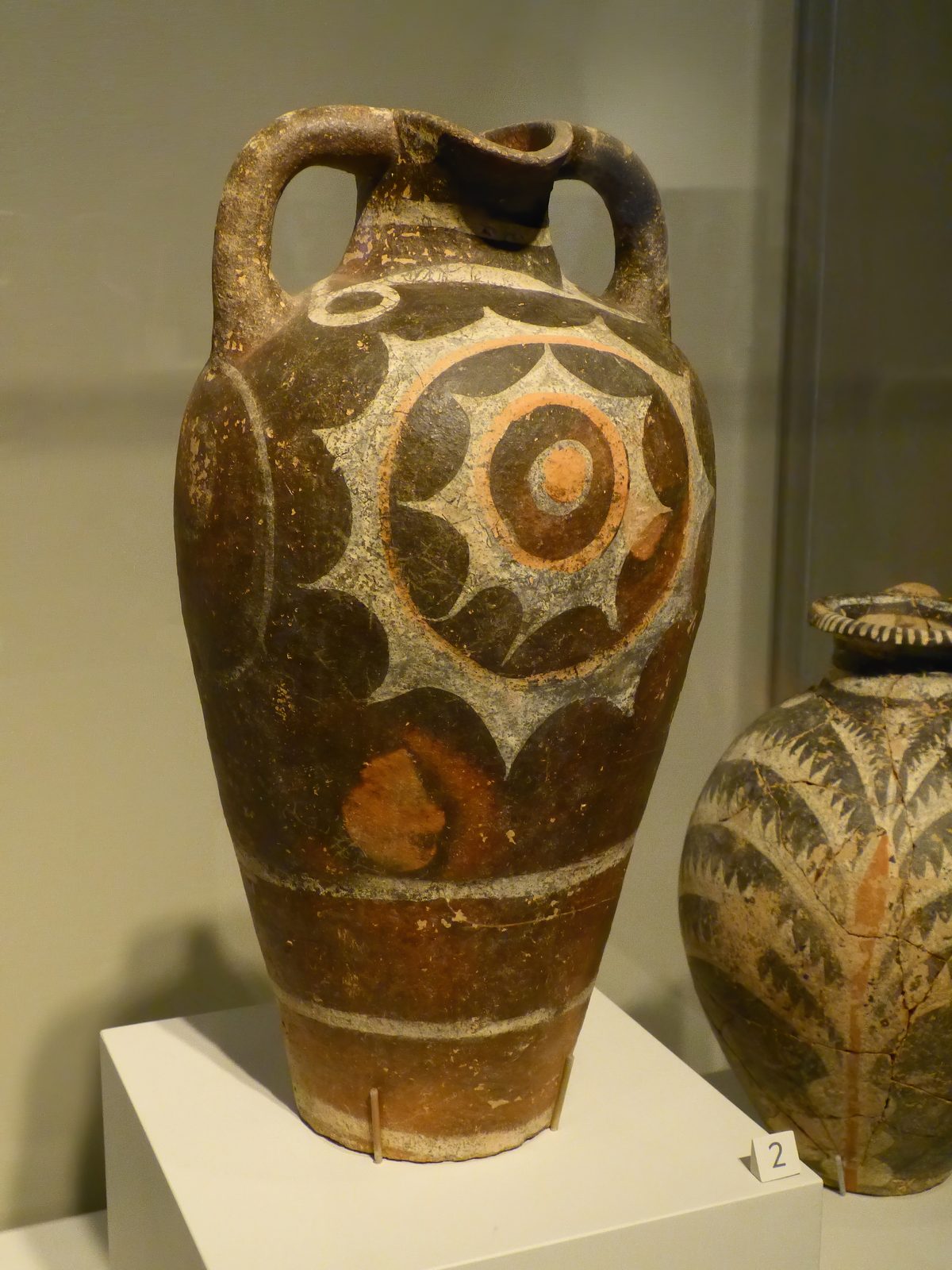
- Kamares ware amphora with spout, from the palace at Phaistos, 1750–1700 BC. Archaeological Museum of Heraklion — photograph by Mary Harrsch, CC BY-SA 4.0, via Wikimedia Commons.
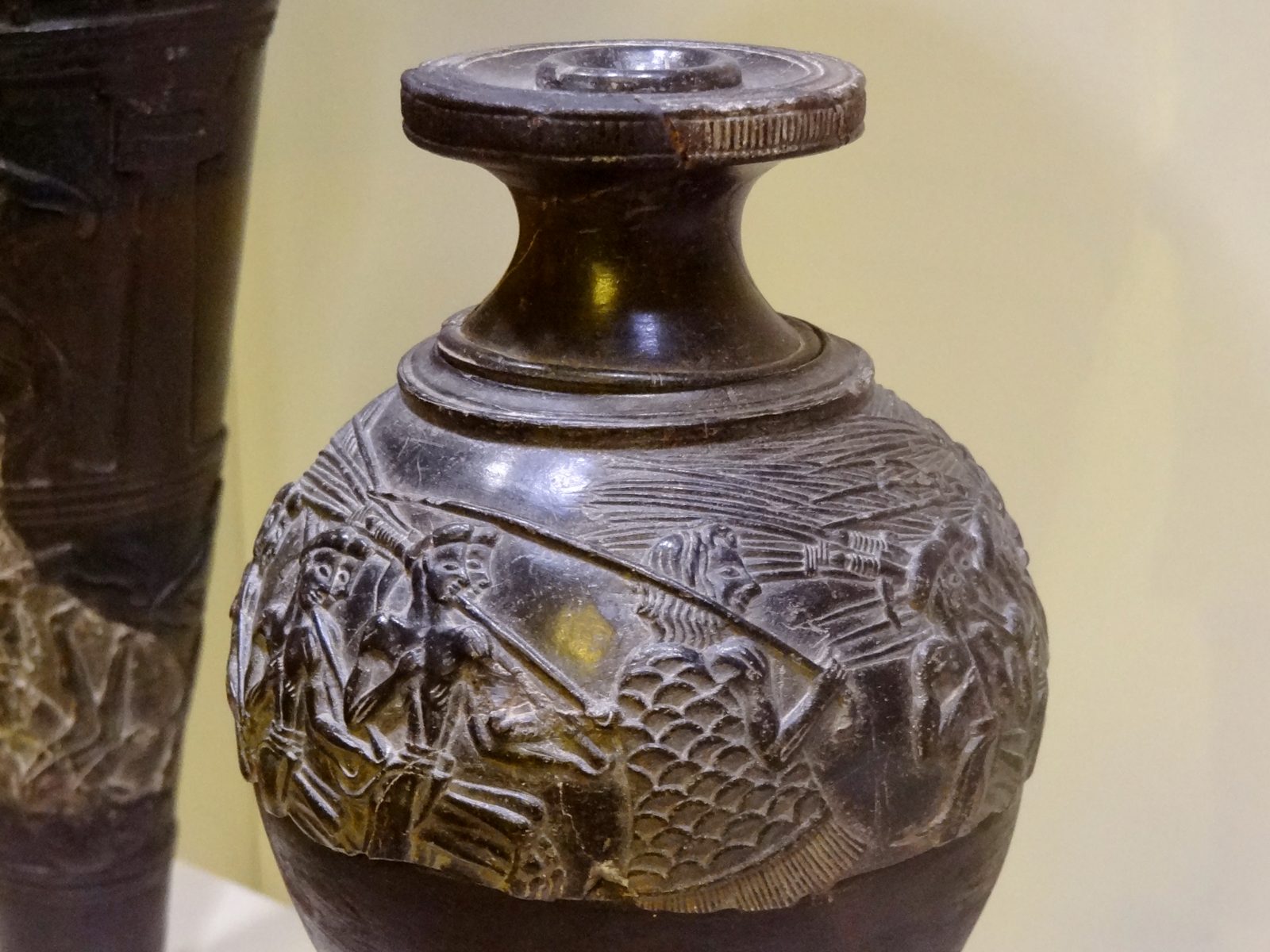
- Harvester Vase (relief rhyton), Hagia Triada, 1500–1450 BC. Archaeological Museum of Heraklion — photograph by Olaf Tausch, CC BY 3.0, via Wikimedia Commons.
- Ship procession fresco, West House (Room 5), Akrotiri, Thera, 17th c. BC. Museum of Prehistoric Thira, Fira — photograph by Zde, CC BY-SA 4.0, via Wikimedia Commons.
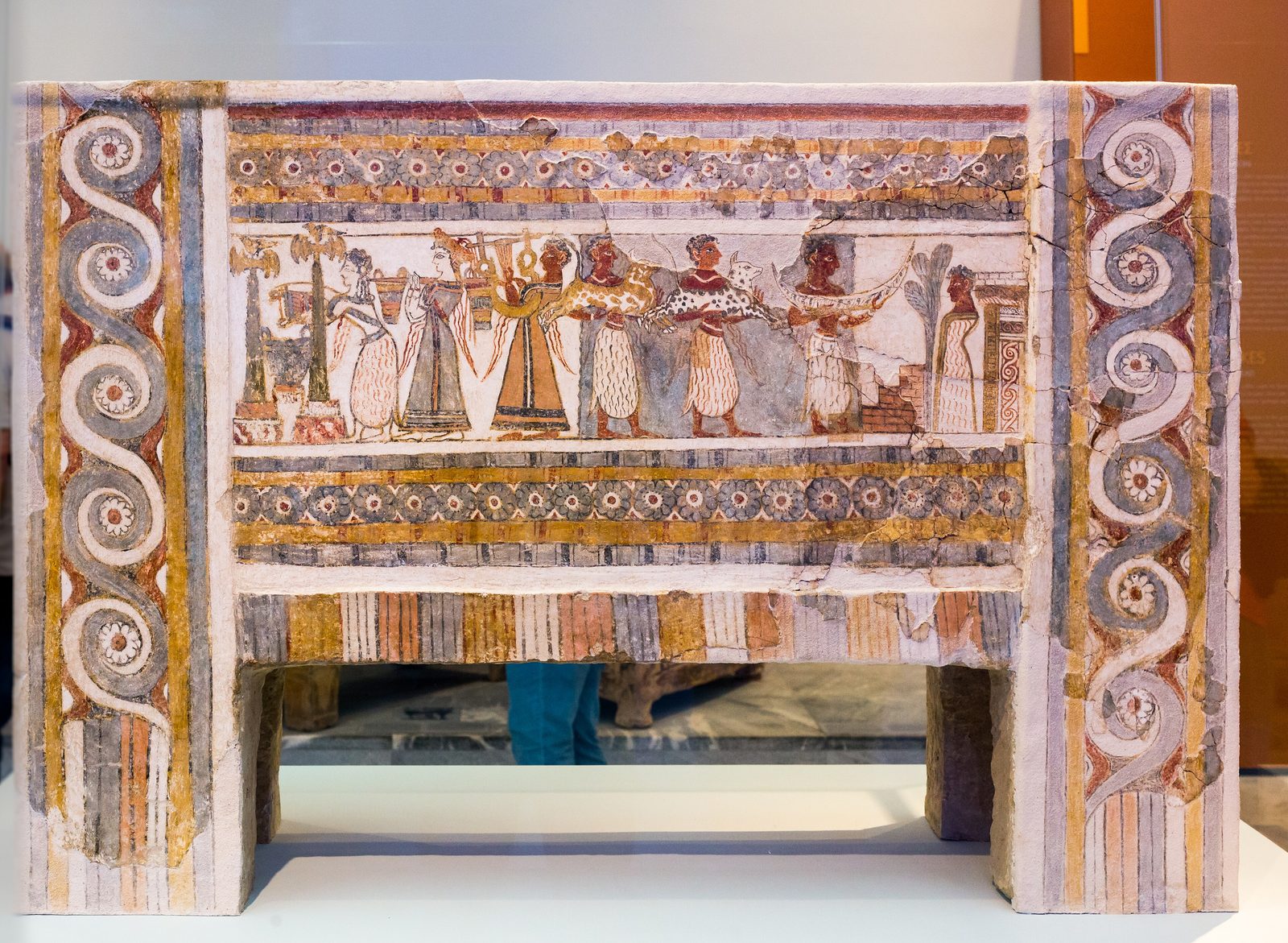
- Painted limestone sarcophagus from Hagia Triada — ritual scenes, 1370–1320 BC. Archaeological Museum of Heraklion (inv. Λ396) — photograph by ArchaiOptix, CC BY-SA 4.0, via Wikimedia Commons.
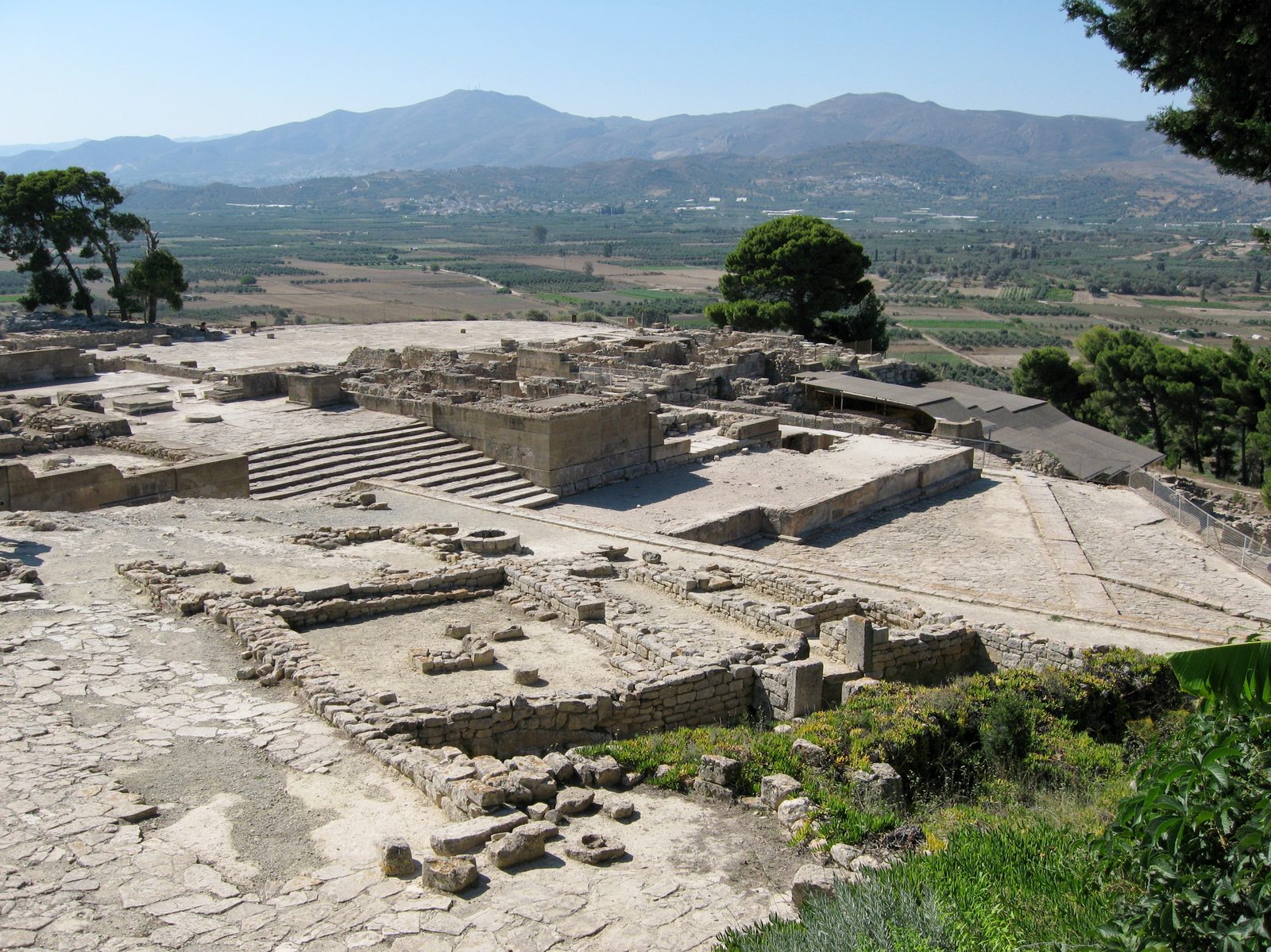
- Ruins of the Palace of Phaistos — photograph by Olaf Tausch, CC BY-SA 3.0, via Wikimedia Commons.
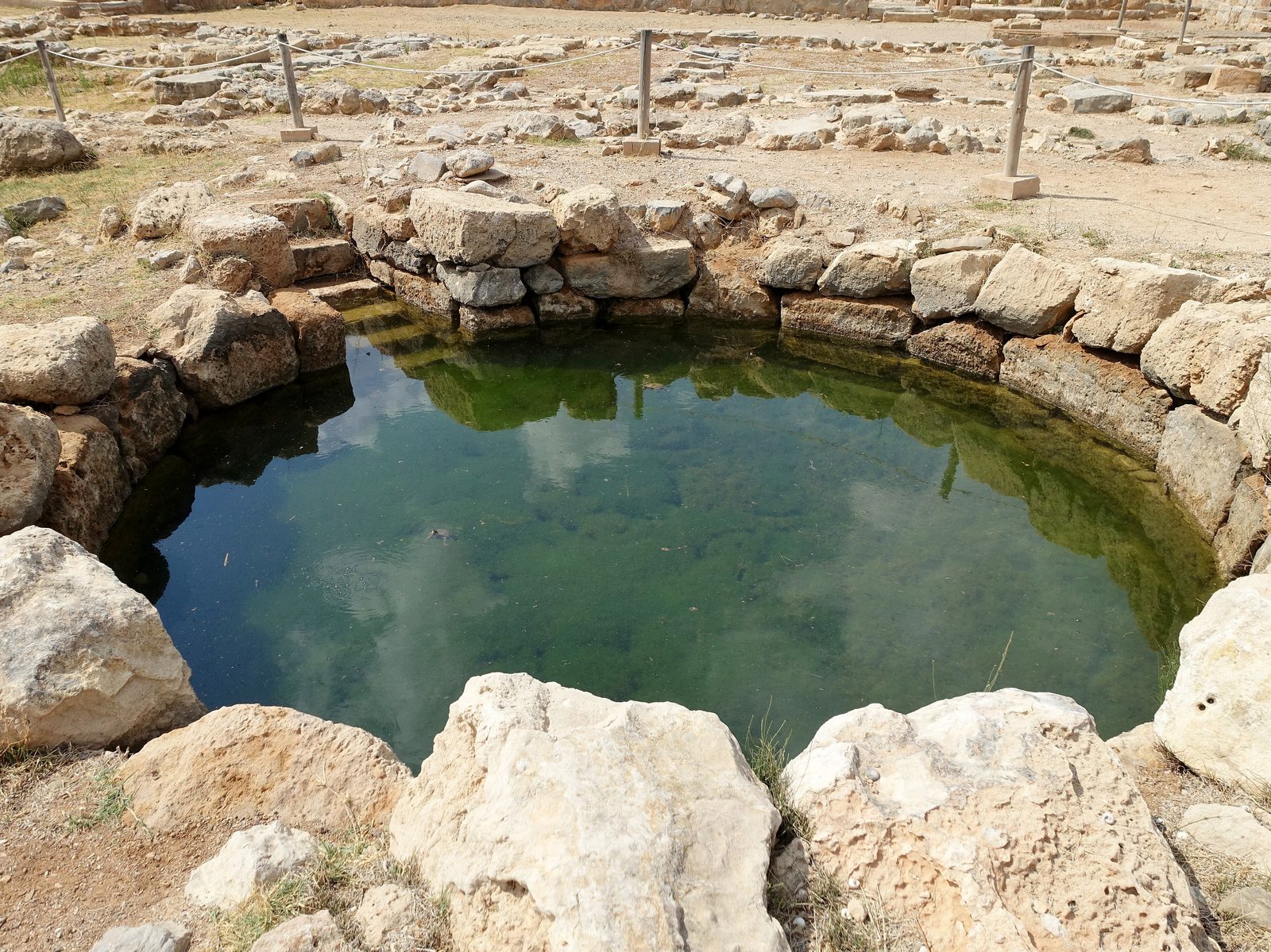
- Palace of Zakros, Kato Zakros — photograph by Olaf Tausch, CC BY 3.0, via Wikimedia Commons.
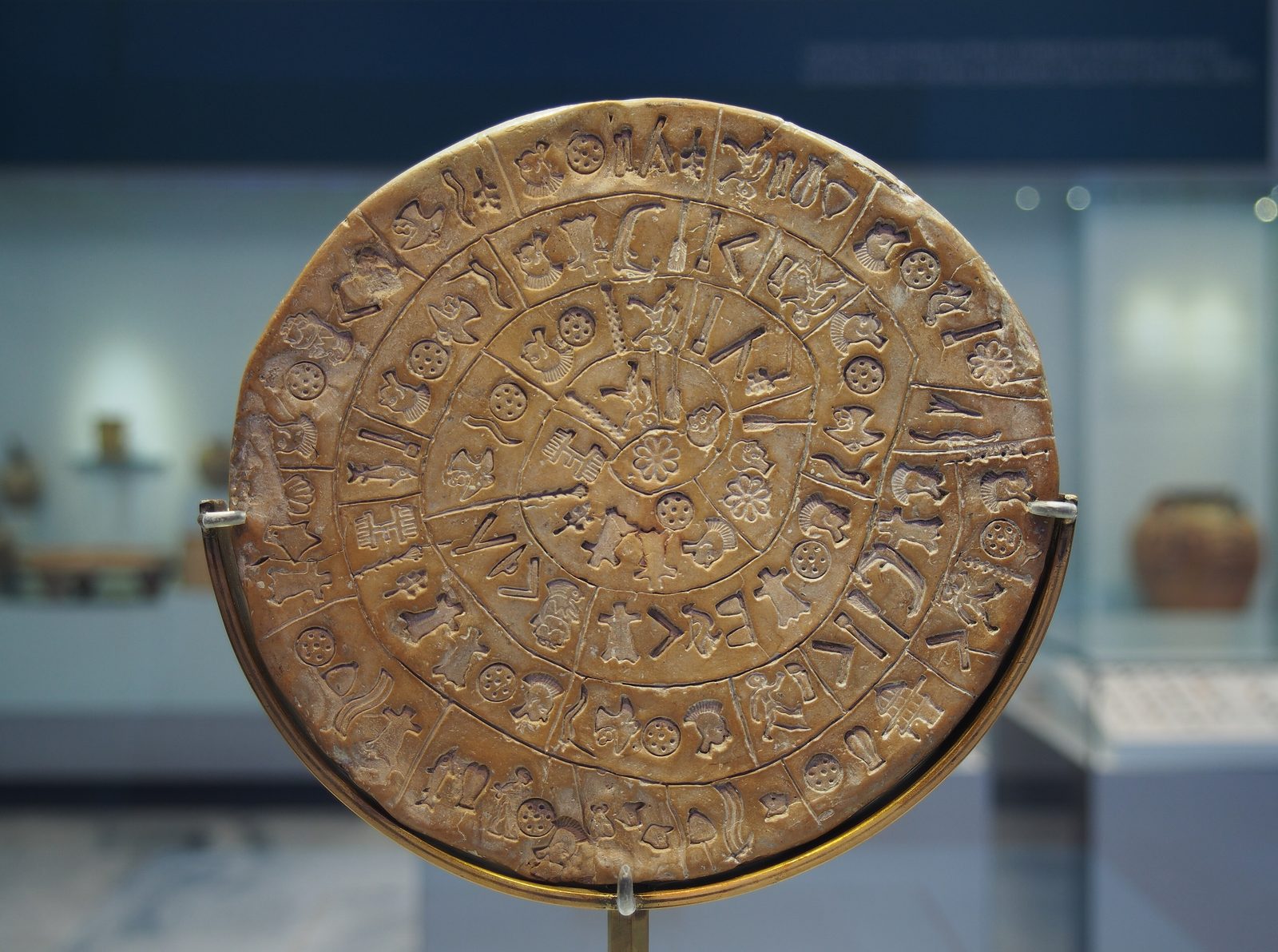
- Phaistos Disc, side A. Archaeological Museum of Heraklion — photograph by C messier, CC BY-SA 4.0, via Wikimedia Commons.


More antiquities research: Antiquities Research