Arabian Gods as Described by Assyria and Babylon
Nineveh's prisoner lists, Babylon's last king at Tayma, and the black stones the ancient world wrote down.
By Richard Vigslist
In about 681 BCE, Hazael, king of the Arabs, travelled to Nineveh, kissed the Assyrian king's feet, and asked for his gods back.
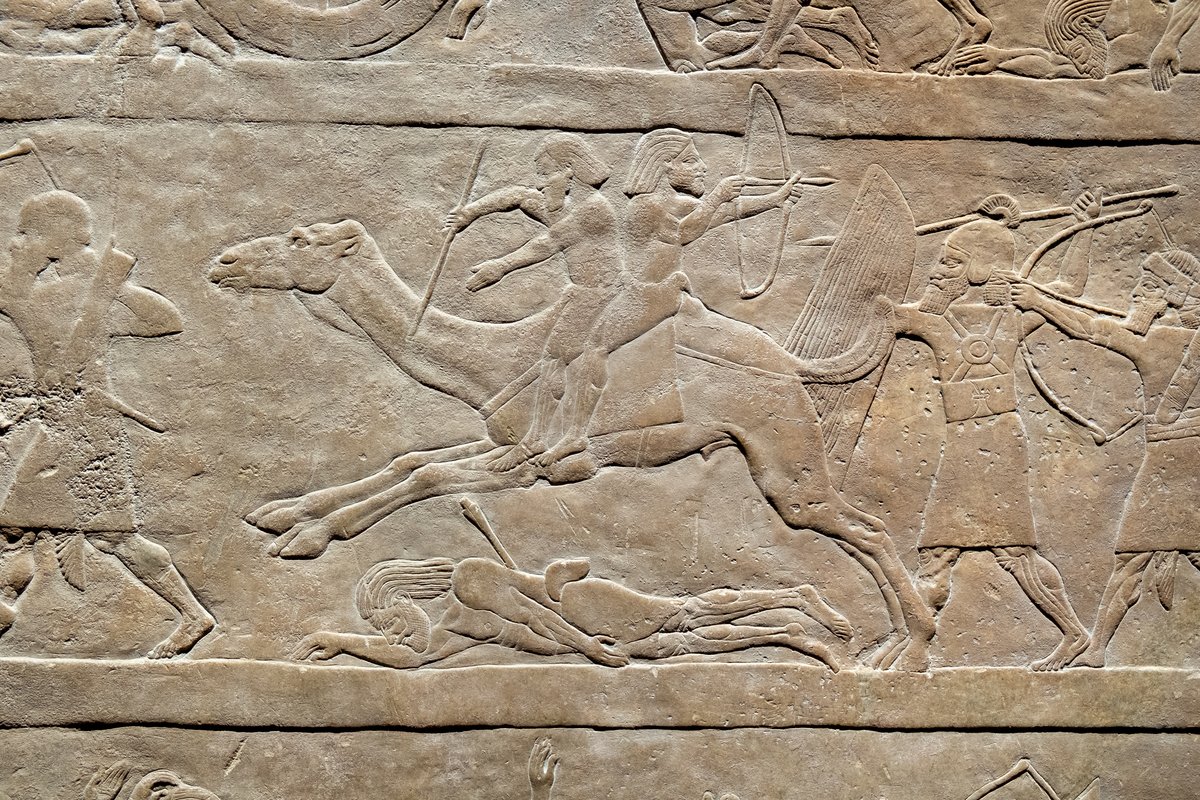
The gods had been taken a decade earlier. In 690 BCE Sennacherib of Assyria marched into the northern Arabian desert, defeated the Arab queen Teʾelḫunu, took the oasis stronghold of Adummatu — Dumah, modern Dumat al-Jandal — and carried its divine statues off to Nineveh as booty, listed with the camels and the spices. Now Hazael stood in the successor king's court, begging for the statues. Esarhaddon, Sennacherib's son, granted the request, and his prisms record it in the king's own words (RINAP 4, Esarhaddon 1):
"For the return of his gods he prayed me and I showed him favour, and the gods Atarsamain, Dai, Nuhai, Ruldaiu, Abirillu, Atarkuruma, the gods of the Arabians — their ruined [effigies] I restored, and the might of Ashur, my lord, and the writing of my name upon them I wrote, and gave them back to him."
Six gods of Arabia, named in cuneiform. Their ruined statues were repaired in Assyrian workshops, the might of Ashur and Esarhaddon's own name carved upon them, then shipped home to Dumah to be worshipped — each god carrying the enemy king's name on its body. A parallel recension (Esarhaddon 97) adds the political half of the bargain: the gods travelled home with Tabua, a Qedarite princess raised in Nineveh's palace, appointed ruler of the Arabs. The price: Hazael's tribute went up by 65 camels and 10 donkeys, and when his son Yauta succeeded him, it went up again — 10 minas of gold, 1,000 choice stones, 50 camels, 100 bags of aromatics.
That passage is the fullest list of Arabian gods to survive in a single early text — and it survives because an empire stole the gods, stamped them, and gave them back. This history starts there: not with Arabia writing about its gods, but with the empires around it writing about them first.
The queens' file
The captured gods were the peak of a century of paperwork. For that century the annals met the Arabs again and again, and the Arabs' opposite numbers were, repeatedly, women. Six named Arab queens stand in the record — Zabibe, Samsi, Yatie, Teʾelḫunu, Tabua and Adiya — in a file the scholarship now counts at twenty-eight texts (Bennett, 2021). Zabibe paid tribute to Tiglath-Pileser III around 738 BCE. Samsi backed a revolt, was defeated — the scribes counted 30,000 camels taken from her — and was brought back to pay tribute. Sargon II, around 715 BCE, deported four Arab tribes to Samaria and set an Arab, Idibiʾilu, as his gatekeeper toward Egypt. Sennacherib fought Yatie's troops in the Babylonian war before he turned on Dumah. Ashurbanipal's annals give the wars their longest narrative: Yauta's revolt, Ammuladi of Qedar captured and carried in chains to Nineveh, and camels divided up like sheep and sold at the market gate for a shekel, or half a shekel, a head.
Teʾelḫunu, the queen defeated at Dumah, carries two titles in the texts: queen of the Arabs, and apkallatu — a priestess title. She was a religious officer of her people's cult, and scholarship connects her office to Atarsamain, first on the prism's list — a connection a recent edition disputes, reading the priestess of the texts as another woman, a kumirtu of Dilbat. At Dumah, politics and religion were the same household, and the annals count Arabia in camels, tribute and gods.
Who the six were
The prism's Akkadian spellings flatten the Arabian names — Akkadian had lost sounds Arabic kept — so each identification stands on its own evidence, and they do not all stand. Atarsamain is Athtar of the Heavens, a heavenly form of the great Semitic Venus god, chief of the six. Nuhai is Nuhay, a primary god of Dumah itself in the oasis's own inscriptions. Ruldaiu is Rudā, the most-invoked male god of the north Arabian desert — the Safaitic graffiti invoke him 630 times, a thousand years later: the same god at two ends of a millennium. Three of the six can be walked out of the prism and into Arabia's own records.
Three cannot. Dai is named once, here, and nowhere else that has been fixed to him; the literature's guesses — a name like "the Caller," a crow-name — remain guesses. Abirillu is named once and is unknown. Atarkuruma is a second Athtar name joined to an element nobody has securely read. Half the window is dark, and the record leaves it dark.
One more document, from Dumah itself, closes the local file: an inscription from the oasis's own country asks three of the prism's gods — Rudaw, Nuha and Athtar of the Heavens — for "help in the matter of my love." The gods Assyria catalogued as diplomatic cargo were, at home, gods a man prayed to about a woman. Only one of these records was written by the worshipper.
A Babylonian decade at Tayma
The second set piece is a residence, not a raid. Nabonidus, last king of Babylon (556 to 539 BCE), campaigned down the Arabian oasis chain, killed the ruler of Tayma, and stayed ten years while his son Belshazzar held Babylon. Three witnesses carry the fact, and they do not like each other.
The Nabonidus Chronicle, Babylon's own year-by-year record, states it flatly: "The king (was) in Tema; the crown prince, his officials and his army were in Akkad" — and, year after year, "the Akitu festival did not take place." Babylon's New Year festival lapsed for the whole decade. The Harran stele H2 gives the king's own voice: "For ten years I wandered the road between the cities of Tēmā, Dadanu, Padakku, Ḫibrā, and Yadiḫu, as far as the city Yathribu. I did not enter into my city, Babylon." The whole northern Hejaz oasis chain, in a king's own inscription, ending at the earliest written occurrence of Yathrib, the town now called Medina. The third witness, the Verse Account, is a hostile poem written to damn him — he killed Tayma's prince and "built there a palace like the palace in Babylon" — but its Tayma agrees with the Chronicle and the stele, so the residence stands; only the sneer is discounted.
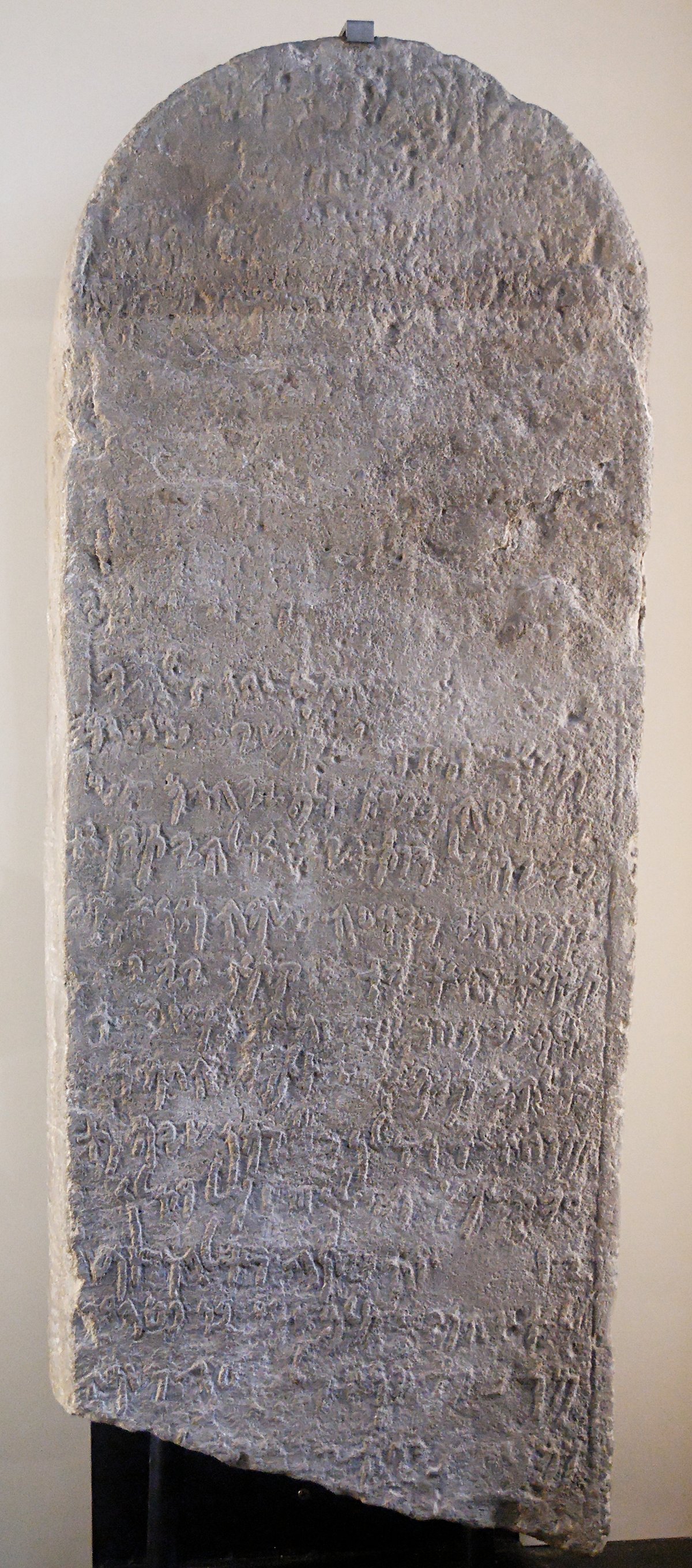
What did the oasis worship while Babylon sat in it? Tayma answers in its own hand, in Aramaic, on the Tayma stele (CIS II 113, Louvre, 6th to 5th century BCE). A priest named Ṣalm-shezib records that he set up his stele in the temple of a god newly installed at Tayma, Ṣalm of Ḥagam, and that "Ṣalm of Mahram and Shingala and Ashima, the gods of Tayma" granted him and his descendants its priesthood for ever, endowed at 21 palm trees a year. Ṣalm, the chief, stood in three local forms — of Maḥram, of Ḥagam, of Rabb — a god with solar marks, a winged disc over his complex at Qaṣr al-Ḥamrā. Shingala, second of the three, has carried a proposed identification for a century — the name read as Sin-galla, "the great Sîn," Harran's moon god — and the proposal is still argued over; it stands as a reading, not a proof. Ashima, third, is the same name that stands in 2 Kings 17:30 as a god of Hamath — a northern god with a passport, at home in an Arabian oasis. That his Tayma cult was the Hamath cult, and not only the name travelling, is inference, graded as inference here.
The Babylonian layer is real — excavations found Nabonidus's cuneiform texts in the oasis's centre — but it left "little or no discernible trace in the architectural remains." A court resided; a city was not rebuilt. And no source in either language says the two cults did anything but coexist — no conversion either way. Both sides' paperwork records Tayma's gods endowed, installed and paid, exactly as before.
The stones at Emar
Six centuries before Esarhaddon, the pattern stands in cuneiform with its rites written out in full. At Emar, a West Semitic city on the middle Euphrates under Hittite overlordship, destroyed in the early 12th century BCE, the diviners' archive kept the city's festival scripts, and in them stands a sacred standing stone: the sikkānu.
The fullest script is the zukru festival (Emar VI 373), Dagan's great festival, kept in full every seventh year. On Daniel Fleming's analysis (Time at Emar, 2000), it grew out of one core event: a procession to a shrine of sikkānu stones, two rows of upright stones outside the wall. The city brings Dagan and all its gods to "the gate of the sikkānu stones." The people eat and drink before them. Then the text, at line 34 and again in its parallel recension: "They anoint the stones with oil and blood." Dagan's statue, its face veiled, is carried between the two rows and unveiled. A second script (Emar VI 369) records the anointing of the sikkānu of the goddess Ḫepat — a named goddess whose cult object is a standing stone, anointed as part of installing the storm god's high priestess. Sikkānu appear at Mari, Ugarit and Ebla as well: a feature of Syrian religion from the third millennium to the end of the Bronze Age.
What a sikkānu was, the scholarship does not settle, and the divide is part of the record. The presence reading — Fleming's line — takes the stones as aniconic presences of gods: Ḫepat's sikkānu is Ḫepat for the purposes of cult, anointed because she is there to receive it. The caution answers that upright stones also commemorate the dead and the ancestors, and not every sikkānu need be a god's body. The Hittite cult inventories of the same century record a royal reform replacing standing stones with images in some cults — and the stones persisting anyway.
Between Emar's stones and Arabia's, this article does not pave the middle. No text from Emar, Mari, Ugarit or Ebla mentions Arabia; no Arabian text mentions Emar; some six hundred years and the whole Syrian desert lie between. What connects them is a shared West Semitic grammar of stone cult — set up a stone, anoint it, slaughter before it, treat it as a god's address — visible at both ends and nowhere documented in transit. Graded plainly: a real pattern, an unproven road.
The house of god
The pattern has a passport, and the passport is a word. Betyl — baetyl — comes into Greek as baitylos, and behind the Greek stands a Semitic compound: byt-ʾl, bet-el, "house of god." It begins as a place and a god: Bethel the town in Genesis; Bethel the god, named among the oath-gods of Esarhaddon's treaty with Baʿal of Tyre (675/674 BCE); its earliest attestation stands on the Aramaic Sefire stelae of the 8th century BCE. By the time Greek writers use it, the word has slid from the house to the stone that makes the house: a stone in which a god is present — Philo of Byblos's baitylia, "animated stones" that fell from heaven. A caution belongs on the word: modern writing has stretched "betyl" over almost any cult stone, and the reference literature criticises the stretch. Kept to its working sense — a stone treated as a god's dwelling or presence — it is the most portable idea in the Semitic religious world.
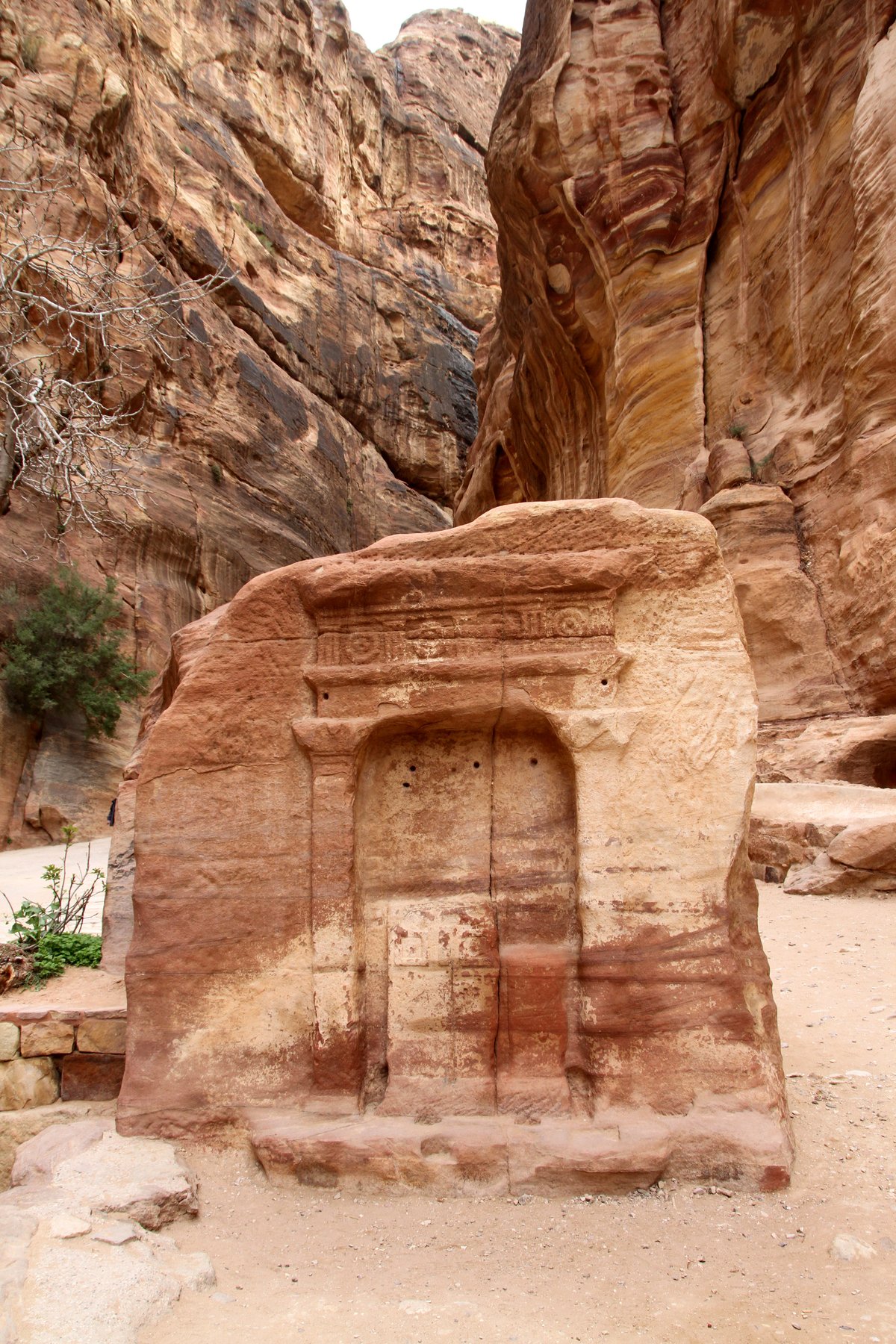
The pattern's script survives in Genesis, and it reads like stage directions. Jacob sleeps with a stone for a pillow, dreams the ladder, and wakes: "This is none other than the house of God." Then the rite, in order (Genesis 28:18 to 22): he sets the stone up as a pillar — a maṣṣēbâ — pours oil on its top, names the place Bethel, house of God, and vows: "this stone, which I have set up for a pillar, shall be God's house." Set up, anoint, name, house. It is the clearest surviving account of what a betyl was for — and its details are the ones the harder evidence keeps repeating: Emar's oil and blood, the slaughter at Arabia's stones, the niches of Petra.
Phoenicia carried the pattern around the Mediterranean in stone and on coins — a conical stone at Byblos, betyl columns as far west as Malta, and at Paphos the conical betyl of Aphrodite Urania, the same goddess Herodotus says the Arabs called Alilat.
The black stone that rode to Rome
The pattern's most documented hour comes in the 3rd century CE. At Emesa in Syria — modern Homs — an Arab dynasty served as hereditary priests of a god whose name is Arabic in its bones: Elagabal, Ilāh al-Jabal, God of the Mountain. His image, in Herodian's words (History 5.3), was "no statue made by man": instead "a huge black stone, rounded at the base and coming to a point at the top, conical in shape," which the people of Emesa "solemnly maintain came down from heaven."
In 218 CE the cult's fourteen-year-old high priest became emperor of Rome, and brought his god with him. The stone was carried to Rome in 219 and installed in a new temple, the Elagabalium, on the Palatine; the imperial coinage shows it riding in a chariot under the legend SANCT DEO SOLI ELAGABAL, "to the holy sun god Elagabal"; and each midsummer he processed it to a second temple outside the walls, running backwards before the chariot so as never to turn his back on his god. In 222 he was murdered by his own guard, his religious acts were annulled, and the stone went home to Emesa — where a coin of Uranius Antoninus, a generation later (253 to 254 CE), shows it back in its temple. Herodian and Cassius Dio are hostile witnesses of the eyewitness generation; the coins are the state's own metal. The meteorite claim made for the stone in modern writing has no analysis behind it — the stone is lost, and "fell from heaven" is the cult's claim, carried here as such. What the episode proves is not geology. It proves that in the 3rd century CE a black Arabian-Syrian betyl could still be carried into the capital of the world and set above Jupiter — nine hundred years after Esarhaddon's scribes flattened Athtar's name into cuneiform, and four hundred years before Mecca's stone enters any paperwork at all.
Arabia's own stones
Inside Arabia the pattern stands in stone by the hundreds. At Petra alone, Robert Wenning's survey (BASOR 324, 2001) counted some 530 betyls — rock-cut niches lining the Siq and the shrines, plain blocks, some carved with stylised eyes and a nose — and his finding governs their reading: a betyl marks the presence of whichever god is being invoked; it is not one god's portrait. Inscriptions bind betyls to Dushara, al-ʿUzzā, al-Lāt, Baʿalshamin and others. The Suda describes the chief of them: Dushara's image at Petra was "a black stone, square, unshaped, four feet high, two feet wide, set on a gold-plated base." Maximus of Tyre, in the 2nd century CE, gives the outsider's version in one line: "The Arabs worship a square stone — who it is, I do not know."
On anointing, the record is graded with care. That Arabian betyls were anointed with oil and sacrificial blood is the standard scholarly reconstruction — from the altars, libation channels and niches built around them, and from the regional paperwork at Emar and in Genesis. But no surviving Nabataean or Safaitic text prescribes it. Arabian betyl anointing is inference — strongly patterned, not attested in an Arabian hand. What Arabia attests in its own hand is the slaughter at the stones, in the Quran's own vocabulary.
The Quran does not describe the old stone cult from outside; it legislates against it from inside a world where everyone knew the objects. The word is anṣāb: stones set up, slaughter-stones. Quran 5:3 forbids "that which has been slaughtered on the anṣāb," pairing the ban with the divining arrows of Hubal's oracle; Quran 5:90 files the anṣāb among "intoxicants, gambling... an abomination, of Satan's handiwork." A founding text does not ban, by name, an object nobody is using. The Meccan detail survives in the record Uri Rubin gathered (JSAI 8, 1986): slaughter in the Ḥijr, beside the Kaaba, near Zamzam, on stones called anṣāb — in one report "the red sacrificial stones," red because the blood was shed and smeared on them. Isāf and Nāʾila, the two stones of the Meccan legend, functioned as anṣāb in the same enclosure. F. E. Peters (The Hajj, 1994) gives the pattern its range: such stones "were widely used among the ancient Arabs, not only in the vicinity of the Kaʿba, but even as tomb-stones and boundary markers for sacred enclosures." Mecca stood inside that complex, not beside it.
The Black Stone, in its family
Now place the famous one. The Black Stone of Mecca — set in the Kaaba's eastern corner, touched and kissed where the circling of the House begins and ends — belongs to this pattern by form and by behaviour: an unworked dark stone in a sanctuary, treated as the point where presence is met and the hand is laid on, in a shrine whose enclosure also held slaughter-stones of the anṣāb type. Its own tradition agrees about the category while insisting on the exception: one report calls it "the right hand of God on earth," and ʿUmar's counter-protest — "I know you are a stone that neither benefits nor harms" (Bukhari 1597) — exists precisely because the pattern's logic was pulling at it, and had to be answered.
But the pattern is bigger than its most famous survivor, and the survivor's limits are stated without flinching. The record cannot date the Black Stone's installation: no source of any grade describes its setting, its arrival or its early history, and the first time the paperwork touches it — the sira's rebuilding scene, around 605 CE — it is already old enough for the clans to fight over the honour of resetting it. It therefore cannot be called the earliest betyl, or the pattern's source, or Arabia's original stone: Petra's betyls, Dumah's cult, Emar's sikkānu and Bethel's pillar all stand in older documents. The strongest form the record carries is this: the Stone is older than every account of it. It arrives fully installed, fully venerated, unexplained — every account of it an account of something that was already there.
What the pattern gives the Stone is not an origin. It gives it a family: a documented company of stones across three thousand years of Semitic religion, inside which a black stone in a Meccan wall is not an anomaly demanding a meteorite or a mystery. It is the pattern's most famous survivor — the one member of the family still receiving the hand, every day, in the same gesture the paperwork describes at Emar, at Bethel, and in the Ḥijr.
Was it broken?
Yes — documented, more than once, after 605. Before 605, silence.
Around 605 CE the sira (Ibn Isḥāq) has the clans of Quraysh dispute the honour of resetting the Stone at their rebuilding of the Kaaba, and Muhammad — not yet a prophet in the story's own frame — arbitrate: the Stone carried on his cloak by all the clans together, then set into the corner by his hands. The tradition presents one whole stone, set intact — the first document that touches it at all.
In 683 CE, in the Umayyad siege of Mecca, the Kaaba caught fire and burned. Al-Azraqī (died 837), Mecca's first historian, records that the Black Stone cracked from the heat into three pieces; other reports blame a stone from the siege catapults. The record disagrees about the mechanism and agrees about the outcome: the Stone broke. Ibn al-Zubayr, rebuilding the Kaaba, rejoined the fragments with a silver binding and reset the Stone with his own hands. The silver that holds it today descends from that repair.
A thinner report from 929 — a man striking the Stone with a sword and chipping it — stands in the chronicles at low weight. In 930 the Qarmatians of eastern Arabia under Abū Ṭāhir al-Jannābī sacked Mecca in the pilgrimage season, pried the Stone from its corner, and carried it to al-Aḥsāʾ, where the sect kept it — by the reasoning reported from their capital a century later — as a "human magnet" that drew the pilgrims. It stayed twenty-one to twenty-three years; the chronicles divide on the count and on the return year, 951 or 952. It came back, by the return-era accounts, in fragments — seven pieces in the figure the tradition repeats — and goldsmiths framed the re-set Stone in silver. A silver frame, renewed under later custodians, has held it ever since; the exposed face now measures about 20 by 16 centimetres, with seven or eight fragments visible in it. It was placed last in the rebuilding of 1630 after the flood — no break recorded; it outlasted the building again.
Before 605, nothing. No source of any grade describes an earlier break, repair, setting or moving, and claims that the Stone was broken in pre-Islamic centuries or carried from another shrine have no document behind them. The fracture history begins where the paperwork begins: a whole stone in the sira's scene, broken in the first siege of Islamic Mecca, broken again by theft and return, held in silver from the 7th century CE to this morning.
The silence under the story
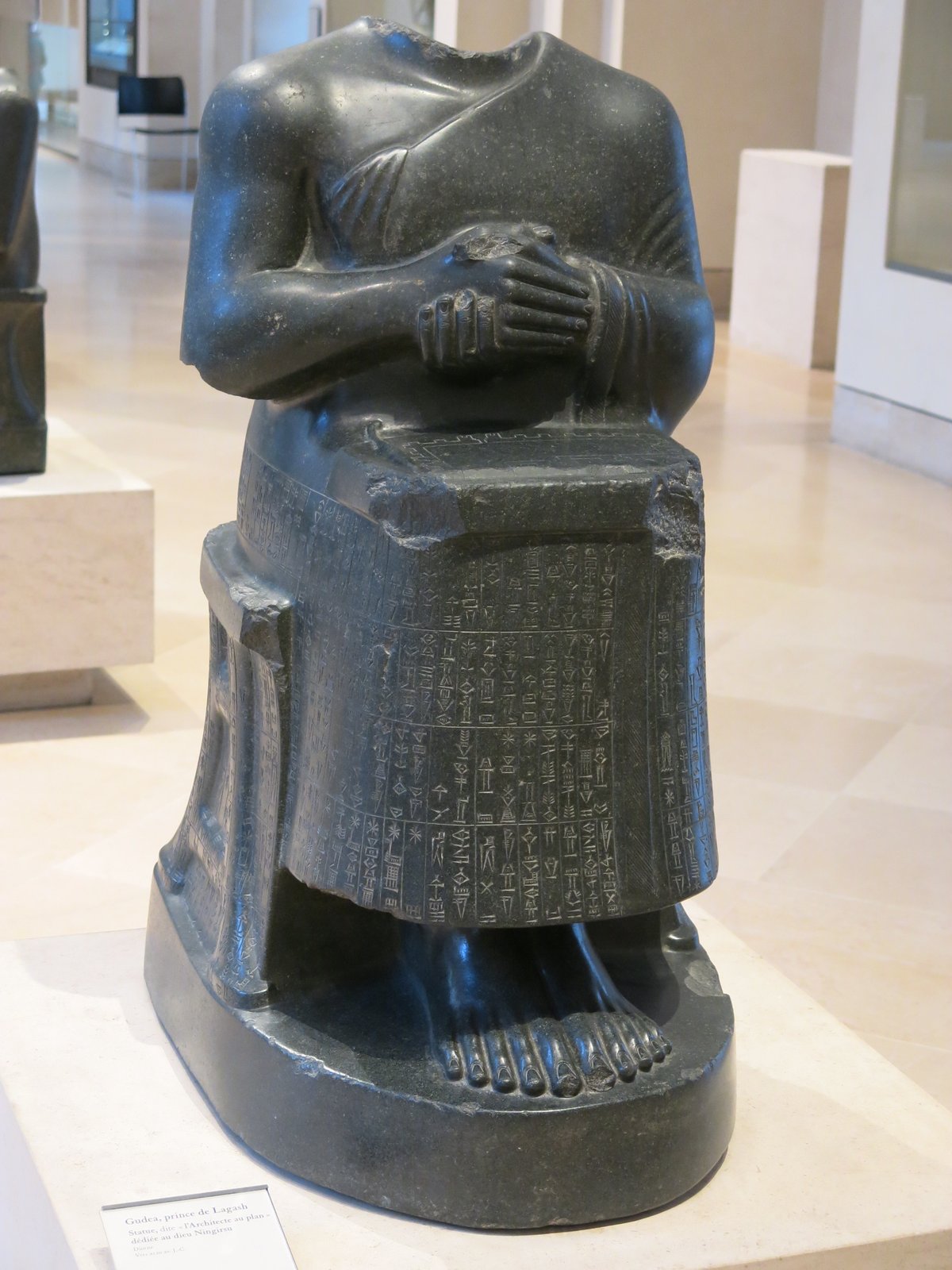
Underneath all of it lies a silence the whole file depends on. Sixteen hundred years before Dumah, and more before Tayma, the cuneiform world already ran a road through Arabian waters — the Gulf chain of Dilmun, Magan and Meluhha — and its paperwork is the oldest in this article. Sargon of Akkad (about 2334 to 2279 BCE) boasts that he "moored to the quays of Akkad the ships of Meluhha, Magan and Dilmun." Gudea of Lagash (about 2100 BCE) describes the trade transacted through gods at both ends — Ninzaga of Dilmun instructed to deliver copper "as if it were simply a question of getting enormous quantities of wheat" — and his inscriptions list the diorite quarried in Magan's mountains for the black statues that still sit in the Louvre. Dilmun has a god of its own in the paperwork, written by its own people: inscriptions on Failaka and Bahrain name Inzak of Agarum.
And in all of that paperwork — royal boasts, temple accounts, myths, ration lists — no Arabian deity appears. Not one god of the peninsula's interior, nothing from the Hejaz. Dilmun's shore was Arabian coastline, and Dilmun's god is in the record; the peninsula behind the shore is not. The earliest Arabian gods in any writing arrive much later, from two directions at once: South Arabia's own first inscriptions, naming Athtar and Almaqah in Sabaic from about the 8th century BCE, and Assyria's annals — Atarsamain's generation. Arabia's gods are old. Their paperwork is not. This is a story about when the gods become visible, and to whose eyes — not about when they began.
The god who was always on both sides
One god crosses the whole map without ever being shipped. The word is Proto-Semitic *ʿAṯtar. In Mesopotamia it surfaces as Ishtar — goddess of Venus, of love and of war. In South Arabia ʿAthtar is male: god of Venus, of the thunderstorm and the unchannelled rain, head of the southern pantheon. At Dumah he wears the prism's form, Athtar of the Heavens, first on Esarhaddon's list. Comparative philology grades the cognacy solid: one name for the Venus god, inherited on both sides from the common Semitic stock, reassigned by each region that kept it. No inscription records Ishtar being carried south or Athtar north. The captured gods moved as cargo within living memory of their texts; this god was already everywhere the texts begin.
The second outside lens is Greek, and it saw the same goddess. Herodotus, writing in the fifth century BCE, names her twice. At 1.131: "The Assyrians call Aphrodite Mylitta, the Arabians Alilat, the Persians Mithra" — al-Lāt filed as the Arabs' Aphrodite, a thousand years before Kalbi catalogued her. At 3.8 he gives the Arabs exactly two gods — Dionysus, whom they call Orotalt, and the Heavenly Aphrodite, Alilat — and describes their most binding oath: two men, seven stones set between them, the stones smeared with the swearers' own cut thumbs' blood, both gods invoked over them. The two-god Arabia is a traveller's simplification — his own century's inscriptions name more gods than he does — but he is the first Greek witness, one of his two names checks out against the stones, and his oath scene is the earliest outside description of an Arabian stone rite. Orotalt does not resolve: Rudā and Dushara are the standing candidates, there is no consensus, and the name is graded unresolved here — real sight, imperfect hearing. The lens stays open for centuries: Jerome reports the Saracens worshipping Venus as the morning star, and Porphyry repeats an older report that at Dumah — the captured gods' own town — a boy was sacrificed yearly and buried under the altar: a late, unverifiable witness.
One famous name-join is refused, on the record. Cuneiform does carry a goddess Allatum: a Hurrian underworld queen under her Akkadian writing, drawn into the orbit of Ereshkigal. Older scholarship simply equated her with Arabia's al-Lāt, and the equation still circulates. The current reference treatment is explicit: the connection has been examined and has not been established; the issue remains unsettled. The profiles pull apart — Allatum belongs to the dead below; al-Lāt is "the Goddess" as a name, an oath-goddess of abundance with a cubic rock at al-Ṭāʾif and over 1,400 invocations scratched by nomads, not one of them funerary. Resemblance, possibly an old kinship of names — not descent, not a trade route. Arabia also left no narrative myth for any of its three goddesses: invocations and dedications survive, and no descent, no death-and-return, nothing like Inanna's. That asymmetry is itself evidence about what kind of religion the stones were keeping.
So the file closes where it opened: with names in other people's writing. A queen-priestess's gods, crated to Nineveh and carved with the conqueror's name before they were allowed home. A Babylonian king's decade among the oasis gods, ending in paperwork at both ends and conversion at neither. Standing stones anointed in a Syrian city whose road to Arabia nobody has documented. A black stone from an Arab mountain-god's temple, processed backwards through Rome. And in a corner of a Meccan wall, the family's most famous survivor — older than every account of it, broken twice in the record and bound in silver, still receiving the hand. When the writing finally reaches Arabia's gods, it reaches them the way empires reach everything: by caravan road and campaign, in tribute lists and treaty clauses — and, once, in a king's own carved confession that he had taken the gods of the Arabians, written his name upon them, and given them back.
Image credits
- Header: Assyrian relief of Arabs on camelback, North Palace of Ashurbanipal, Nineveh (British Museum 124926). Photo: Anthony Huan, CC BY-SA 2.0.
- Gudea of Lagash, Louvre AO 2. Public domain.
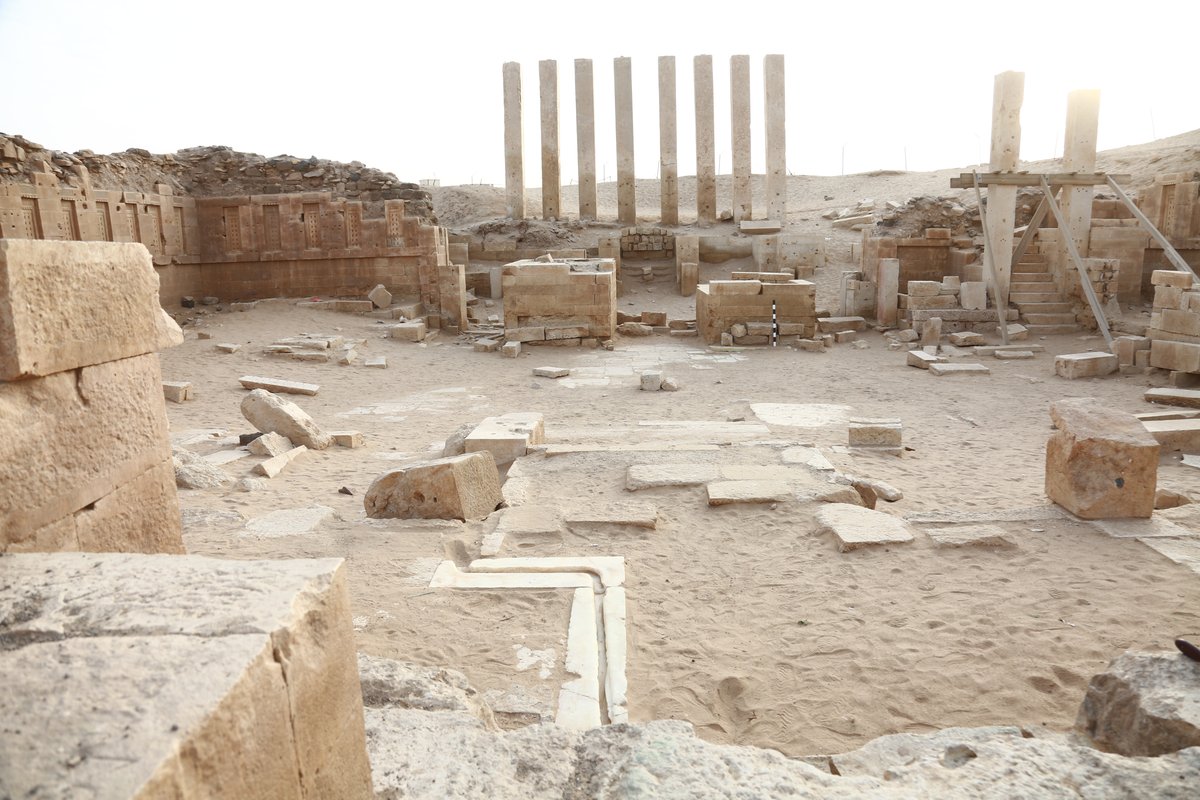
- Awwam temple, Ma'rib. Photo: Ali Mohamed, CC BY-SA 2.0.
- Tayma Stele, Louvre AO 1505. Public domain.
- Betyl of Dushara, the Siq, Petra. Photo: Gerd Eichmann, CC BY-SA 4.0.
- Black limestone kudurru of Marduk-nadin-akhe (British Museum). Photo: Gary Todd, CC0.
More antiquities research: Antiquities Research